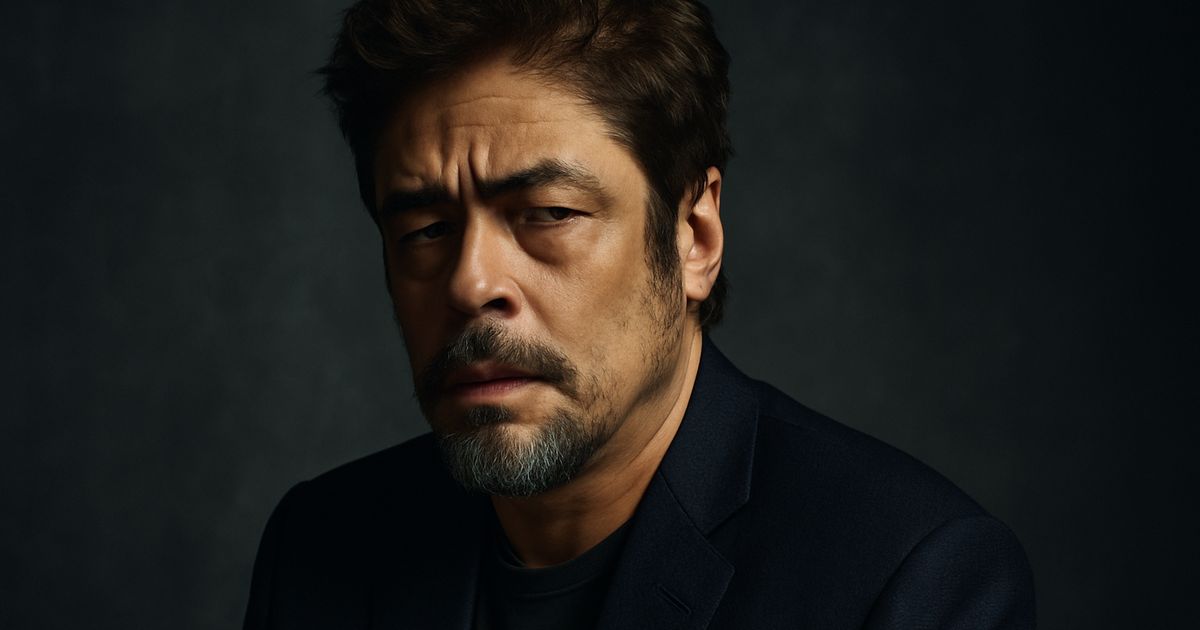
A Childhood Shaped by Loss and Resilience
In a rare and candid revelation, Academy Award-winning actor Benicio Del Toro has offered a poignant glimpse into the origins of his intense screen presence, tracing it back to a childhood marked by anxiety and his mother's chronic illness. The actor, known for his immersive and often unsettling performances, described himself as "a very restless and nervous child," a state of being he directly attributes to the constant worry surrounding his mother's health. This personal insight, emerging from a recent interview, provides a compelling new lens through which to view not only the man but also the formidable body of work he has built—a career defined by characters who are themselves often restless, haunted, and operating on a raw, nervous edge. For fans and film scholars alike, Del Toro's introspection reframes his artistic journey, suggesting that the very traits that fueled his childhood anxiety were later harnessed and alchemized into the fuel for his unique brand of cinematic genius.

The Revelation: Connecting the Artist to the Anxious Child
The headline quote, "Era un niño muy inquieto y nervioso. Creo que tiene que ver con el hecho de que mamá siempre estaba enferma" ("I was a very restless and nervous child. I think it has to do with the fact that mom was always sick"), serves as a key to understanding Benicio Del Toro's formative years. This admission is significant precisely because Del Toro is famously private, rarely offering such direct personal history in interviews. He typically lets his work speak for him. By linking his innate nervous energy to the domestic reality of his mother's ongoing illness, he provides a humanizing backstory to the palpable intensity he brings to every role.
This context transforms how we perceive his acting methodology. The "restlessness" he describes isn't merely a character choice; it appears to be a foundational part of his psyche, channeled into his physicality—the wary eyes, the deliberate, sometimes hesitant speech patterns, and the sense of a character constantly processing internal and external threats. The statement suggests that his childhood environment, one of concern and vigilance, fine-tuned his sensitivity to emotional undercurrents and unspoken tensions, skills that are invaluable for an actor specializing in complex, morally ambiguous roles. It moves the discussion from mere talent to a deeper synthesis of personal experience and artistic expression.
Background: From Puerto Rico to Hollywood Icon
Benicio Monserrate Rafael Del Toro Sánchez was born on February 19, 1967, in San Germán, Puerto Rico. His mother, Fausta Genoveva Sánchez Rivera, was a lawyer, and his father, Gustavo Adolfo Del Toro Bermúdez, was an attorney and farmer. When Del Toro was nine years old, his mother passed away from hepatitis, a loss that undoubtedly cemented the anxious atmosphere of his early years. Following her death, he and his older brother, Gustavo, were raised by their father. The family relocated to a farm in Pennsylvania before Del Toro eventually attended the University of California, San Diego, and later studied acting at the Stella Adler Conservatory in New York and the Circle in the Square Theatre School.
Del Toro's career began with small television and film roles in the late 1980s. His breakthrough came with his scene-stealing performance as the enigmatic, mumbling crook Fred Fenster in Bryan Singer's The Usual Suspects (1995), for which he won independent spirit awards. He solidified his status as a formidable character actor with roles in Fear and Loathing in Las Vegas (1998) and Traffic (2000). His portrayal of the morally conflicted Mexican police officer Javier Rodríguez in Traffic earned him the Academy Award for Best Supporting Actor, making him one of the few Hispanic actors to win an Oscar. This trajectory from a nervous child in Puerto Rico to an Oscar-winning Hollywood mainstay is a testament to his ability to transform personal depth into professional mastery.
Analyzing the Artistry: How Childhood Shaped a Career
Viewing Benicio Del Toro's filmography through the lens of his recent revelation reveals fascinating patterns. The characters he is most celebrated for are often outsiders, men grappling with internal turmoil, ethical ambiguity, and a deep-seated restlessness. His Oscar-winning role in Traffic is a prime example: Javier Rodríguez is a man navigating the corrosive, nervous-making world of drug cartels and corruption, trying to maintain his integrity in a system designed to break it. The character's weariness and simmering anxiety feel authentic, perhaps because the actor understands the weight of carrying concern.
This analysis extends to what many consider his magnum opus: Che (2008), Steven Soderbergh's epic two-part biopic where Del Toro embodies revolutionary Ernesto "Che" Guevara. The performance is less about grand speeches and more about capturing Che's intense, focused, and internally restless spirit. Similarly, in Sicario (2015), his portrayal of the shadowy consultant Alejandro Gillick is a masterclass in controlled, lethal nervous energy. He is a man whose entire being is a reaction to profound personal loss, moving with a quiet, terrifying purpose. Even in a blockbuster like Guardians of the Galaxy, his character, The Collector, is a bundle of eccentric, nervous tics and obsessive energy. It becomes clear that Del Toro doesn't just play nervous characters; he understands the root systems of anxiety, obsession, and vigilant restlessness from the inside out, giving each performance a rare psychological veracity.
The Hermetic Personal Life: A Sanctuary Forged from Chaos
This insight into his childhood also sheds light on another aspect frequently noted in profiles: his intensely private and "hermetic" personal life, as referenced in one of the related headlines. For an actor who exposes so much on screen, Del Toro is remarkably guarded off-screen. He rarely discusses his romantic relationships in detail and maintains a low profile outside of film promotions. This dichotomy makes perfect sense when considered alongside his description of a nervous childhood. If the public world of fame and scrutiny is inherently overstimulating, constructing a private, controlled sanctuary becomes an essential act of self-preservation.
His guarded nature isn't aloofness but rather a professional and personal strategy. It allows him to protect the raw materials of his own experience—the anxiety, the memories, the emotional reflexes formed in childhood—so that he can deploy them with precision in his work, not have them dissipated by constant public exposure. This separation between the man and the artist is what allows the artist to delve so deeply into darkness and complexity; he has a fortified self to return to. His personal life remains a closely held script, one he refuses to perform for the paparazzi or the talk show circuit, ensuring that his performances remain the sole focus of his public offering.
Historical Context: Trauma and Creativity in Hollywood
Benicio Del Toro's story fits into a long and complex tradition in the arts, where childhood adversity or trauma becomes a wellspring for creative expression. From Charlie Chaplin's poverty-stricken youth informing his Little Tramp to the profound loneliness felt by artists like Ingmar Bergman or Frida Kahlo channeled into their work, the transformation of personal pain into art is a recurring narrative. In Hollywood, actors like Joaquin Phoenix, whose childhood was marked by family tragedy and life in a cult, have similarly translated a fraught personal history into performances of unparalleled intensity and vulnerability.
What sets Del Toro apart within this context is the specific nature of the trait he identifies: a generalized, pervasive nervousness linked to a loved one's illness. This isn't about a single catastrophic event but a sustained atmospheric condition of worry. This aligns him less with actors who portray explosive breakdowns and more with those who specialize in a simmering, pervasive unease—think of the late Philip Seymour Hoffman or Gena Rowlands. His contribution to this lineage is a unique brand of masculine, physical restlessness that speaks to a specific kind of childhood vigilance. He represents a branch of this artistic tree where anxiety is not a weakness to be overcome off-screen, but a sensitive instrument to be tuned and played on-screen.
What to Watch For: The Future of Del Toro's Craft
Understanding this foundational aspect of his personality allows audiences and critics to watch his future work with a sharper eye. The question becomes less "How will he play this role?" and more "How will the restless, nervous energy he channels be manifested in this new context?" His upcoming projects will be scrutinized for this signature quality, now understood as a core part of his artistic identity rather than just a stylistic tic. Will he continue to explore characters directly shaped by loss and vigilance, or will he subvert expectations by playing a character of pure, calm certainty as a counterpoint?
Furthermore, this revelation may influence the types of stories he chooses to tell as a producer or director. Having articulated this link between his life and art, he may be drawn to narratives that explore similar psychological landscapes, perhaps even stories centered on childhood anxiety or familial illness. His career has already shown a preference for gritty, morally complex dramas (Traffic, Sicario, 21 Grams), and this personal insight reinforces why those stories resonate so deeply with him. As he moves into later stages of his career, one can anticipate roles that carry even greater gravitas, perhaps portraying paternal figures or men reflecting on a lifetime of carried worry, where the nervous child and the weathered adult finally meet on screen.
Sources & References
The information and analysis in this article are based on the provided source material and publicly known biographical details of Benicio Del Toro. The primary revelation is sourced from the headline interview. For further reading on his filmography and career, the related headlines provide additional context.
- Benicio Del Toro: “Era un niño muy inquieto y nervioso. Creo que tiene que ver con el hecho de que mamá siempre estaba enferma” (Primary Source Interview)
- De su dura infancia a su hermética vida sentimental: Benicio del Toro, más allá del cine (Related Profile)
- Las 10 Mejores Películas de Benicio del Toro (Filmography Context)