Sandy's accidental 'fludge' sends viewers into a Sunday morning panic
It was meant to be a calm Sunday morning for the millions glued to the Friends of Big Bear Valley eagle nest cam. Instead, they got a heart-stopping ten minutes that ended with one of the beloved eaglets taking her first flight – in the most chaotic way possible.
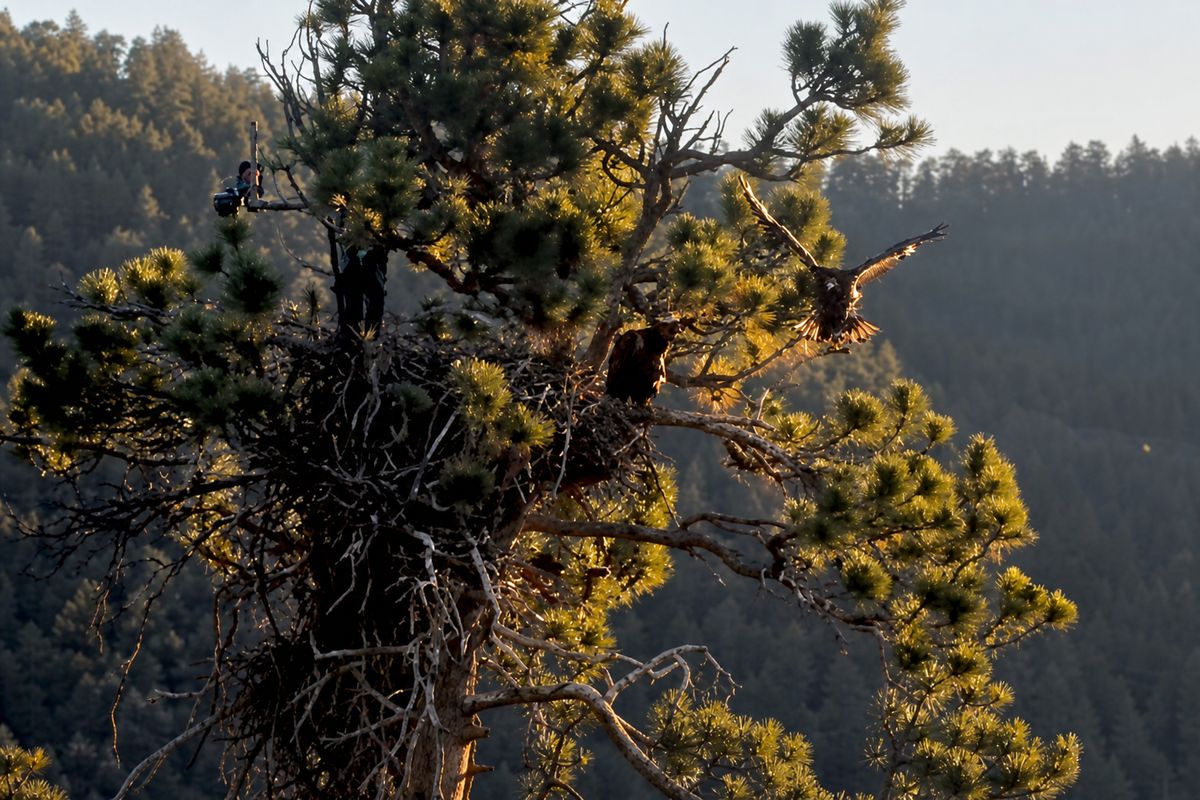
Shortly before 11.30am on 28 June 2026, Sandy – one of two eaglets hatched to celebrity bald eagles Jackie and Shadow – was flapping her wings on a branch just outside the nest. She lost her footing. Then she fell to a lower branch. Then another. Then she dangled upside down for what felt like an eternity. Finally, she dropped out of camera view entirely.
“I about had a heart attack,” viewer Christie Schultz posted on the FOBBV Facebook page. She wasn't alone. The chat exploded with concern. But then the security camera caught something remarkable: Sandy had spread her wings and flown to another tree. She had just executed what eagle experts call a “fludge” – an accidental first flight caused by a tumble.
“We have a security camera, and we saw footage of her flying to another tree,” said Jenny Voisard, FOBBV’s media manager. “We haven’t picked her up yet, but she’s probably just resting.” Fair enough. First flights are exhausting, even when they happen by accident.

The moment everything changed: a minute-by-minute breakdown of the fludge
Let's unpack exactly what happened. At about 11.24am, Sandy was perched on what the organisation calls the “back porch branch” – a favourite practice spot near the nest. She was exercising her wings, building up the strength that would eventually let her soar. But she overdid it. She slipped, caught herself on a lower branch, slipped again, and then found herself hanging upside down.
For a full seven minutes – an eternity in livestream time – she hung there. Viewers watched, helpless, as she struggled to right herself. Then, at 11.30am, she dropped again, this time disappearing from the main camera's view. But here's the thing: this wasn't a disaster. It was her launch.
“Fortunately we saw her fly and land on another tree from our security camera,” the Friends of Big Bear Valley said in a statement. “Right now she is likely hiding out and getting her bearings.” Her mother, Jackie, was nearby, keeping a watchful eye. The organisation reminded everyone that it is illegal to enter the habitat during this sensitive time, and that the eagles need space to learn.
Voisard later confirmed that Sandy had indeed taken flight – just not in the graceful, planned way everyone had expected. “Everyone was saying Luna was going to go first, because he was a boy, and they develop faster,” Voisard said. “But Sandy was like, ‘I don't think so.’”
Who are Jackie, Shadow, Sandy and Luna?
To understand why this moment matters so much, you need to know the cast of characters. Jackie and Shadow are a well-known pair of bald eagles who nest in Big Bear Valley, California. They've been livestreaming their lives for years, building a devoted global audience. Their two eaglets hatched in early April 2026, and millions watched the live feed as the eggs cracked open.
The eaglets were named Sandy and Luna after a public naming contest. Sandy's name honours Sandy Steers, the late biologist and longtime executive director of the Friends of Big Bear Valley, who died earlier in 2026. Steers had championed the eagles for years, leaving behind a $10-million mission to protect their foraging habitat. Naming an eaglet after her feels fitting – a living tribute to the woman who dedicated her life to these birds.
Luna, the sibling, is still at the nest. At the time of writing, she hasn't fledged yet. Bald eagle chicks typically take 10 to 14 weeks to make their first flight, and the twins are right on schedule. Sandy's fludge came just a few days after her 12th week, which is perfectly normal. The timing of their first flight has been a subject of intense speculation – especially since advocates recently argued against Fourth of July fireworks near the nest, worried the noise would spook the eaglets before they were ready to fly.
What happens after an eaglet's first flight?
Sandy's first flight wasn't a graceful glide into the sunset. It was a messy, awkward, clumsy affair. But that's exactly how it's supposed to go. “First flights are uncoordinated, and landing is even harder,” Voisard explained. The birds often end up in trees they didn't plan for, panting and terrified. But the parents don't panic. They simply fly to wherever the eaglet ended up and feed them there.
For the next several weeks, Sandy and Luna will still depend on Jackie and Shadow for food. The parents will bring fish and carrion to wherever the eaglets are perched. Over time, the eaglets will learn to hunt on their own – but that's a slow process. They'll also need to master landing, which is actually harder than flying. Expect a lot of crash landings and flailing talons.
Once they're truly independent, sometime around late summer, the young eagles will become nomadic. They'll explore for the first five years of their lives, wandering across vast territories. Bald eagles don't reach sexual maturity until age five, and only then do they develop the iconic white head and tail feathers. So Sandy and Luna have a long journey ahead. But it all starts with that clumsy, terrifying, wonderful first flight.
The Bigger Picture: why millions watch eagle cams and what it says about us
It's easy to dismiss eagle livestreams as a quirky internet fad. But the obsession with Jackie, Shadow, Sandy and Luna reveals something deeper about human nature and our relationship with the natural world. In an age of constant digital noise, people are hungry for slow, real-time connection to something wild and unscripted. The eagle cam offers drama without cynicism, tension without trivia. It's pure, unmediated nature – and that's increasingly rare.
This story also intersects with broader trends in conservation technology. The Friends of Big Bear Valley use multiple cameras, including security cameras, to monitor the eagles without disturbing them. This non-invasive approach has revolutionised how we study and protect wildlife. It also creates a powerful advocacy tool: when millions watch an eaglet take its first flight, they become emotionally invested in protecting the habitat that makes that flight possible. Sandy Steers understood this better than anyone. Her legacy is a reminder that conservation isn't just about science – it's about storytelling.
There's also a quiet political dimension. The FOBBV's recent fight to restrict Fourth of July fireworks near the nest shows how wildlife advocacy is increasingly clashing with human traditions. The eagles don't care about Independence Day; they just want a quiet place to raise their young. And the public, for the most part, backs the eagles. That shift in priorities – from human entertainment to wildlife welfare – is a sign of changing values, one livestream at a time.
What's next for Sandy and Luna?
As of late June, Sandy is out there somewhere in the trees near the nest, likely resting and recovering. Voisard said she'll probably return to the nest at some point – eaglets often come back for food and comfort after their first flight. Luna is still at home, practising her own wing flapping. Expect her to fledge any day now, possibly in a more controlled manner. Or maybe she'll pull a fludge of her own. Nature doesn't follow a script.
For now, the best thing fans can do is stay away from the habitat and let the eagles be eagles. The organisation has made it clear that entering the area is illegal and dangerous for the birds. So keep watching the livestream, keep rooting for Sandy and Luna, and remember: even when it looks like a disaster, it might just be the beginning of something beautiful.