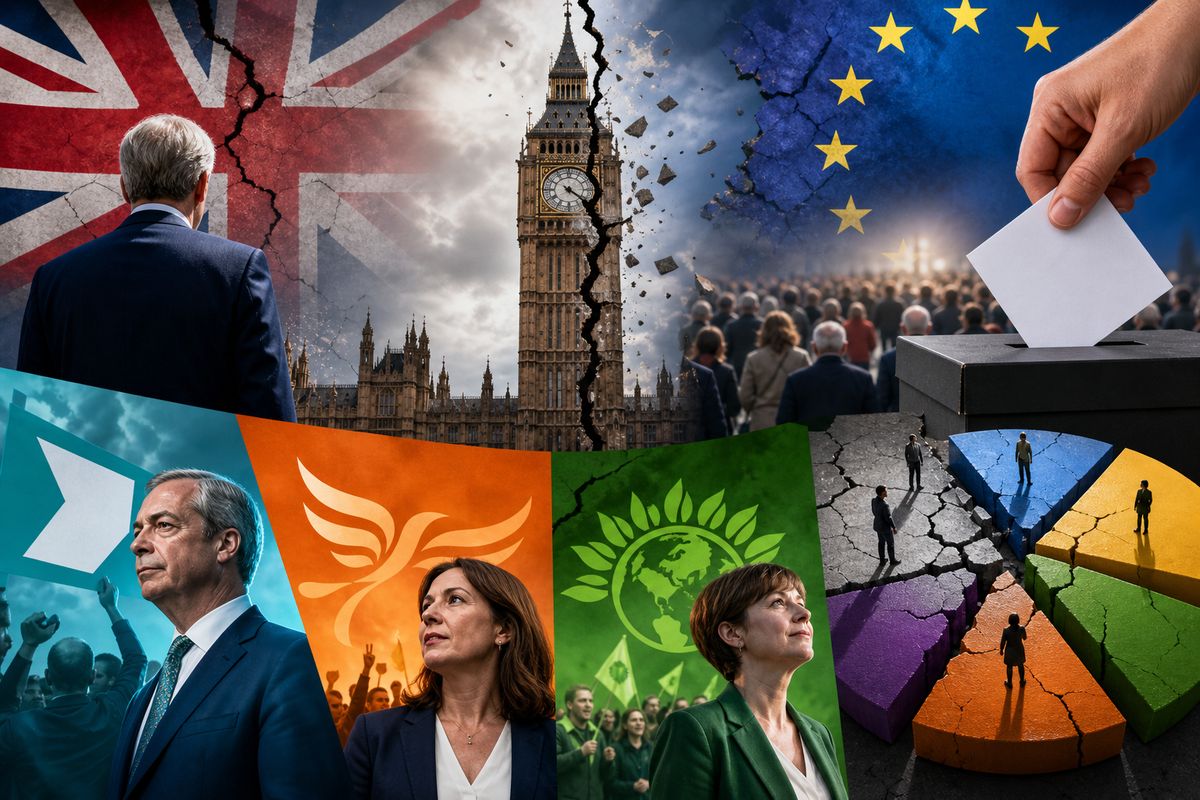
Brexit at 10: The Fracturing of Britain's Political Order
A decade after the United Kingdom voted to leave the European Union, the political landscape has been fundamentally reshaped. The two-party system that dominated Westminster for generations is cracking under the strain. Smaller parties are surging, traditional loyalties are crumbling, and both Labour and the Conservatives are struggling to hold together coalitions that once seemed unshakeable. The European Consortium for Political Research and the Institute for Government have both turned their attention to the phenomenon, publishing analyses that trace how Brexit at 10 has accelerated political fragmentation like nothing since the rise of the Liberal Party in the early 20th century.
This isn't just about UKIP or the Brexit Party. It's about a deeper realignment: voters who once saw themselves as either solidly red or blue now shop around. The Liberal Democrats, the Greens, Reform UK, and even the Scottish National Party (SNP) have all added seats or significantly increased their vote share in successive general elections. The question is whether this fragmentation is a temporary aftershock or the new normal.

The Event: How the Referendum Unlocked Fragmentation
The 2016 referendum itself was a blunt instrument. It didn't just split the country on Leave versus Remain. It shattered internal party discipline. For the Conservatives, it exposed a deep divide between Europhile and Eurosceptic wings, a divide that would consume five prime ministers in six years. For Labour, it forced a leader (Jeremy Corbyn) with historically weak ties to the EU to hold a party that overwhelmingly backed Remain, leading to years of internal strife and eventually a landslide defeat in 2019.
That 2019 general election was a watershed. Boris Johnson's Conservatives won a massive majority by peeling off Labour's traditional 'red wall' seats in the Midlands and North. But that victory was built on a coalition that would prove fragile. And Labour, reduced to its lowest seat tally since 1935, began a long, slow rebuild. Meanwhile, smaller parties like the Liberal Democrats and the Greens increased their vote share even if it didn't translate into many seats, thanks to first-past-the-post. The stage was set for the fragmentation that Brexit at 10 has now fully revealed.
Rise of Smaller Parties: Reform UK, Lib Dems, and the Greens
Reform UK: From Brexit Party to Right-Wing Insurgent
Reform UK, the successor to Nigel Farage's Brexit Party, has become the most direct beneficiary of Conservative disillusionment. By 2024, it was polling consistently in double digits, peeling away right-wing voters unhappy with the Tories' inability to deliver on immigration control, net zero targets, and economic growth. In by-elections, Reform often came second or third, siphoning just enough votes to let Labour or the Lib Dems win. The Institute for Government's analysis of Brexit at 10 notes that the Conservative Party's membership has aged and shrunk, while Reform's activist base has grown younger and more networked.
Liberal Democrats: Banking on Tactical Voting
The Liberal Democrats have also capitalised on fragmentation, particularly in southern England. They positioned themselves as the unequivocal pro-European, centre-left alternative. In the 2024 general election, they won their highest number of seats since 2005, largely by capturing Tory voters in affluent 'blue wall' seats who were repelled by Johnson's scandals and Truss's chaos. They now hold dozens of constituencies that were solidly Conservative a decade ago. The party's strategy has been hyper-local and tactical: target seats the Tories hold with narrow majorities, and urge Labour supporters to vote Lib Dem to oust the incumbent.
The Green Party: From Niche to Mainstream Challenger
The Green Party, once dismissed as a single-issue protest vote, has become a serious player in many local councils and a growing force in Westminster. Its success is not directly about Brexit but about the broader disillusionment with the two major parties. On climate, housing, and social justice, the Greens offer a radical alternative. By 2026, they hold four parliamentary seats and have significant representation in the London Assembly, Brighton, and Bristol. They are the clearest example of how Brexit at 10 has opened space for issue-based parties that don't fit the old left-right axis.
The Labour Party's Struggle for Identity After Brexit
Labour's journey over the decade has been a masterclass in painful reinvention. Under Jeremy Corbyn (2015-2020), the party lurched left, alienating many of its traditional working-class supporters while energising a younger, more metropolitan membership. The 2019 defeat was crushing: the party lost seats it had held for generations, especially in Leave-voting areas. Keir Starmer, who succeeded Corbyn in 2020, promised to rebuild trust. He moved the party back to the centre, purged antisemitism, and adopted a 'soft Brexit' stance that essentially accepted leaving the EU while seeking a close relationship.
Yet as the Institute for Government's Brexit at 10: The Labour Party briefing suggests, the party remains internally divided. The pro-Remain faction, strong among members and MPs in London, pushes for rejoining the single market or even the EU itself. The traditional Labour heartlands, meanwhile, are sceptical. Starmer has walked a tightrope, avoiding any explicit rejoin pledge while emphasising 'making Brexit work'. This ambiguity has cost Labour some support to the Lib Dems in Remain areas, while in Leave areas, Reform UK has made inroads among working-class voters who feel Labour has abandoned them on immigration and sovereignty. The fragmentation cuts both ways.
The Conservative Party's Post-Brexit Turmoil
The Conservatives have arguably been hit hardest by the fragmentation their own policies unleashed. The party that delivered Brexit was never united on what it should look like. From Theresa May's failed deal to Boris Johnson's 'oven-ready' agreement, from Liz Truss's mini-budget disaster to Rishi Sunak's stabilisation, the party has cycled through leaders and manifestos. The Institute for Government's Brexit at 10: The Conservative Party analysis points out that the party's membership base has shrunk by nearly 40% since 2016, and its donor pool has fragmented, with money flowing to Reform UK instead.
In 2024, the Conservatives lost power, winning fewer seats than at any time since 1997. The rise of smaller parties on the right means the Tories can no longer take their right flank for granted. Reform UK's constant threat of a candidate in any marginal seat forces Conservative strategists to look over their shoulder. At the same time, the loss of moderate one-nation Tories to the Liberal Democrats has left the parliamentary party more Eurosceptic and harder-right than at any point in history. Fragmentation has hollowed out the middle, and the Conservatives are struggling to define what they stand for beyond 'not Labour'.
The Bigger Picture: What Political Fragmentation Means for Democracy
The fragmentation visible in UK politics is not unique. Across Europe, from France to Germany to Italy, established parties are losing their grip. The difference in the UK is that the first-past-the-post electoral system was designed to discourage fragmentation. For decades, it worked: the two major parties routinely won 90% of seats on 70% of the vote. Now, with smaller parties winning larger vote shares and converting them into seats more effectively (thanks to tactical voting and by-election surges), the system is creaking.
What does this mean for governance? Coalitions or minority governments become more likely. The 2010 coalition was a rarity; by 2026, it seems plausible that no single party will win an outright majority in the next general election. This could force a fundamental rethink of how Britain is governed. Already, talks of electoral reform are back on the table, with the Liberal Democrats and Greens demanding proportional representation. The SNP, too, sees an opportunity to break the Westminster stranglehold. Brexit at 10 may well be remembered not just for the UK's departure from the EU, but for the beginning of the end of the two-party system. Whether that leads to more responsive, representative politics or to gridlock and extremism is the defining question of the next decade.
The big losers so far are the party machines. The big winners are ideas and movements that can bypass established channels. Brexit itself was a movement, not a party. Its legacy is a political culture where loyalty is conditional, engagement is transactional, and the old certainties are gone. For better or worse, Britain in 2026 is more fragmented, more fluid, and more unpredictable than at any point in the last century. And that is a direct line leading back to one vote, ten years ago.
Conclusion: Fragmentation as the New Normal
A decade on, the Brexit referendum continues to shape British politics in ways both expected and surprising. The rise of smaller parties at the expense of the Tories and Labour is the most visible symptom of a deeper disease: a loss of trust in the ability of the major parties to deliver. The European Consortium for Political Research and the Institute for Government have documented this shift carefully, but the full consequences are still unfolding. What is clear is that the old duopoly is broken. The question is not whether fragmentation will continue, but whether the political system can adapt to manage it without losing the stability that makes democracy work.