British Airways Takes Flight with Starlink, Marking a UK Aviation First
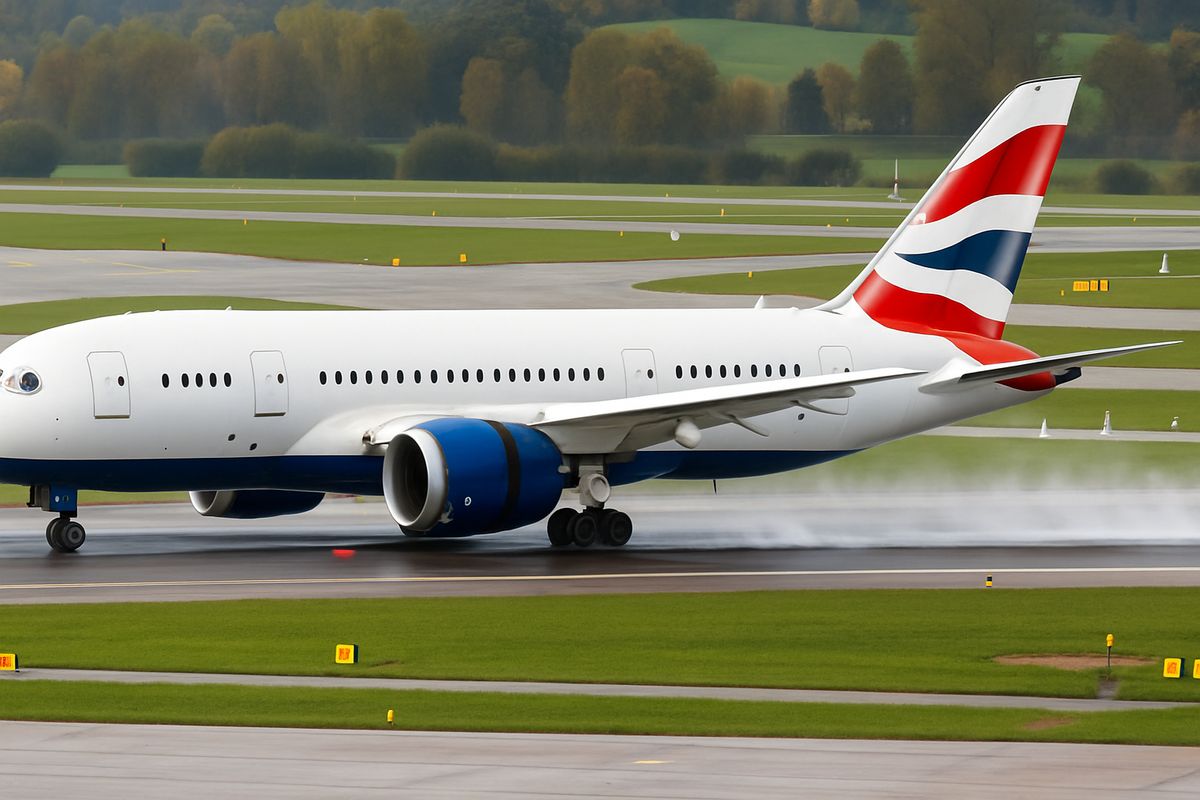
In a landmark move for UK aviation, British Airways has officially launched Elon Musk's Starlink satellite internet on its flights, becoming the first UK-based carrier to offer the high-speed service. The inaugural Starlink-equipped flight, a Boeing 787-8 Dreamliner, departed London Heathrow for Houston on March 18, 2026, signalling the start of a comprehensive fleet-wide rollout. This initiative is a central pillar of the airline's multi-billion-pound transformation plan, designed to fundamentally upgrade the passenger experience by offering free, gate-to-gate, high-speed connectivity for streaming, working, and staying connected. The deployment positions British Airways at the forefront of a fierce competitive battle for in-flight connectivity supremacy, particularly within the European market.
The first aircraft to receive the retrofit, registered G-ZBJJ, underwent installation at British Airways' Heathrow engineering base between late February and mid-March 2026. Prior to the Houston service, it had already been actively trialled on routes to destinations including Mumbai (BOM), Montreal (YUL), and Cincinnati (CVG). This phased testing approach allows the airline's engineering teams to validate real-world performance and reliability before accelerating the installation programme across its entire mainline and BA Euroflyer fleet of over 300 aircraft, a process slated for completion within the next two to three years.

Engineering a Connectivity Revolution: The Starlink Rollout Strategy
British Airways is executing a deliberate and strategic engineering plan for its Starlink integration. The airline is initially focusing on its Boeing 787-8 Dreamliner fleet, a subset of aircraft that previously lacked any onboard Wi-Fi system. This decision is tactically astute; installing a new system on a "clean-sheet" aircraft is significantly less complex than retrofitting planes with existing, older-generation connectivity hardware. It allows engineering teams to build crucial experience, streamline processes, and minimise aircraft downtime before tackling more technically challenging installations on other widebody and narrowbody types.
According to reports from PYOK, this methodical, fleet-type-by-fleet-type approach is designed to enhance efficiency and reduce operational disruption. Following the 787-8s, the programme will expand to select Boeing 787-9s and then to larger aircraft like the Airbus A380. The final phase will encompass the short-haul workhorses of the fleet, the Airbus A320 family jets. The scale of the project is immense, involving major structural modifications, extensive new wiring, software integration, and rigorous testing to ensure safety and performance. Once complete, the service will be activated from the moment passengers board until the moment they disembark, eliminating the traditional wait until cruising altitude.
The IAG Group Deal: A Collective Leap Forward
This rollout is not an isolated project for British Airways alone. It stems from a broader group-level agreement signed by its parent company, International Airlines Group (IAG). The contract extends Starlink technology to other IAG carriers, including Aer Lingus, Iberia, Vueling, and LEVEL. In total, over 500 aircraft across the airline group are slated to be equipped. However, the commercial model will differ: while British Airways has committed to offering Starlink free of charge in all cabins, the group's low-cost carriers like Vueling and LEVEL are expected to treat it as a paid add-on, reflecting their distinct business models.
Starlink vs. The Old Guard: A Technological Paradigm Shift
To understand the significance of British Airways' move, one must grasp the technological leap that Starlink represents. Traditional in-flight connectivity (IFC) has long been dominated by providers like Panasonic Avionics and Thales, which primarily use geostationary (GEO) satellites. These satellites orbit at an altitude of roughly 35,786 km, resulting in high latency (signal delay) that makes activities like video calls, competitive gaming, or seamless streaming difficult or impossible. Bandwidth was also often limited and shared among many users, leading to slow, unreliable connections.
Starlink, a division of Elon Musk's SpaceX, operates a constellation of thousands of small satellites in Low Earth Orbit (LEO), typically at altitudes between 340 km and 550 km. This proximity to Earth drastically reduces latency, bringing it closer to ground-based broadband speeds. Furthermore, the vast number of satellites creates a dense mesh network capable of delivering high bandwidth to concentrated areas, such as busy flight paths over the Atlantic. For passengers, this translates to the ability to reliably stream 4K video, participate in video conferences, and browse the internet with speeds previously unimaginable at 35,000 feet.
The Competitive Landscape Heats Up
British Airways is entering a rapidly evolving and competitive IFC market. Several major global carriers have already selected Starlink, including Air France (which is installing it on its short-haul fleet), Qatar Airways, Emirates, and Hawaiian Airlines. In North America, United Airlines has been a pioneer, deploying Starlink across its regional and domestic narrowbody fleet for over a year, though its widebody installation remains pending.
The main emerging competitor to Starlink in the LEO space is Project Kuiper, backed by Amazon. However, its satellite constellation is still in development, with JetBlue currently being the only airline publicly committed to the technology, targeting activation around 2027. This gives Starlink a crucial multi-year head start in establishing itself as the de facto standard for next-generation aviation connectivity, a window of opportunity that airlines like British Airways are keen to exploit.
Strategic Implications: Differentiation, Data, and the Ryanair Spat
For British Airways, the free offering of Starlink is a powerful tool for brand differentiation and customer retention. CEO Sean Doyle has explicitly stated that on short-haul European routes, this technology "will really differentiate us from our competitors." In a market saturated with low-cost carriers where ancillary fees are the norm, offering a premium, high-speed service for free is a compelling value proposition, particularly for business travellers and digital natives for whom constant connectivity is non-negotiable.
This strategic positioning was thrown into sharp relief by a very public disagreement between Elon Musk and Ryanair CEO Michael O'Leary in early 2026. O'Leary publicly dismissed installing Starlink on Ryanair's fleet, citing concerns over fuel efficiency, cost, and insufficient passenger demand to justify the investment. Musk responded on his social media platform X, calling O'Leary an "idiot" and musing about whether he should buy the airline. O'Leary later claimed the "PR spat" had driven a 2-3% increase in Ryanair sales. This exchange underscores the high-stakes debate within the industry: while carriers like British Airways view cutting-edge connectivity as an essential service for the future, others see it as an unnecessary cost on ultra-short, price-sensitive routes.
Beyond passenger experience, the technology also offers operational benefits for the airline itself. Improved connectivity facilitates better real-time communication between flight crews, cabin crews, and ground operations, enabling more efficient management of maintenance issues, passenger connections, and logistical challenges.
What's Next: The Future of Connected Skies
The successful launch by British Airways is not an endpoint but a catalyst for the next phase of in-flight connectivity. Over the next two to three years, the aviation industry will closely watch the scalability of IAG's massive retrofit programme. The key metrics will be reliability in diverse weather conditions and over oceans, the true cost of ownership (including any impact on fuel burn from the antenna's drag), and passenger adoption rates. If Starlink delivers on its promise, it will create immense pressure on competing airlines, particularly full-service carriers on transatlantic and other long-haul routes, to match or exceed the offering. We can expect a wave of new partnership announcements as the technology proves itself.
Looking further ahead, the proliferation of LEO connectivity will enable more than just passenger internet. It will form the backbone of the "connected aircraft," streaming vast amounts of real-time engine health, airframe, and systems data to the ground for predictive maintenance. This could dramatically improve aircraft utilisation, reduce delays, and enhance safety. Furthermore, as the Internet of Things (IoT) expands, seamless cabin connectivity will allow for smarter, more personalised cabin environments, from bespoke in-flight entertainment to dynamic lighting and climate control.
The battle for the skies will also intensify between Starlink and Amazon's Project Kuiper once the latter's constellation is operational. Competition should drive innovation, lower costs, and potentially lead to hybrid systems that use multiple satellite networks for ultimate redundancy and global coverage. For passengers, the era of treating in-flight internet as a slow, expensive luxury is rapidly closing. The expectation, soon to be set by pioneers like British Airways, will be for fast, free, and reliable connectivity as a standard feature of air travel, fundamentally reshaping how we work, play, and stay informed while traversing the globe.
Elevating the Journey: A New Standard for Air Travel
The introduction of Starlink on British Airways flights represents more than a simple technology upgrade; it is a strategic redefinition of the onboard experience. By committing to a free, fleet-wide rollout, the airline is making a significant statement about the value it places on customer connectivity and its vision for modern air travel. This move aligns with a broader £7 billion investment plan aimed at transforming every touchpoint of the customer journey, from booking to baggage claim.
The implications extend beyond British Airways and even the IAG group. It sets a new benchmark, particularly in the European market, where in-flight connectivity has often lagged behind North America. As the rollout progresses over the coming years, it will challenge rivals, delight passengers, and test the robustness of LEO satellite technology on a massive scale. The successful integration of Starlink could well prove to be a defining chapter in British Airways' history, marking its transition into a truly digital, connected airline for the 21st century. The connected skies are no longer a futuristic concept—they are now a reality taking off from Heathrow.