A New Portrait for a National Collection
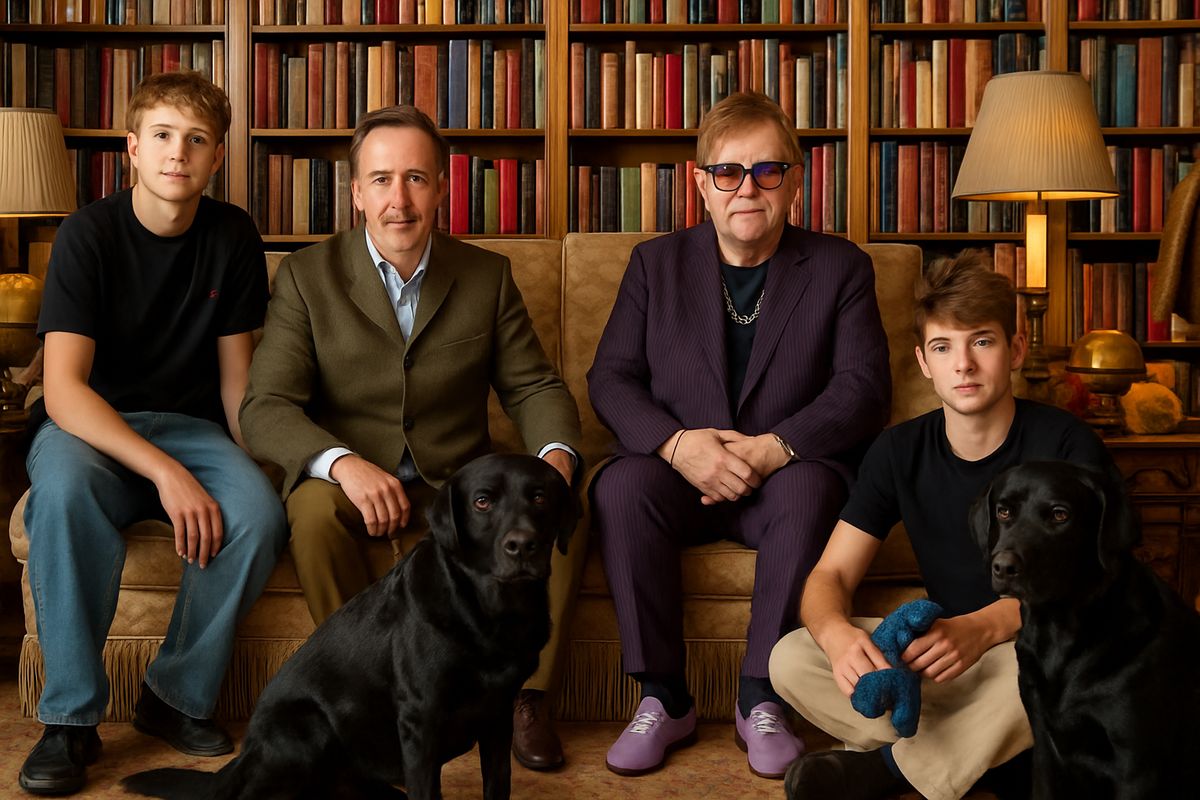
On 3 March 2026, the National Portrait Gallery in London unveiled a significant new acquisition: a photographic portrait of Sir Elton John, his husband David Furnish, and their two teenage sons, Zachary, 15, and Elijah, 13. The image, captured by celebrated American artist Catherine Opie in the library of the family's Windsor home, presents a candid, domestic scene that is both intimate and emblematic. The subjects are joined by their pet Labradors, Joseph and Jacob, completing a portrait of a modern family unit. Sir Elton is seated in a distinctive purple suit and pink-tinted glasses, Furnish wears a green suit, and their sons are in black T-shirts—one perched on the sofa arm, the other on the floor holding a dog toy. The gallery announced the portrait would join its permanent collection, described as housing "portraits of the people who have shaped the history and culture of the UK."
The unveiling is not an isolated event but a carefully curated cultural moment. It coincides with the opening of a major separate exhibition at the gallery dedicated to Catherine Opie's celebrated 30-year career, positioning the family portrait as both a standalone commission and a highlight within a broader artistic narrative. The portrait has been hung in a room alongside other contemporary cultural icons, including Sir David Beckham, Dame Judi Dench, the late Amy Winehouse, and actress Letitia Wright. This placement immediately contextualizes the John-Furnish family within a pantheon of influential British figures, while its domestic setting offers a starkly different, more personal counterpoint to traditional formal portraiture.

The Artist and the Sitters: A Meeting of Creative Minds
The commission brings together two formidable forces in their respective fields: one of the world's most iconic musicians and a preeminent contemporary photographer. Catherine Opie is renowned for her deeply nuanced portraits that explore American identity, community, and the construction of social landscapes. Her work often focuses on subcultures and LGBTQ+ communities, making her an artistically resonant choice for this subject. Sir Elton John and David Furnish, both prolific art collectors and patrons, explicitly acknowledged this synergy. In a joint statement, they said: "To have our family photographed by Catherine Opie and on display at the National Portrait Gallery is a huge honour. We are huge admirers of her work and proud to have her beautiful and poignant images in our collection."
The portrait's setting—the family's personal library—acts as a powerful secondary canvas. The shelves behind them are densely packed with hundreds of books, primarily biographies, offering a curated glimpse into the family's intellectual and cultural passions. This bibliographic backdrop is a deliberate and revealing element. It includes works on cultural giants from Andy Warhol, David Hockney, and Madonna to Beethoven, Prince, and the Beatles. The collection spans sport, with biographies of Watford FC legend Troy Deeney reflecting Sir Elton's lifelong devotion, and politics, with figures from Winston Churchill and Nelson Mandela to Gandhi and Tony Blair. Notably, the shelves also hold volumes on LGBT history, anchoring the family's personal story within a broader social struggle. This detail transforms the portrait from a simple family photo into a complex statement about identity, legacy, and the intersection of public and private life.
Historical Context: Portraiture, Celebrity, and the Evolving Family
The National Portrait Gallery, founded in 1856, has a long tradition of documenting the nation's history through the faces of its most influential figures. For centuries, this meant oil paintings and later photographs of monarchs, military leaders, politicians, and literary giants. The inclusion of pop culture celebrities like Elton John is a relatively modern evolution, reflecting a democratization of influence where cultural impact rivals political power. However, this particular portrait marks several profound departures from tradition. It is not a formal, posed studio shot of a singular "great man," but a relaxed, contemporary image of a family. It depicts a same-sex couple and their children, a representation of family structure that would have been unthinkable for a national institution even a few decades ago.
This act of institutional recognition carries immense symbolic weight. It follows a lineage of portraits that have documented changing social norms, but it actively participates in cementing a new norm. The gallery itself framed the commission as "a remarkable opportunity... to bring together an artist and sitters in celebration of LGBTQ+ representation, philanthropic work and highly regarded photographic art." This statement explicitly links artistic merit with social progress and philanthropy (a nod to the Elton John AIDS Foundation's decades of work), framing the portrait as a multi-faceted cultural document. It moves beyond celebrity worship to acknowledge a holistic contribution to national life.
The Significance of the Domestic Setting
Opie's choice to photograph the family in their home library, surrounded by the artifacts of their daily life and interests, is a critical artistic decision. It aligns with a modern shift in portraiture away from grandeur and toward authenticity and intimacy. The power of the image lies in its suggestion of a real, lived-in moment. The teenagers' casual poses, the presence of the dogs, and the sprawling book collection all work to demystify the global icon, presenting him first and foremost as a father and partner within a domestic unit. This resonates with related media coverage, such as headlines noting "Elton John's Sons Are All Grown Up," which highlight the portrait's function as a document of personal, familial passage of time as much as a public commemoration.
Analysis: Curating Legacy in the Public Eye
The unveiling of this portrait is a masterclass in legacy curation. For Elton John and David Furnish, it represents a conscious step in shaping how their family will be remembered within the UK's official cultural narrative. It is a move from the tabloid pages to the hallowed halls of a national institution, a transition that confers a specific type of legitimacy and permanence. The portrait freezes a moment in their family's life—with their sons as teenagers—and elevates it to the status of historical record. This is particularly poignant for an LGBTQ+ family, as it represents a claim to a heritage and a future that has often been denied or marginalized in traditional historical accounts.
For the National Portrait Gallery, the acquisition is a strategic statement of relevance. It demonstrates an understanding that contemporary British culture is multifaceted and that family structures have evolved. By placing this modern, diverse family portrait alongside historical figures, the gallery actively rewrites and expands the visual story of Britain. It also bridges the gap between high art and popular culture, using the undeniable draw of Elton John to bring audiences into a conversation about portrait photography, representation, and social history. The concurrent Opie exhibition further deepens this context, allowing visitors to appreciate the family portrait as part of a serious artistic oeuvre, not merely a celebrity snapshot.
The Role of the Bibliophile Backdrop
The meticulously stocked bookshelves are far from a random set dressing. They serve as a visual biography, a map of the family's intellectual and cultural influences. The inclusion of figures from Gary Barlow to Gandhi, from Stormy Daniels to Nelson Mandela, paints a picture of eclectic, wide-ranging curiosity. It suggests a household where music, politics, sport, film, and LGBTQ+ history are in constant dialogue. This transforms the sitters from passive subjects into active curators of their own image. They are not just being looked at; they are showing us what they look at, what they value, and what has shaped them. In an age of often superficial celebrity culture, this layer of intellectual depth is a deliberate and powerful communicative act.
Why It Matters
While most coverage will rightly celebrate this as a milestone for LGBTQ+ visibility and a touching family moment, its deeper implication lies in the institutional alchemy it performs. The National Portrait Gallery, by accepting this commission, is not just adding another famous face to its walls. It is performing a quiet but radical act of historical revisionism. It is using its authority to retrospectively legitimize a life story that, for much of Elton John's early career, was forced into secrecy and coded language. The portrait, hung in perpetuity, becomes a corrective—a declaration that this family, in this form, has always been part of the British story. It normalizes through institutional endorsement, a far more powerful tool than any magazine spread or social media post.
Furthermore, this event highlights a shifting paradigm in how cultural influence is measured and memorialized. The portrait acknowledges that legacy in the 21st century is multifaceted: it is built not just on professional achievement (Elton's unparalleled musical career) but on advocacy (their philanthropic work), on family, and on the conscious cultivation of a personal and collective history. Readers should see this not merely as a news item about a celebrity, but as a case study in how power—cultural, social, and even soft political power—is now wielded and cemented. The takeaway is to look beyond the family in the frame to the frame itself: who gets to decide what history looks like, and what stories are chosen for the official record, is constantly evolving. This portrait is evidence of that evolution in real-time.
What to Watch For Going Forward
The inclusion of this portrait will likely set a precedent for the National Portrait Gallery and similar institutions worldwide. Observers should watch for future commissions that continue to diversify the concept of a "national portrait"—perhaps highlighting families of different ethnicities, backgrounds, and structures who have shaped contemporary Britain. The public and critical reception to the Opie exhibition will also be telling; a strong response will reinforce the artistic seriousness of such commissions beyond their headline value.
For Elton John and David Furnish, this portrait marks a point of maturation in their public narrative, shifting focus from individual stardom to familial and philanthropic legacy. The portrayal of their teenage sons, Zachary and Elijah, offers a glimpse into the next generation. How they navigate public life, if they choose to, will be a sequel to this captured moment. Finally, the portrait's enduring presence in a national collection ensures that this specific vision of their family will influence public perception for decades to come, solidifying a chapter in the ongoing story of both a family and a nation's culture.