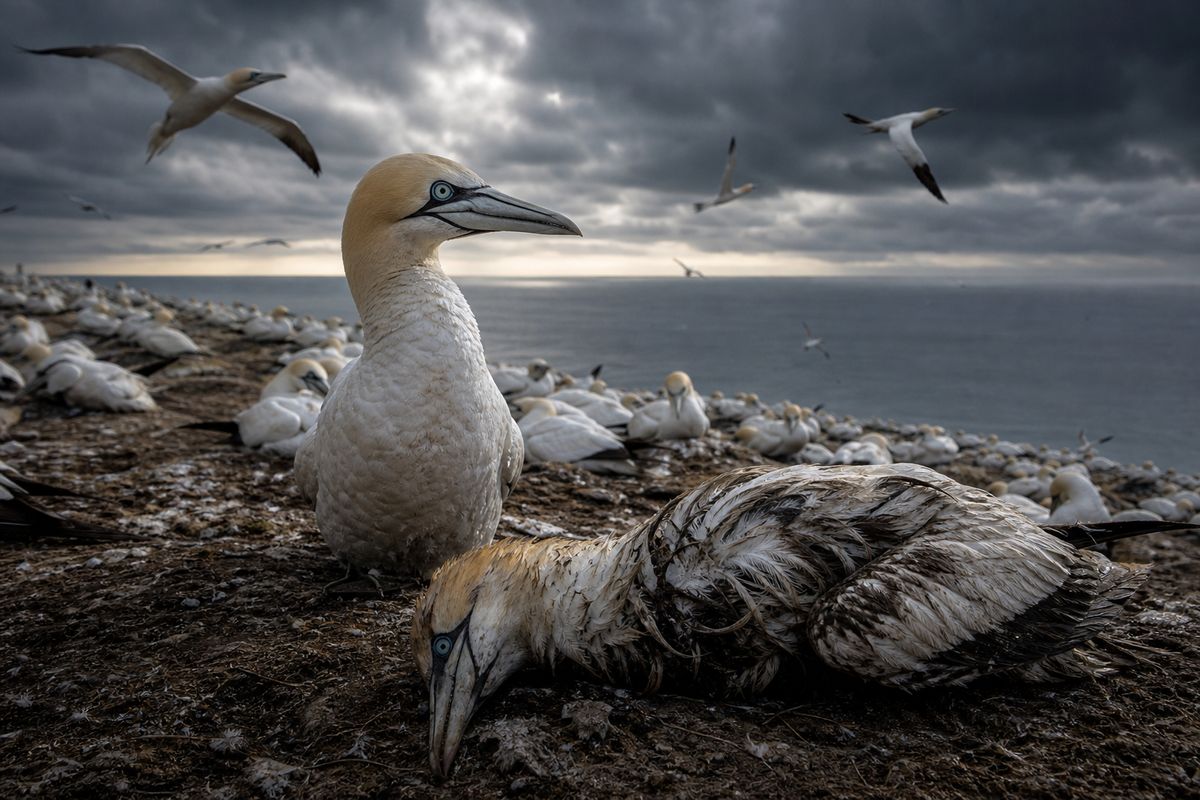
Gannet colonies face decades-long recovery after bird flu devastation, new study warns
For anyone who has stood on a clifftop watching northern gannets plunge into the sea, the sight is unforgettable. These majestic seabirds, with their six-foot wingspans and golden crowns, are a defining feature of Britain's coastline. But a devastating outbreak of avian flu in 2022 has left two of the world's largest gannet colonies reeling. And new research suggests they won't recover until at least 2041.
A study led by the RSPB and Aarhus University has delivered a stark verdict: adult gannet mortality rates quadrupled during the outbreak. At Bass Rock in Scotland, the colony shrank by 26% in 2023. At Grassholm in Wales, the decline was even steeper at 38%. These are not just numbers. They represent tens of thousands of birds lost, and a population that will take nearly two decades to rebuild.
The findings, published today (6 July 2026), are the first to provide robust estimates of adult survival in a seabird species during the H5N1 bird flu pandemic. They also offer the first clear predictions of long-term impact and recovery timelines. The picture is bleak, but not hopeless. The authors argue that with sustained monitoring and targeted conservation, we can give these colonies a fighting chance.

Inside the study: fourfold increase in adult deaths
The research focused on two of the world's most important gannet colonies: Bass Rock in the Firth of Forth and Grassholm off the coast of Pembrokeshire. Together they host a significant chunk of the global northern gannet population. In the 11 years before 2022, average annual adult mortality at Bass Rock was 6%. At Grassholm it was 11%. During the 2022 outbreak, those figures shot up to 33% and 47% respectively.
That fourfold increase in deaths is catastrophic for a species that produces only one chick per year and does not begin breeding until it is five or six years old. "The bird flu outbreak in 2022 dealt an unprecedented deadly blow to UK seabirds," said Jude Lane, lead author of the study and an RSPB marine conservation scientist. "These findings show that key gannet colonies on Bass Rock and Grassholm will be impacted for decades to come."
Population modelling forecasts that both colonies will not recover to the size they would have been without the outbreak until at least 2041. And that is an optimistic scenario. In reality, recovery could take even longer if further outbreaks occur or if additional pressures like climate change compound the damage. The virus was first confirmed in gannets at Bass Rock on 4 June 2022, and at Grassholm the following month.
Why adult mortality matters more than chick loss
Seabird populations are driven by the survival of adult breeding birds. Lose a few chicks in a bad year, and the colony can bounce back quickly. But when adult birds die in large numbers, the damage is long-lasting. Each lost adult represents not just a missing bird, but a gap in the breeding population that will take years to fill. Young gannets take half a decade to reach maturity. Even if conditions improve immediately, recruitment of new breeders is painfully slow.
The UK is home to a high proportion of the global northern gannet population. What happens on Bass Rock and Grassholm matters far beyond our shores. The study authors have recommended that the species' global conservation status be revised. Currently the northern gannet is listed as Least Concern on the IUCN Red List. Given the high mortality rates and slow recovery projections, that classification looks increasingly outdated.
"With long-term monitoring at key colonies and across wider populations we can better understand the impacts," Lane added. "With that knowledge we are in a far better position to address the many other pressures facing seabirds and halt the devastating declines of recent years."
Climate change: the other hammer blow for seabirds
Bird flu is far from the only threat. A separate report released today by the RSPB and British Trust for Ornithology (BTO) confirms that climate change is already reshaping UK bird populations in profound ways. Seabirds are among the most affected. Warming seas are reducing the availability of sandeels and other small fish that seabirds rely on. Storms, once rare events, are becoming more frequent and intense. For puffins and Arctic terns, the outlook is grim.
Existing research suggests that, without conservation action, some seabird species could decline by more than 70% by 2050 under a high-emissions scenario. The climate report identifies three key impacts: shifting species distributions, loss of seasonal food supplies, and growing pressure on protected areas. For example, golden plovers and dotterels are losing the cool, damp conditions they need, while willow warblers are abandoning southern England entirely for cooler Scottish climes.
These changes interact with bird flu in dangerous ways. Stressed populations with reduced food supplies are less resilient to disease outbreaks. A weakened colony hit by avian flu takes even longer to recover when its feeding grounds are also degrading. The dual threat of pandemic disease and climate disruption is creating a perfect storm for Britain's seabirds.
Wales's seabird cities: a national treasure under siege
Wales is home to globally important seabird colonies. Grassholm, one of the two study sites, holds one of the world's largest gannetries. Alongside Skomer, Skokholm, Ramsey Island and The Skerries, these "seabird cities" support 1.35 million breeding birds each year. They draw tourists from across the UK and overseas, bringing vital income to local communities. But as the new study shows, that spectacle is at risk.
"Will future generations still experience Wales' seabird cities?" asks the RSPB in a separate call to action. The organisation is urging the Welsh Government to deliver on its commitment to implement a Seabird Conservation Strategy for Wales. Key demands include maintaining a dedicated working group, providing long-term funding, identifying critical feeding areas for protection as Marine Protected Areas, and embedding robust biosecurity measures into statutory organisations.
There is hope. Conservation works when it is properly resourced. Rat eradication and biosecurity measures on Ramsey Island helped Manx shearwater numbers recover from just 500 pairs in 1998 to 6,200 in 2022. Storm petrels have returned to breed for the first time. But the scale of the bird flu impact on gannets is vastly larger than the rodent problem on Ramsey. It demands a commensurate response.
What needs to happen now: monitoring, funding and political will
The study was funded by a consortium that includes Neart na Gaoithe Offshore Wind Ltd, Seagreen Wind Energy Ltd, Berwick Bank Wind Farm, a NERC Emergency Grant, and the Department for Energy Security and Net Zero's Offshore Energy Strategic Environment Assessment Programme. That funding was essential for generating the data. But ongoing surveillance is not guaranteed. Without sustained investment in seabird monitoring, we will miss the early warning signs of future outbreaks.
The authors stress that while we cannot prevent diseases like bird flu, we can mitigate their impact by addressing other pressures. That means ending overfishing of forage species, reducing pollution, minimising disturbance at colonies, and tackling climate change at source. It also means rethinking how we manage protected areas. The climate report notes that many Special Protection Areas were established based on historical species distributions. As those distributions shift, the network needs to become more flexible.
The RSPB's senior policy officer, Bethany Chamberlain, put it plainly: "Climate change is already affecting the UK and has the potential to cause unprecedented impacts to birds and nature more widely. However, we know the solutions. When we help look after nature, nature can help to build our resilience to climate change. We need coordinated and urgent action from governments that gives nature a central role to help us adapt."
A race against time for the UK's seabirds
The news from Bass Rock and Grassholm is sobering. But it is not a death sentence. Northern gannets are resilient birds. They have survived centuries of hunting, egg collecting and habitat change. With a clear understanding of the threat and a commitment to act, we can still ensure that gannets remain part of Britain's coastal heritage for generations to come. The clock is ticking, however. The study shows that even under best-case assumptions, recovery will take until at least 2041. That is a long time. And the window to act is now.
The RSPB is calling on everyone who cares about seabirds to support their seabird appeal. For those in Wales, the message is even more urgent: the Welsh Government must deliver its Seabird Conservation Strategy before the next breeding season. Without it, the noise of Wales' seabird cities may one day fall silent. And that would be a loss not just for wildlife, but for all of us who find wonder in the wild places of these islands.
Sixty-two per cent of UK breeding seabird species are now in decline. That figure rises to 70% in Scotland. The gannet, once a symbol of the sea's abundance, is now a marker of how quickly things can change. But it could also become a symbol of recovery if we choose to act. The science is clear. The question is whether the political will can match it.