The Dawn of Hydrogen Powered Backup Systems
Power cuts are a nuisance for households, but for data centres and critical infrastructure they can be catastrophic. The traditional answer has been simple: diesel generators. They're loud, dirty, and increasingly at odds with net-zero commitments. Now, two major projects are testing a cleaner alternative: hydrogen. UK Power Networks is developing a hydrogen backup system that can restore power within seconds. Meanwhile, Equinix, the global data centre giant, is trialling hydrogen fuel cells at its facilities in Ireland. These are not small experiments. They signal a potential shift in how we think about backup power.
The idea isn't exactly groundbreaking on paper. Hydrogen fuel cells have been around for decades. They convert hydrogen into electricity with only water as a byproduct. The challenge has always been cost, storage, and infrastructure. But with renewable energy expanding and grid stability becoming more complex, hydrogen backup is getting a serious look. UK Power Networks, which manages the electricity distribution network for London, the South East, and the East of England, is partnering with UK Power Networks (themselves) and other tech firms to trial a system that can kick in almost instantly after a power outage. That's critical for hospitals, telecoms, and industrial processes where every second counts.
Equinix's test in Ireland is equally significant. The country has a growing data centre sector, but also faces challenges in grid capacity and renewable intermittency. Hydrogen backup could allow data centres to operate without relying on diesel, cutting carbon emissions significantly. The project, covered by Inspenet, is part of a broader push by Equinix to achieve climate neutrality by 2030. Both projects are still in early stages, but they represent a concrete move away from fossil fuel contingency planning.

How Hydrogen Backup Works
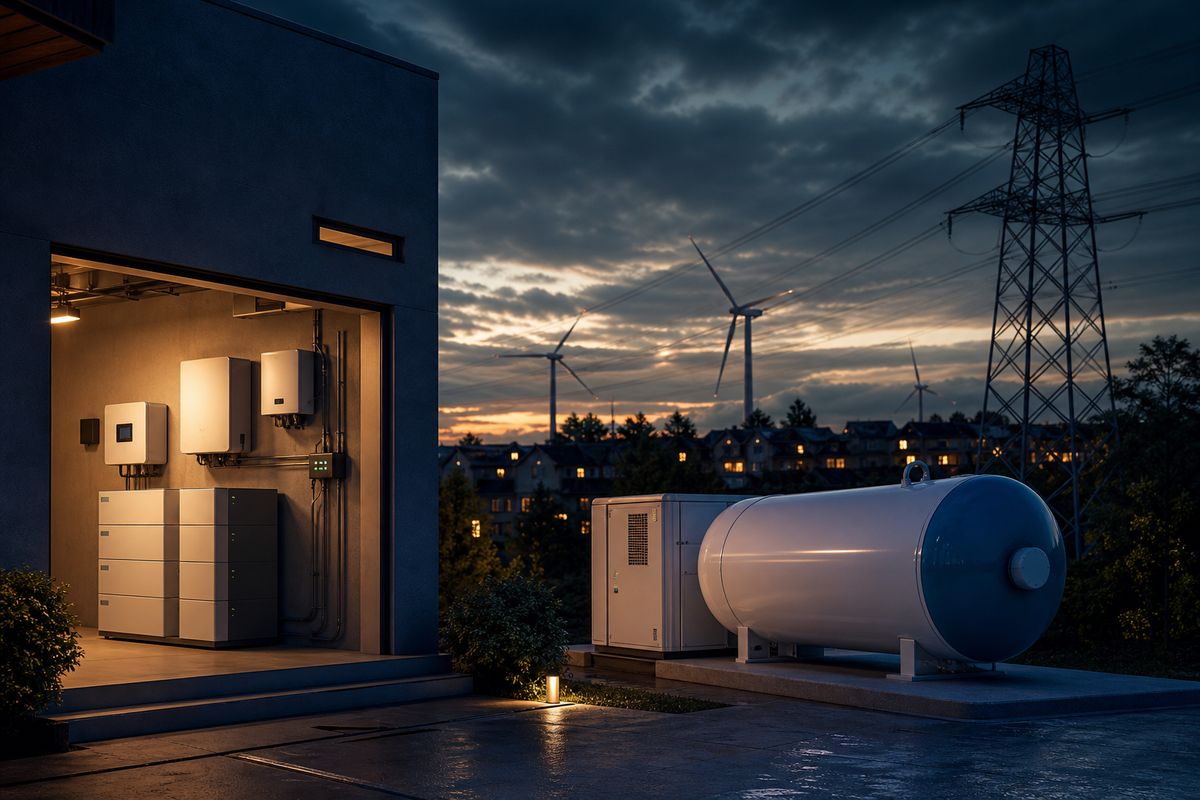
Let's be clear: this isn't about burning hydrogen like natural gas. The tech here is fuel cells. They combine stored hydrogen with oxygen from the air to produce electricity, heat, and water. No combustion, no nitrogen oxides, no carbon dioxide. The main components are the hydrogen storage tank (typically high-pressure cylinders or cryogenic tanks) and the fuel cell stack itself. The fuel cell converts hydrogen directly into direct current (DC) electricity, which an inverter then converts to alternating current (AC) for the grid or building loads.
The speed of response is what sets these systems apart. UK Power Networks' system is designed to restore power within seconds. That's comparable to a UPS (uninterruptible power supply) but with much longer runtime. A battery bank might last for minutes or an hour; a hydrogen storage system can provide power for hours or days, depending on the tank size. For data centres, this means they can ride through extended outages without burning diesel. For grid operators, it means a dispatchable, zero-emission backup that can support frequency regulation and peak shaving.
The Equinix trial in Ireland uses fuel cells supplied by Plug Power, a company that has been pushing hydrogen solutions for logistics and stationary power. The system will be tested at a data centre in Dublin, one of Europe's largest hubs. If successful, Equinix plans to roll out hydrogen backup across other sites. The key metric is cost: hydrogen is still more expensive than diesel on a per-kilowatt-hour basis, but carbon pricing and corporate sustainability targets are narrowing the gap.
Storage and Safety Considerations
One of the biggest hurdles for hydrogen backup is storage. Hydrogen has very low energy density by volume, meaning you need big tanks or very high pressures. It's also highly flammable, though not more so than natural gas if handled properly. Modern hydrogen storage systems use Type IV composite cylinders rated at 350-700 bar, or cryogenic liquid hydrogen at -253°C. Both require careful safety engineering, especially in urban environments or inside data centre buildings.
But here's the thing: the same safety concerns existed for diesel generators. Diesel is flammable, produces toxic exhaust, and requires regular refuelling. Hydrogen systems can be designed with leak detection, ventilation, and blast walls. And because hydrogen disperses quickly in air (it's the lightest gas), leaks are less likely to accumulate in dangerous concentrations outdoors. The industry is learning fast, and codes like NFPA 2 (Hydrogen Technologies Code) are becoming standard.
Background on the Key Players
UK Power Networks is a subsidiary of CK Hutchison Holdings and serves about 8.3 million homes and businesses. It's one of the Big Six distribution network operators (DNOs) in Britain. The company has been a testbed for innovation, including electric vehicle charging and smart grid technology. Its hydrogen backup project is part of a broader initiative called "Resilience as a Service," where it explores alternatives to traditional diesel generators for critical infrastructure. The system uses a 500 kW fuel cell integrated with existing substation equipment.
Equinix is a global colocation data centre company with over 240 facilities worldwide. It operates in 70+ metros and is a backbone of the internet. The company has committed to reaching 100% renewable energy and achieving climate neutral operations by 2030. The hydrogen trial in Ireland, announced in early 2024, is a key part of that strategy. Equinix's director of energy and sustainability, Equinix (official site), has stated that hydrogen could be a "game-changer" for backup power, but acknowledges that scaling will take time and investment.
Also involved in the supply chain are companies like Ballard Power Systems (fuel cells) and Hexagon Purus (hydrogen storage). These are established players with track records in transport and stationary power. Their involvement adds credibility and technical depth to the projects.
What This Means for the Industry
Energy storage is often framed in terms of batteries: lithium-ion to smooth solar and wind, pumped hydro for longer durations. But hydrogen offers something batteries can't easily do: long-duration, high-power backup that can sit idle for months without degradation. A fuel cell doesn't suffer from the same cycle life limitations as a battery. You can store hydrogen for years and only convert it when needed. For grid operators, that's a powerful tool.
The data centre sector is particularly hungry for this. Hyperscalers like Google, Amazon, and Microsoft have all committed to 24/7 carbon-free energy. Yet their backup generators, which run on diesel, are often the last bastion of fossil fuels. If hydrogen backup can replace diesel, it would dramatically cut the carbon footprint of the IT industry. But the economics need to improve. Currently, green hydrogen (produced via electrolysis using renewable electricity) costs $5-$8 per kilogram, compared to about $0.50 per litre for diesel. However, diesel generators also produce CO2, which has a cost under carbon pricing schemes. And as more renewable capacity comes online, the cost of electrolysis will fall.
Another angle: hydrogen backup can support the grid itself. Utilities like UK Power Networks are experimenting with using these systems not just for emergency backup, but also for demand response. When the grid is under stress, the fuel cell can export power, reducing the load on substations. This turns a backup asset into a revenue-generating resource. That's a big deal for the business case.
Why It Matters: The Hidden Transformation of Resilience
Let's step back and think about what resilience really means. For most of the 20th century, grid resilience was about building redundant lines and having spare transformers. Backup generation was an afterthought, bolted on with diesel. The world is changing. Extreme weather events, cyberattacks, and the electrification of everything are making power outages more frequent and more consequential. At the same time, the push to decarbonise means we can't just throw diesel at the problem.
Hydrogen backup systems offer a way to square the circle: zero-emission power that can run for days. But the real insight is that these systems force a rethink of how we value energy storage. Right now, we think of storage as something that's used daily (like a home battery) or rarely (like a generator). Hydrogen blurs that line. A fuel cell can be used for daily frequency regulation and then, when a storm hits, run continuously for 72 hours. That dual-use capability is where the real disruptive potential lies, not just in replacing diesel.
What's more, the projects by UK Power Networks and Equinix are happening in the real world, not in a lab. They're being deployed in dense urban environments and hyperscale data centres. They face real permitting, safety, and operational challenges. If they succeed, they'll create templates that can be copied across the developed world. If they fail, they'll teach us valuable lessons about the limits of hydrogen. Either way, this is a crucial experiment. And it's happening right now, in London and Dublin.
The Road Ahead: Challenges and Next Steps
Don't expect hydrogen backup to replace diesel overnight. The infrastructure for hydrogen production, delivery, and storage is still minimal. Most hydrogen today is "grey" (made from natural gas, with emissions). Green hydrogen requires new electrolysers and renewable energy capacity. The UK has a hydrogen strategy, and Ireland is developing one, but deployment is slow. For data centres, on-site hydrogen generation via electrolysis is possible but adds complexity and cost.
There's also the question of energy efficiency. Producing green hydrogen, compressing it, and converting it back to electricity in a fuel cell is only about 30-40% efficient round-trip. Batteries are 85-95% efficient. For short-duration backup (a few hours), batteries are clearly better. For long-duration backup (10+ hours), the equation shifts in favour of hydrogen. The sweet spot is likely a hybrid system: batteries for the first few seconds to minutes, then fuel cells for the long haul. Many of these projects are exploring exactly that.
Finally, regulation needs to catch up. Building codes for hydrogen in data centres or substations are still evolving. Fire departments need training. Insurance companies need data. These are solvable problems, but they take time. The UK Power Networks project is expected to run for at least two years, gathering performance data and safety evidence. Equinix's trial will likely follow a similar timeline. By 2026 or 2027, we'll have a much clearer picture of whether hydrogen backup is viable at scale.
This article was based on reporting by Fuel Cells Works, Transport + Energy, and Inspenet. The projects are ongoing and subject to change.