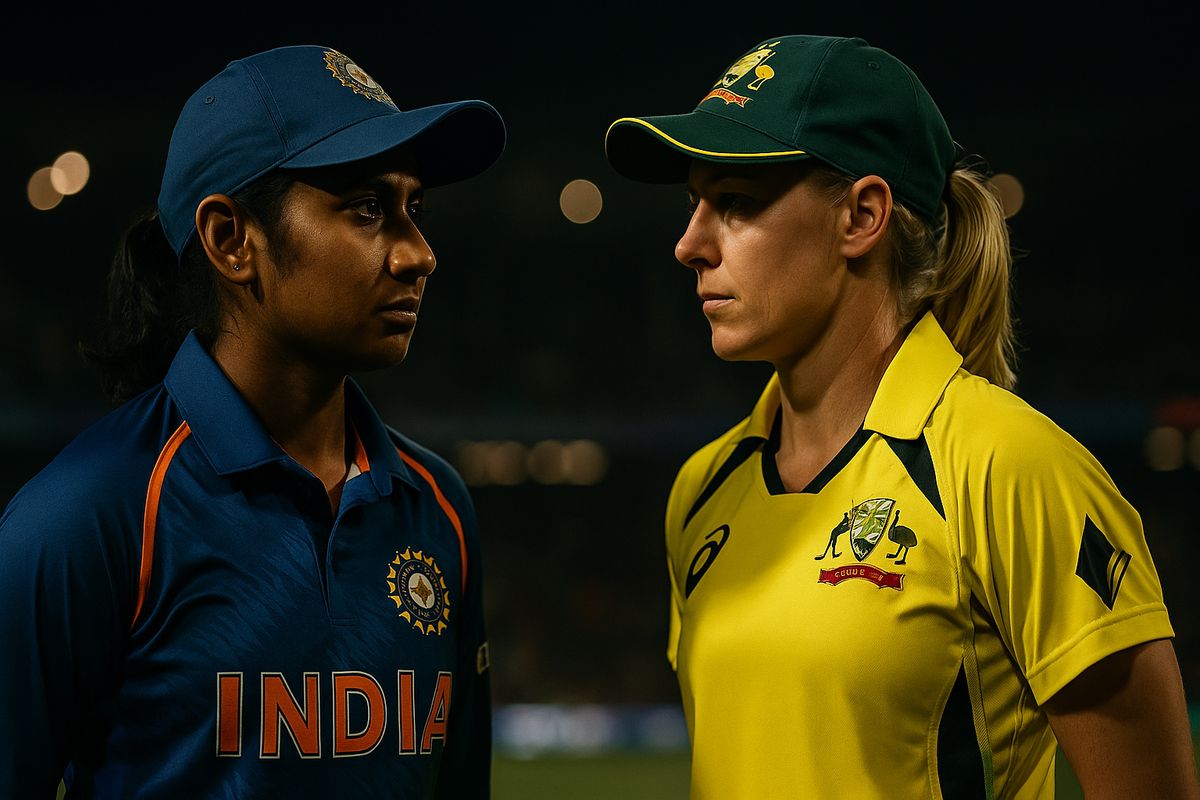
A Daunting Challenge at the WACA
The Indian women's cricket team arrives at the WACA Ground in Perth for a one-off Test against Australia, a venue synonymous with pace, bounce, and intimidation. The headlines framing this encounter—"India revisit 2023 win ahead of WACA Test as daunting challenge awaits"—point to a team drawing on recent history for inspiration while staring down one of the most formidable tasks in the sport. This is not just another match; it is a quest for validation on foreign soil, a chance to salvage a multi-format series, and a battle against both a world-class opponent and the legendary pitch itself. The related narrative of being "inspired by T20 success to salvage series with Test" adds another layer, revealing a team using momentum from the shorter format to fuel their belief in the ultimate five-day challenge.
The context is critical. India enters this Test trailing in the multi-format series points system. A victory in the Test match, worth four points, is essential to their hopes of claiming the overall series against the dominant Australians. The WACA, however, is a great equalizer and a great destroyer. Its famous pace and steep bounce have undone batting line-ups for generations, offering a stern examination of technique and temperament. For India, the reference to their 2023 win—a historic one-off Test victory against Australia in Mumbai—serves as a psychological anchor, a reminder that they have conquered this opponent before, even if under vastly different conditions.

Recalling the 2023 Blueprint for Success
The 2023 victory in Mumbai was a landmark moment for Indian women's cricket. Played on a turning track at the Wankhede Stadium, it was a match defined by spin and subcontinental mastery. India won by 8 wickets, a comprehensive result built on massive first-innings contributions. Smriti Mandhana and Jemimah Rodrigues scored centuries, while Sneh Rana and Deepti Sharma shared nine wickets between them. It was a triumph of home advantage and precise execution, ending a 23-year wait for a Test win against Australia.
Revisiting that win now is a strategic exercise in confidence-building. The core of that victorious team—captain Harmanpreet Kaur, vice-captain Smriti Mandhana, all-rounder Deepti Sharma, and bowler Sneh Rana—forms the backbone of the squad in Perth. The memory provides tangible proof that Australia can be beaten. However, the coaching staff and players are acutely aware that the blueprint from Mumbai cannot be directly transplanted to Perth. The conditions are diametric opposites. Where Mumbai required patience against spin, the WACA will demand courage and quick reflexes against pace. The revisit is less about tactical replication and more about reinforcing the belief, discipline, and collective resolve that underpinned that historic success.
Profiles in the Spotlight: Key Players and the WACA Factor
The contest will hinge on key individuals from both sides adapting to the unique stage. For India, the experienced duo at the top, Smriti Mandhana and Shafali Verma, will be under immediate scrutiny. Mandhana's elegant strokeplay will be tested by the extra bounce, while Verma's aggressive instincts must be tempered with judicious shot selection. In the middle order, the captain, Harmanpreet Kaur, carries the burden of inspiration, her power-hitting needing adjustment to the quicker, bouncier track. The all-round capabilities of Deepti Sharma and Pooja Vastrakar become even more valuable, offering balance with both bat and ball.
For Australia, the conditions play to their traditional strengths. A pace attack likely featuring Darcie Brown, Kim Garth, and the all-round prowess of Annabel Sutherland and Tahlia McGrath will relish the opportunity. The experience of Ellyse Perry, both with the bat and as a seam bowler, looms large. The Australian batting lineup, featuring Beth Mooney, Phoebe Litchfield, and the captain Alyssa Healy, is adept at playing horizontal bat shots and capitalizing on width, skills perfectly suited to the WACA. The venue itself is the silent twelfth player for Australia, a factor India must overcome mentally before a ball is bowled.
The T20 Momentum Catalyst
The related headline noting India is "inspired by T20 success" refers to their victory in the final T20I of the preceding series. While the formats are profoundly different, winning a high-pressure game against the same opponent breaks psychological barriers. It demonstrates an ability to execute under pressure and provides a tangible, recent memory of success on Australian soil. This momentum is intangible but crucial; it can transform a mindset from hoping to compete into believing to win, providing a vital spark as they transition into the more demanding Test arena.
Historical Context: India's Rocky Road in Women's Test Cricket
To understand the magnitude of this challenge, one must appreciate India's unique position in women's Test cricket. Unlike England and Australia, who maintain a regular Ashes Test series, India plays the format infrequently, often going years between matches. This irregularity creates a dual challenge: a lack of long-form rhythm and immense pressure to perform in each rare outing. Their historic win in 2023 was only their second-ever Test victory against Australia, with a 28-year gap between them.
Furthermore, India's record in Tests outside Asia is sparse. A famous victory in England in 2021 showcased their potential, but consistent success overseas remains the final frontier. A win at the WACA would arguably be their greatest-ever achievement in Test cricket, surpassing even the 2023 home win. It would signal a maturation of the team, proving they can adapt and triumph in the most alien of conditions. The historical context frames this not just as a match, but as a potential watershed moment for the program's development and global standing.
Tactical Analysis: Confronting the WACA's Legend
The tactical battle will be fascinating. India's pace attack, likely led by Renuka Singh Thakur and Pooja Vastrakar, must learn quickly. The key for Indian seamers will be consistency in line and length, exploiting any movement off the seam and using the bounce as a weapon rather than being intimidated by it. Bowling too short on this surface can be punished, while over-pitching offers driving opportunities. The spinners, Deepti Sharma and Sneh Rana, will play a different role than in Mumbai; here, they will be containing and breaking partnerships, likely bowling with more defensive fields.
With the bat, the Indian technique will be microscopically examined. The fundamental adjustment is in back-foot play and leaving the ball. Batters must be comfortable playing the cut and pull shots, but with control. The infamous "corridor of uncertainty" just outside off-stump becomes a minefield with extra bounce. Patience will be paramount; seeing off the new ball and wearing down the Australian attack will be a victory in itself. The team's ability to build partnerships, rather than relying on individual brilliance, will likely determine their first-innings total, which is often decisive at the WACA.
Why It Matters
This Test matters far beyond the four series points at stake. For the global women's game, it represents a critical step toward competitive balance. A strong Indian showing—or better yet, a victory—at a fortress like the WACA proves that the top tier of women's cricket is not a duopoly but a expanding, competitive landscape. It validates the investment in the Women's Premier League (WPL) and other domestic structures, showing they can produce players robust enough for all conditions. A one-sided Australian victory, while expected by many, would reinforce a stagnant narrative of dominance that the sport is trying to move beyond.
From a strategic perspective, this match is a litmus test for the future of women's Test cricket itself. As the format seeks a more secure foothold alongside white-ball juggernauts, compelling, competitive matches in iconic venues are its lifeblood. A gritty, tense contest at the WACA, regardless of winner, does more for the format's profile than a dozen predictable fixtures. It showcases the unique technical and mental challenges of Test cricket, differentiating it from the shorter games and arguing for its preserved place on the calendar.
For fans and administrators, the key takeaway should be a focus on context and narrative over mere outcome. The scoreboard will show a winner, but the true measure of success for India will be in the contest: Did they adapt? Did they fight? Did they push Australia to the brink? If they can answer yes, even in a losing cause, it builds a foundation for future tours. The wider implication is that the growth of women's cricket depends on these high-stakes, high-difficulty challenges being embraced, not avoided. This match is a bold experiment, and its resonance will influence how often teams like India are willing to schedule Tests in such daunting environments.
What to Watch For Going Forward
The immediate future hinges on the first session of the Test. How India's top order negotiates the initial burst of pace will set the tone for the entire match. Watch for early signs of technical adjustment—players standing taller, playing later, and leaving with conviction. The performance of India's pace bowlers in their first spells will be equally telling; can they hit the right areas and create pressure rather than offering relieving boundary balls?
Looking beyond this match, the outcome will influence the narrative around India's next overseas cycle. A competitive display will generate demand for more frequent Test matches, particularly high-profile tours. It will also put pressure on the home board to prepare more sporting, pace-friendly pitches domestically to better prepare future generations. For Australia, a loss would be a shock but a healthy one, prompting introspection and ensuring the competitive fire continues to burn. A win would reaffirm their aura but also highlight the need for more strong challengers to sustain interest.
Ultimately, this one-off Test at the WACA is a milestone. It is a measure of how far Indian women's cricket has come and a indicator of the distance it must still travel. It is a celebration of Test cricket's unique demands and a test of the sport's competitive depth. The team that revisits its 2023 win for inspiration must now write a completely new chapter, one defined not by turning dust but by relentless pace, unwavering courage, and the pursuit of history on one of cricket's most hallowed and hostile grounds.