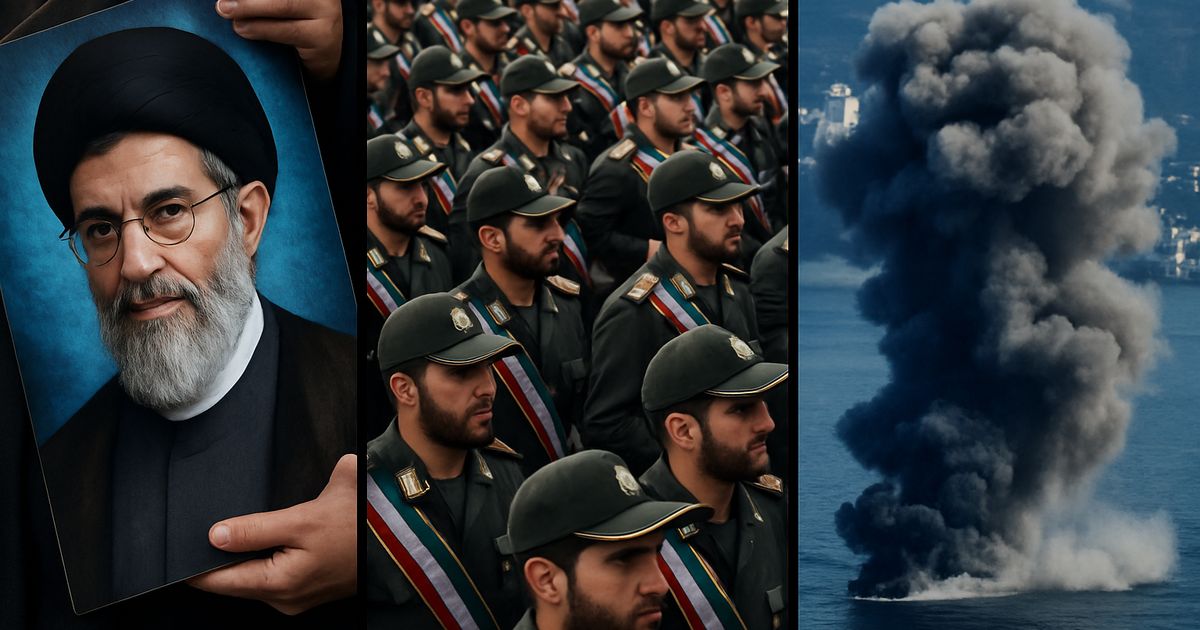
Iran's Calculated Escalation: A New Blueprint for Retaliation
The recent headlines from the Middle East paint a picture of a region on a knife's edge. A fire at the US embassy in Riyadh following a drone strike, coupled with a stark US State Department advisory urging all American citizens to leave the Middle East, signals a dangerous new phase in regional tensions. At the heart of this escalation lies a critical development: Iran's new retaliation strategy. This is not a spontaneous outburst of violence but a calculated, multi-domain approach designed to project power, deter adversaries, and reshape the rules of engagement without triggering a full-scale war. The strategy represents a significant evolution in Iran's asymmetric warfare playbook, moving beyond proxy attacks to a more direct, yet deliberately calibrated, form of state-on-state confrontation.
This new phase was catalyzed by the targeted killing of senior Iranian military officials, widely attributed to Israel, in Damascus. Iran's response was not the massive, immediate barrage some feared. Instead, it unfolded as a measured, multi-pronged campaign. The reported drone strike near Riyadh and the subsequent embassy fire, while details remain murky, fit a pattern of targeting symbolic US interests in allied capitals. Simultaneously, Iran's Islamic Revolutionary Guard Corps (IRGC) and its network of allied militias—from the Houthis in Yemen to Hezbollah in Lebanon and groups in Iraq and Syria—have demonstrated heightened readiness and coordination. This strategy leverages Iran's "forward defense" doctrine, where it seeks to keep conflict away from its borders by pressuring adversaries through a network of partners and direct actions across the region.

Deconstructing the Strategy: Tools and Tactics
Iran's new retaliation blueprint is characterized by several key pillars that distinguish it from previous confrontations. First is the integration of direct and proxy action. While Iran has long relied on its "Axis of Resistance," the new strategy involves more overt IRGC operations alongside proxy activities, creating a cloud of plausible deniability while sending an unambiguous message of capability. The use of drones and precision missiles, technologies in which Iran has invested heavily, allows for strikes with strategic impact from a distance, reducing the risk to Iranian personnel.
Second is the expansion of the geographic battlefield. Rather than confining responses to the immediate theater of conflict—such as Syria or the Israel-Lebanon border—the strategy now explicitly includes threats to US and allied interests across the Arabian Peninsula and the broader Gulf. The incidents in Riyadh underscore this widened aperture. Third is the exploitation of economic and logistical chokepoints. The persistent threat to shipping in the Red Sea and the Strait of Hormuz, demonstrated by Houthi attacks on commercial vessels, is a core component of this strategy, applying global economic pressure as a form of leverage.
Finally, the strategy employs psychological and diplomatic warfare. The US State Department's unprecedented blanket travel warning for the entire Middle East is a testament to the success of this tactic. By creating an atmosphere of pervasive, unpredictable threat, Iran forces its adversaries into a defensive, reactive posture, complicating military planning and straining international alliances. This multi-vector approach is designed to be exhausting, costly, and difficult to counter with conventional military responses.
The Regional Ripple Effect: Testing Safe Havens and Alliances
The implementation of this strategy sends shockwaves far beyond the immediate conflict zones, directly testing the foundations of regional stability and economics. A prime example is the intense pressure now placed on Dubai's long-cherished status as a neutral, secure business hub. As highlighted in related coverage, Dubai's safe-haven status is being put to the test. The emirate has thrived for decades as an oasis of calm and commerce amidst regional turmoil, attracting capital, talent, and corporate headquarters. Iran's strategy of widened conflict and threats to regional stability directly undermines this proposition.
Investors and expatriates, spooked by embassy incidents and government travel warnings, may begin to question the long-term security of assets and personnel in the Gulf. While Dubai itself is not a direct target, its prosperity is inextricably linked to the perception of stability in its neighborhood. A prolonged period of elevated threat, with incidents like the Riyadh embassy fire, chips away at that perception. This economic dimension adds a powerful, non-kinetic layer to Iran's strategy, indirectly pressuring Gulf Arab states, which host significant US military assets, to perhaps distance themselves from Washington's policies or advocate for de-escalation on terms favorable to Tehran.
Furthermore, the strategy strains the intricate web of regional alliances. It places US partners like Saudi Arabia and the UAE in a difficult bind: publicly standing with Washington while privately fearing the economic and security consequences of being caught in the crossfire. It also tests the cohesion of the Israeli-US alliance, probing for differences in their respective red lines and appetite for risk. The regional ripple effect, therefore, is not just about explosions and drone strikes; it is about confidence, capital flows, and the delicate political balancing acts of multiple states.
Historical Context: From the Tanker War to the Drone Age
To fully understand Iran's new retaliation strategy, one must view it as the latest iteration in a long history of asymmetric conflict. The 1980s "Tanker War" during the Iran-Iraq conflict saw attacks on commercial shipping in the Gulf, a tactic now modernized with drones and smarter missiles. The 1990s and 2000s were defined by the rise of Hezbollah and other proxy forces, establishing Iran's "forward defense" model. The 2010s saw the deployment of Iranian military advisors and resources to prop up the Assad regime in Syria, cementing a land bridge to the Mediterranean.
The new strategy synthesizes these historical elements with 21st-century technology and geopolitical shifts. The US withdrawal from the Iran nuclear deal (JCPOA), the assassination of IRGC Quds Force commander Qasem Soleimani in 2020, and the ongoing shadow war with Israel have created a context where traditional deterrence has eroded. Iran's development of a large domestic drone and missile arsenal, often supplied to its proxies, has given it a cheaper, more deniable, and more widely distributable tool of power projection than ever before. This technological leap allows it to execute the new strategy of widespread, persistent harassment.
Comparisons to Russia's "hybrid warfare" in Ukraine are apt, but with a distinct Middle Eastern flavor. Iran is a master of operating in the "gray zone"—the space between peace and declared war. Its new strategy is a refined gray zone playbook, aiming to achieve political and strategic objectives by accumulating tactical actions that, individually, may not warrant a major war, but collectively impose a heavy toll.
The Path Ahead: Escalation Ladders and Diplomatic Off-Ramps
Looking forward, the key question is whether this new strategy contains the conflict or inadvertently escalates it towards a major regional war. The immediate triggers to watch are miscalculation and misattribution. A drone strike that causes significant American, Israeli, or Gulf Arab casualties could force a leader into a disproportionate response they had sought to avoid. The crowded battlespace over Syria and Iraq, with US, Israeli, Iranian, and various militia aircraft and air defenses operating in proximity, is a particular flashpoint.
Another critical development will be the international community's response to the economic warfare component. If Houthi attacks in the Red Sea intensify or if Iran directly threatens Hormuz, it could trigger a more robust multinational naval coalition and stricter enforcement of sanctions, further cornering the Iranian economy. Domestically, Iran's leadership will be gauging the costs of its strategy. While it bolsters the revolutionary narrative of "resistance," a severe economic downturn or a devastating military counterstrike could fuel public discontent the regime can ill afford.
Diplomatically, the strategy may be intended to create leverage for future negotiations. By demonstrating the high cost of continued pressure, Iran may hope to bring the US and Europe back to the nuclear negotiating table on more favorable terms, or to secure guarantees against Israeli attacks on its nuclear program. However, the strategy also hardens adversarial positions, making diplomatic off-ramps harder to find. The coming months will be a test of crisis management, signaling, and the resilience of regional security architectures that have long been fraying.
Why It Matters
Most analysis of Iran's new retaliation strategy focuses on the military tit-for-tat and the immediate risk of war. While critical, this misses the deeper, more insidious victory Tehran may be seeking: the gradual, voluntary retreat of Western power and influence from the Middle East. The strategy is a form of sustained, low-grade attrition designed not to win a battle, but to win a war of endurance. Every travel warning that leads a multinational corporation to scale back its regional footprint, every insurance premium hike on Gulf shipping, and every hesitant diplomatic move by a US ally fearing economic blowback represents a strategic gain for Iran. It normalizes a higher level of risk and disorder, making the region less hospitable to the very presence—commercial and military—that has underpinned the US-led order since the 1990s.
This connects to a broader global pattern where middle powers are developing sophisticated asymmetric toolkits to challenge stronger adversaries. Iran's playbook—combining drones, proxies, cyber tools, and economic coercion—is being studied from Caracas to Pyongyang. It demonstrates how a technologically capable but conventionally weaker state can level the playing field and tie a superpower in knots. For readers, the crucial takeaway is to stop viewing each drone strike or militia attack as an isolated event. They are interconnected moves in a long-term campaign to rewrite the regional security rulebook. The real metric of success or failure will not be the body count from any single strike, but the trajectory of investment flows, alliance confidence, and the perceived costs of Western engagement over the next five years.