A Defining Victory in the Desert
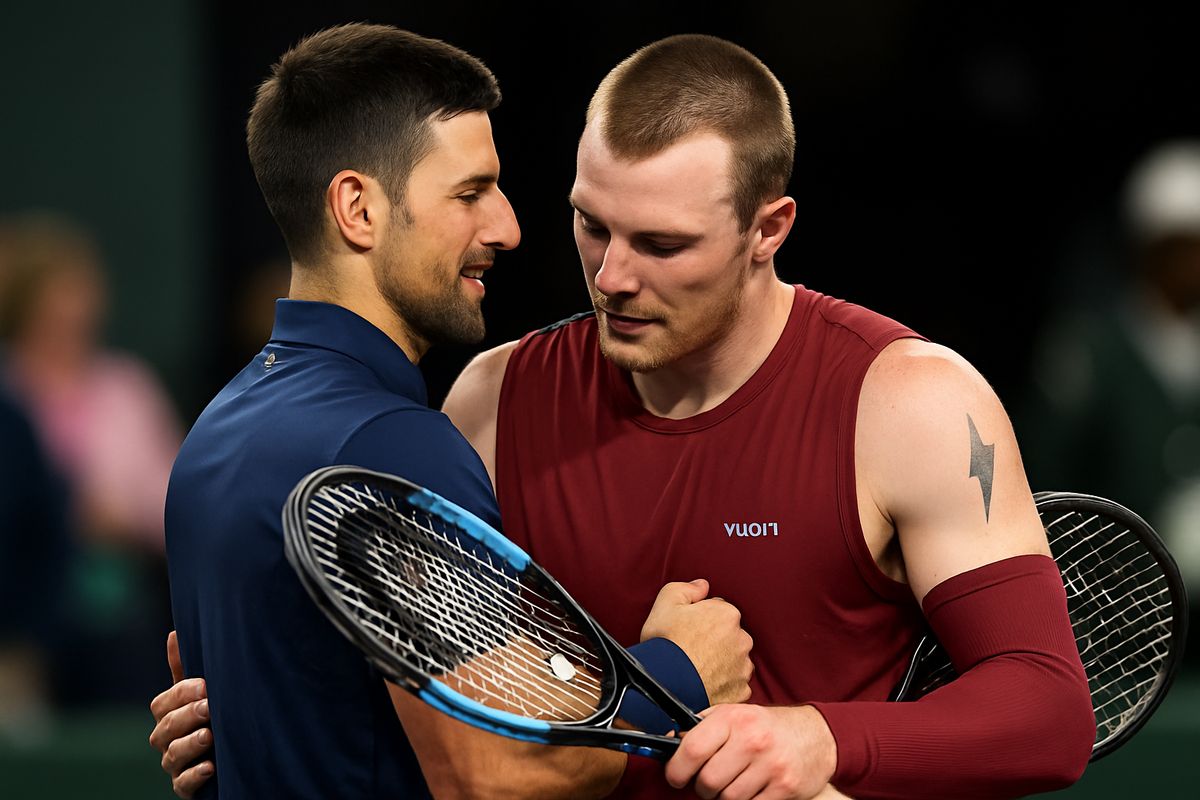
In a match that will be replayed in highlight reels for years, Britain's Jack Draper secured the most significant victory of his career, defeating the legendary Novak Djokovic 4-6, 6-4, 7-6(5) in a gripping last-16 encounter at the 2026 BNP Paribas Open in Indian Wells. The two-and-a-half-hour marathon, decided by a tense final-set tiebreak, was not just a tennis match; it was a symbolic passing of the torch, a statement of intent from a rising star, and a testament to the resilience of a player who spent eight months sidelined by injury. This victory keeps Draper's title defence on track and marks his first-ever win over the 24-time Grand Slam champion, a player he described as "the greatest tennis player of all time."
The narrative was rich with subplots. Draper, the defending champion, was playing only his second ATP Tour event since the previous summer, having battled a debilitating arm injury. Djokovic, at 38, was fighting to prove his enduring dominance against the sport's new generation. The match ebbed and flowed dramatically: Djokovic claimed a hard-fought first set, Draper battled back to level, and the decider saw both players pushed to their physical limits. Crucially, Draper held his nerve in the tiebreak, converting his first match point after Djokovic sent a backhand into the net, sealing a win that reverberated across the tennis world.
This result was the centrepiece of a remarkable week for British tennis at the prestigious "fifth major." Alongside Draper's heroics, Cameron Norrie scored a commanding straight-sets victory over world number six Alex de Minaur, and Sonay Kartal, the British women's number two, battled through a painful back injury to reach the last 16 with a stunning comeback win over former major champion Madison Keys. For a brief period, three Britons were flying high in the California desert, a collective success story that underscores a potential shift in the nation's tennis fortunes.

The Protagonists: Champion and Challenger
To understand the magnitude of Draper's win, one must examine the profiles of the two men on opposite sides of the net. Novak Djokovic needs little introduction. The Serbian icon, a five-time champion at Indian Wells, has spent over two decades redefining excellence in men's tennis. With a record 24 Grand Slam singles titles and countless weeks at world number one, his legacy as one of the sport's greatest—if not *the* greatest—is secure. At 38, his presence in the latter stages of a Masters 1000 event is a testament to his unparalleled physical conditioning and competitive ferocity. Facing him represents the ultimate litmus test for any aspiring champion.
Jack Draper's journey has been one of prodigious talent tempered by physical fragility. The 24-year-old left-hander from Sutton has long been earmarked as Britain's next major hope, possessing a powerful, aggressive game built around a thunderous serve and flat, penetrating groundstrokes. His breakthrough victory at Indian Wells in 2025 announced him as a genuine force on the ATP Tour. However, his career has been repeatedly interrupted by injuries, most recently an arm issue that forced an eight-month layoff after the 2025 US Open. His return to defend his biggest title, as he admitted to Sky Sports, was fraught with the challenge of playing "without pain" while searching for match sharpness. This context made his victory over Djokovic not just an athletic achievement, but a monumental mental triumph.
The British Contingent's Collective Charge
While Draper's win captured the headlines, the performances of his compatriots painted a picture of broader British strength. Cameron Norrie, the former world number eight and 2023 Indian Wells finalist, delivered a performance reminiscent of his peak. His 6-4, 6-4 dismantling of the speedy and consistent Alex de Minaur was a masterclass in controlled aggression and tactical discipline. As the 27th seed, Norrie outperformed his ranking, using his signature heavy forehand to dictate play and secure a place in the fourth round against Australian qualifier Rinky Hijikata.
On the women's side, Sonay Kartal's run was arguably the story of grit over glamour. The 24-year-old from Brighton, ranked outside the top 100, had already saved a match point to defeat the higher-ranked Emma Navarro. She then rallied from a set down to overcome the powerful Madison Keys, a former Australian Open finalist. Kartal's journey was conducted in visible pain, managing a persistent back injury that required on-court treatment. Her brave run ended in the fourth round when she was forced to retire against world number three Elena Rybakina, but not before she had proven her capability to compete with the very best. "It's a match like today which shows the fighter in me," Kartal told the BBC.
Historical Context and the Weight of the Moment
Draper's victory must be framed within the historical rivalry—or lack thereof—between the two players. Their only previous meeting came on one of tennis's grandest stages: the Centre Court of Wimbledon in 2021. On that day, a teenage Draper, ranked outside the top 250 and playing on a wildcard, stunned the tennis world by taking the first set off the defending champion Djokovic. Although he ultimately lost in four sets, he announced his potential to a global audience. Fast forward nearly five years, and the dynamic had shifted profoundly. Draper was no longer the wide-eyed debutant but a reigning Masters 1000 champion, albeit one on a precarious comeback trail.
Indian Wells itself holds a unique place in the tennis calendar. Often called the "fifth Grand Slam" due to its size, prestige, and demanding conditions, winning here is a career-defining accomplishment. The slow, gritty hard courts reward patience, physicality, and tactical nuance. For Draper to defend his title here, against the sport's ultimate benchmark so soon after returning, adds multiple layers of significance to the win. It echoes past moments where future champions announced themselves by slaying giants, much like a young Roger Federer defeating Pete Sampras at Wimbledon in 2001.
Why It Matters: Beyond a Single Match Result
This victory matters because it represents a potential inflection point in the men's game. For years, the "Big Three"—Djokovic, Rafael Nadal, and Roger Federer—have been the immovable objects against which the next generation measured itself. While Carlos Alcaraz and Jannik Sinner have already broken through to claim major titles, the psychological barrier of defeating Djokovic in a high-stakes, tight match remains formidable. Draper didn't just beat an ageing champion; he outlasted and out-clutched Djokovic in a final-set tiebreak, a scenario where the Serb's mental fortitude is legendary. This does more than earn Draper 90 ranking points; it injects an entire cohort of players with the belief that Djokovic, while still phenomenal, is now beatable in the biggest moments on the biggest stages.
Furthermore, the collective success of Draper, Norrie, and Kartal signals a vital depth in British tennis that has often been lacking. For too long, British hopes rested on a single individual—first Tim Henman, then Andy Murray. The current landscape is different. With Draper as a potential top-10 mainstay, Norrie as a consistent tour-level threat, and emerging talents like Kartal demonstrating major-tournament mentality, British tennis is building a sustainable system, not relying on a solitary superstar. This multi-pronged challenge is essential for maintaining a high-performance culture and ensures the nation remains relevant in both team competitions like the Davis Cup and across the tour's biggest events.
Finally, Draper's win is a powerful narrative of resilience. In an era where athletic careers are increasingly prolonged through advanced science, the story of a young player overcoming a potentially career-altering injury to return and immediately scale the summit again is profoundly inspiring. It sends a message about the importance of patience, intelligent rehabilitation, and self-belief. For aspiring athletes everywhere, Draper's journey from the treatment table to defeating Novak Djokovic in the California desert is a textbook example of how to navigate the inevitable setbacks of a professional sporting career.
The Road Ahead and Lasting Implications
The immediate consequence of Draper's win is a continued title defence and a surge in confidence that money cannot buy. However, the true test will be consistency. Can he back up this monumental effort physically and emotionally in the subsequent rounds? Can he translate this desert triumph into sustained success on clay and grass? For Djokovic, the questions are of a different nature. Does this loss signal the beginning of a more predictable decline, or is it merely a blip in another season where he will contend for majors? At 38, every loss to a younger player will be scrutinised for evidence of a changing guard.
For the broader ATP Tour, Draper's victory adds another compelling contender to an already fascinating landscape. With Alcaraz and Sinner establishing a rivalry, and now Draper re-announcing himself with a signature win, the post-"Big Three" era is becoming richer and more competitive. It promises a future where multiple players have the weapons and the belief to win the biggest titles, a scenario that is ultimately healthier and more exciting for the sport than a prolonged period of dominance by one or two individuals.
In conclusion, Jack Draper's victory over Novak Djokovic at the 2026 Indian Wells Masters was more than a fourth-round match result. It was a confluence of personal redemption, generational challenge, and national sporting pride. It demonstrated that the future of men's tennis is in capable and exciting hands, while simultaneously paying tribute to the enduring greatness of its present king. As the dust settles in the Coachella Valley, one thing is clear: a new chapter in British tennis, and perhaps in the global tennis hierarchy, has just been compellingly written.