A City of Stone and Silence: Jerusalem's Tense Wait
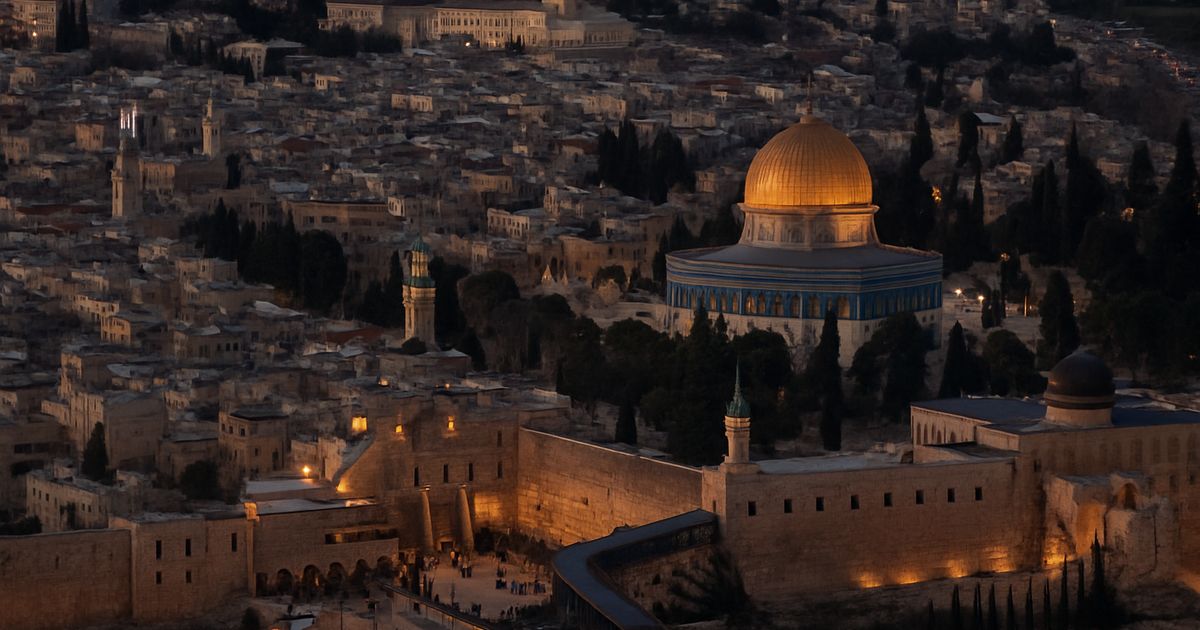
In the shadow of the Church of the Holy Sepulchre, one of Christianity's holiest sites, Mohammed Liftawi sits in his shop surrounded by unsold souvenirs. The ancient, winding streets of Jerusalem's Old City, typically thronged with pilgrims and tourists, are unnervingly quiet. "Jerusalem is very empty," he tells Sky News correspondent Adam Parsons, waving an arm at the deserted lane. "We have no tourists, we have nothing. They have fled because of the war." This palpable tension, captured in late February 2026, is the immediate reality for Jerusalem's residents as the specter of a major regional war between the United States and Iran looms large. The city, a sacred nexus for three major religions, finds itself holding its breath, its economy stalling and its populace divided between fear, fatalism, and fervent support for military action.
The source material paints a vivid picture of a community bracing for impact. After surviving the economic devastation of the COVID-19 pandemic, shopkeepers like Liftawi now face a second catastrophic slowdown driven by geopolitical fear. The report underscores a universal dread of conflict—"nobody likes war"—but also reveals starkly divergent attitudes about its necessity. This on-the-ground dispatch from the Old City, just a short walk from the Jaffa Gate, serves as a critical human barometer for the high-stakes diplomatic and military maneuvering occurring in capitals thousands of miles away. The quiet is not peaceful; it is the quiet of apprehension.

Voices from the Old City: Fear, Fatalism, and Fury
The Sky News report provides a microcosm of Israeli society through a handful of interviews, revealing a complex spectrum of opinion far removed from the monolithic portrayals often seen in international coverage. For 67-year-old Khalil Al-daqaq, whose family has run a shop near the Holy Sepulchre for decades, the mood is one of weary uncertainty. "It's tense here. Unexpectedly. We don't know what's going to happen in the coming days. Or the next hour," he says. His perspective is one of seasoned resilience, having witnessed decades of conflict. "Some people are really scared, but you know - what will happen, will happen." His critique is pointed: "What we are missing over here are logical, sensible guys. For the leaders… we're just numbers to them."
In stark contrast stands Moshe Cohen, 23, encountered at Jaffa Gate. He smiles as he expresses a desire for war to begin "in a few days." His rationale is direct: Iran, he believes, is the financial and ideological head of the snake supporting groups like Hamas in Gaza. "You have to take off the head and make the world a better place," he argues. When asked if Israel should act alone if the US hesitates, he and his friend Bezalel agree without doubt: "Yes we should." This hawkish stance is complemented by the spiritual fatalism of Yaakov Simcha, a 21-year-old Torah student from New Jersey, who says, "I believe in God, and I believe that whatever he wants to happen is going to happen… I'm just going to sit back and continue my studies." These three voices—the pragmatic merchant, the ideological nationalist, and the devout fatalist—encapsulate the psychological landscape of a nation on the brink.
The Spark and the Tinderbox: The Reported Strike on Khamenei
The pervasive tension in Jerusalem did not emerge in a vacuum. It is directly fueled by seismic events reported in related headlines, most notably the claim from an Israeli official that Supreme Leader Ayatollah Ali Khamenei was killed in an Israeli airstrike. While the source material provided does not include detailed reporting on this event, its incorporation as a related headline is crucial context. Such an event, if confirmed, would represent an unprecedented escalation, a direct decapitation strike on the highest authority of the Islamic Republic. Iran's leadership is built around the institution of the Supreme Leader; an attack of this magnitude would not be a proportional retaliation but a potentially regime-threatening act.
Historically, the Israeli-Iranian shadow war has been conducted through proxies, cyber-attacks, and strikes on Iranian assets in third countries like Syria. A move to directly target the Supreme Leader on Iranian soil would shatter all existing norms and red lines. It would almost certainly compel a massive and direct Iranian military response, potentially triggering the very US-Iran war that Jerusalem fears. This reported action connects directly to the sentiments expressed by Moshe Cohen—the desire to "take off the head"—and explains the depth of Khalil Al-daqaq's anxiety. It transforms the geopolitical tension from a theoretical crisis into a tangible, immediate trigger with catastrophic potential for regional war.
Historical Context: The Unending Cycle of Brinkmanship
The current crisis sits atop decades of entrenched hostility. The US-Iran adversarial relationship has been a constant since the 1979 Islamic Revolution, cycling through periods of intense pressure and fleeting diplomacy. The Israeli-Iranian relationship, once cordial under the Shah, has been one of existential threat and covert conflict since the revolution. Key flashpoints include Iran's nuclear program, its support for Hezbollah in Lebanon and Shia militias across the region, and its rhetorical commitment to Israel's destruction. Previous moments of extreme tension, such as after the US assassination of Qasem Soleimani in 2020 or during the negotiations over the Joint Comprehensive Plan of Action (JCPOA), provide a blueprint for how crises can escalate—or be narrowly contained.
For Jerusalem itself, this state of suspended anxiety is tragically familiar. The city has been a focal point of conflict for millennia, and in the modern era, its residents have endured wars, intifadas, and sporadic violence. The quiet streets Mohammed Liftawi laments recall other periods when tourism evaporated due to security concerns. However, the prospect of a full-scale war between major state actors like the US and Iran, possibly triggered by an attack of the magnitude reported against Khamenei, represents a qualitative shift. It is not a localized Israeli-Palestinian conflict or a limited exchange with Hezbollah, but a potential regional conflagration that could draw in multiple state militaries and fundamentally reshape the Middle Eastern order. The fatalism expressed by residents is born from this long history of conflict and the understanding that their city is often ground zero.
Why It Matters
Most coverage of escalating Middle East tensions focuses on the macro-geopolitics: troop movements, diplomatic statements, and the potential impact on global oil markets. The critical perspective missing is how this perpetual state of "brinkmanship-as-normal" corrodes the social and economic fabric of everyday life in the region's heart. The story from Jerusalem's Old City is not just about war anxiety; it's about the death of normalcy. For shopkeepers like Liftawi and Al-daqaq, the cycle of crisis means their livelihoods are perpetually hostage to decisions made in Washington, Tel Aviv, and Tehran. This creates a generation of entrepreneurs and citizens for whom long-term planning is a fantasy, entrenching economic fragility and deepening societal pessimism. The real casualty, before a single missile is fired, is the very possibility of a stable, prosperous civil society.
Furthermore, this dynamic empowers extremists and marginalizes moderates on all sides. When the public discourse, as seen with Moshe Cohen, begins to accept—or even welcome—cataclysmic war as a necessary solution, the space for diplomacy and de-escalation vanishes. Leaders are incentivized to adopt more hawkish postures, knowing a portion of their base is primed for confrontation. Conversely, the fatalism of "God's plan" or "what will happen, will happen" leads to political disengagement, ceding the field to those eager for conflict. Readers should understand that the quiet streets of Jerusalem are a canary in the coal mine. They signal not just fear of an imminent explosion, but the slow, suffocating acceptance that life in one of humanity's most historic and spiritually significant cities is permanently defined by the threat of annihilation. The story matters because it shows that the road to war is paved with the eroded resilience of ordinary people.
What to Watch For Going Forward
The immediate trigger point will be Iran's official response to the reported strike on Khamenei. A confirmed death would necessitate a reaction of historic scale from Tehran. The world must watch for whether that response is a direct military strike on Israeli or US assets, a massive proxy barrage, or a strategic move like accelerating nuclear breakout—and how Washington and Jerusalem then counter-respond. The statements and military preparedness of regional actors like Saudi Arabia, the UAE, and Hezbollah will be crucial indicators of whether the conflict remains bilateral or rapidly multilateral.
Within Israel, public sentiment will be a key factor. The related headline "How Israelis Feel About Another Potential War With Iran" suggests this is a live issue. Will the initial support for decisive action, as voiced by Cohen, hold if Israeli cities face sustained missile barrages? Or will a war-weary public, mindful of the economic cost and human toll, pressure the government for a swift conclusion? Finally, observe the streets of Jerusalem itself. The return of tourists will be the clearest signal that immediate danger has passed. Conversely, a prolonged emptiness will indicate that the region has settled into a new, even more dangerous phase of cold war, where the next spark is never far away. The hope expressed by Khalil Al-daqaq—"When it is calm and peaceful, they will return"—hangs in the balance, dependent on decisions made far from the ancient stones of his shop.