The Shot That Defined a Golfer: Daly's Infamous 18 at Bay Hill
In the annals of professional golf, few single-hole performances are as legendary, or as cautionary, as John Daly's 18 on the par-five sixth hole at Bay Hill during the 1998 Arnold Palmer Invitational. This was not a mere bad hole; it was a spectacular, public unraveling that has become a permanent fixture in golf's blooper reel and a defining moment in the career of one of the sport's most volatile and popular figures. The event resurfaced in public discourse in March 2026, as news coverage contrasted Daly's historic collapse with Bryson DeChambeau's successful navigation of the same daunting challenge 23 years later, highlighting the evolution of power golf and the fine line between aggressive genius and catastrophic failure.
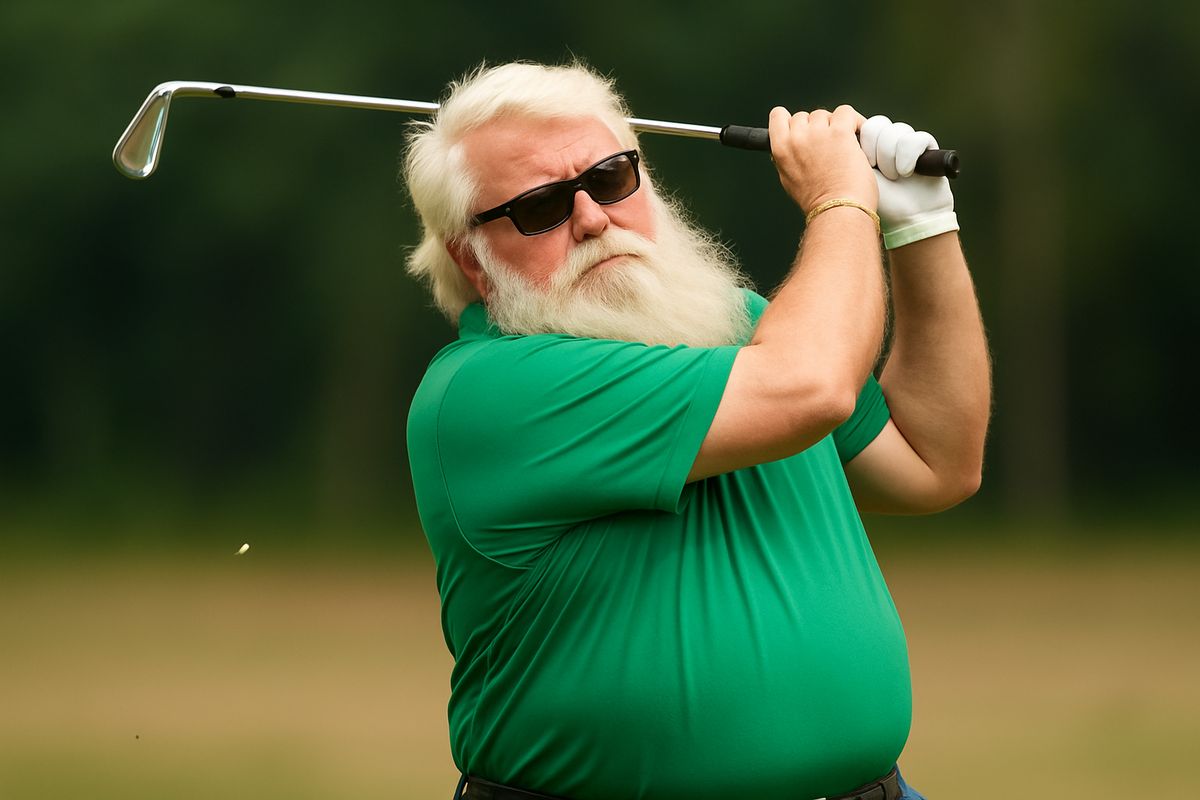
The scene was the sixth hole at the Bay Hill Club and Lodge, a hole that curves aggressively around a massive lake, daring long hitters to cut the corner. On that Sunday in 1998, Daly, synonymous with a "grip-it-and-rip-it" philosophy, decided to take the most direct, aggressive line over the water. What followed was a repetitive, almost tragicomic cycle of splash after splash. According to reports, Daly hit his first drive into the water. Rather than opting for a conservative lay-up with his next shot, he continued to attempt the heroic carry, sending five more balls into the same hazard. He did not see a blade of grass until his 11th stroke. His 13th shot found the water again, hit a rock, and ended up in a greenside bunker. After escaping the bunker, he two-putted for a staggering score of 18—a number more familiar on an American football scoreboard than a professional golf card.
Daly's own post-round reflection was characteristically candid. "It wasn't that I didn't care, but I guess after 32 holes I lost my patience," he admitted. He attributed the disaster to a fatal imbalance of traits: "I had the courage to keep going for it, but I didn't have the wisdom to bail out right." He described a golfer's nightmare feedback loop, where each failed attempt led to an overcompensation that made the next shot worse. "I kept aiming farther and farther right, but the more right I aimed, the more I hooked it left." This moment encapsulates the John Daly paradox: breathtaking power and crowd-pleasing audacity, perpetually at war with a lack of strategic restraint.

Bryson DeChambeau's Contrasting Conquest of the Same Hole
Fast forward to the 2021 Arnold Palmer Invitational, where the sixth hole at Bay Hill presented the same intimidating challenge. This time, it was Bryson DeChambeau, the modern era's premier golfing scientist and power hitter, standing on the tee. The context, however, was different. DeChambeau, having bulked up dramatically, was in the midst of redefining the limits of driving distance. The crowd's expectation for him to attempt the heroic carry over the lake was palpable.
DeChambeau successfully threaded the needle. He drove the ball perfectly, finding the fairway in a single shot, a feat that drew massive cheers from the gallery. He went on to record birdies on the sixth hole in three of the four rounds that tournament, a stark contrast to Daly's double-digit disaster. DeChambeau's technical post-round analysis highlighted the modern, data-driven approach to such risks. He discussed wind conditions, spin rates (contrasting a driver with "3,000 spin" versus his normal "2,000 spin"), and clubhead weight, explaining why he could or could not attempt the shot on a given day. "There was a high expectation level of me trying to go for the green there and it was a little pressure that I wasn't expecting," he said, acknowledging the spectacle. His success was a triumph of calculated aggression, a formula that would help him win the tournament at 11-under par.
The 2026 news cycle juxtaposed these two moments not just as a simple "failure vs. success" story, but as a lens through which to view the current fractured state of professional golf. As the articles noted, the 2026 Arnold Palmer Invitational, a PGA Tour signature event with a $20 million purse, featured neither Daly (a PGA Tour Champions player and fan attraction) nor DeChambeau (who joined the Saudi-backed LIV Golf circuit in 2022). The comparison became a nostalgic point of discussion, linking two eras of power golf separated by organizational schism.
Profiles in Power: The Men Behind the Moments
John Daly: The Unfiltered Original
John Daly burst onto the golf scene in 1991 by winning the PGA Championship as the ninth alternate, a true Cinderella story. His prodigious length off the tee and "everyman" persona made him an instant fan favorite. However, his career has been a rollercoaster of major championship wins (including the 1995 Open Championship), personal struggles, fines, and suspensions. Daly's appeal has always been his raw, unfiltered, and aggressive style. He plays with a volatility that fans find relatable and thrilling, even when it leads to disaster, as it did at Bay Hill. His 18 is not seen as a mark of shame by his supporters, but as an emblem of his never-lay-up ethos.
Bryson DeChambeau: The Scientist of Swing
Bryson DeChambeau represents the next evolution of the power player. A physics major, he approaches golf as an engineering problem, with single-length irons, detailed analytics, and a relentless pursuit of optimization. His dramatic physical transformation to add muscle and swing speed was a deliberate strategy to maximize distance, fundamentally changing how he—and many who followed—attacked golf courses. Where Daly's power was natural and instinctual, DeChambeau's is manufactured and systematic. His successful carry at Bay Hill in 2021 was a validation of his method, proving that immense power, when meticulously calibrated, could conquer risks that had ruined others.
Historical Context: Golf's Highest Scores on Record
While Daly's 18 is infamous, it does not hold the official record for the highest score on a single hole in PGA Tour history. That dubious honor is a 19, shared by three players: Ray Ainsley at the 1938 U.S. Open, Hans Merrell at the 1959 Bing Crosby Pro-Am, and Dale Douglass at the 1963 Bing Crosby Pro-Am. Ainsley's 19 is particularly legendary; at Cherry Hills, his ball landed in a creek, and under a misunderstanding of the rules at the time, he believed he had to play it as it lay. He spent nearly half an hour swatting at the submerged ball as the current carried it downstream, tallying stroke after stroke.
More recently, in a twist of fate, John Daly managed to outdo his own Bay Hill catastrophe by carding a 19 during a PGA Tour Champions event at the Sanford International in September 2025. The unofficial record, however, belongs to World Golf Hall of Famer Tommy Armour, who reportedly scored a 23 on a par-five during the 1927 Shawnee Open, though conflicting reports prevent its official recognition. Daly's 18 sits firmly within this strange pantheon of golfing nightmares, a testament to how quickly a round can spiral into the surreal when hazard, obstinacy, and misfortune collide.
The Evolution of Risk and Reward in Modern Golf
The juxtaposition of Daly's 1998 meltdown and DeChambeau's 2021 success illustrates a significant shift in professional golf's relationship with risk. In Daly's era, the aggressive line over a hazard like Bay Hill's lake was a high-variance gamble, heavily dependent on perfect execution and a bit of luck. There was less analytical framework to determine the precise percentage chance of success; it was often a gut decision. Daly's failure was a worst-case scenario of that approach.
DeChambeau's era, fueled by advanced tracking technology (like TrackMan), detailed course mapping, and ball flight analytics, allows players to quantify risk. A player can know with remarkable precision their carry distance, dispersion pattern, and the exact wind effect. The decision to go for a heroic carry is less a dare and more a calculated equation: if the data says a well-struck drive has an 80% chance of clearing the water and gaining a significant strategic advantage, the play is justified. DeChambeau's comments about spin rates and wind conditions are a window into this data-driven mindset. His success represents the maturation of power golf from raw aggression to optimized aggression.
Why It Matters
Beyond the simple schadenfreude of a superstar's collapse or the awe of a monster drive, the legacy of Daly's 18 and its contrast with DeChambeau's success speaks to fundamental tensions in sports and human endeavor. It is a case study in the psychology of perseverance versus the wisdom of adaptation. Daly's repeated attempts to force the same failing solution—hitting driver over the water—is a classic example of the sunk cost fallacy in real time, a spectacle of a brilliant mind trapped by its own identity. For the average golfer or anyone facing a repeated failure, the lesson isn't simply "lay up." It's the importance of having the strategic flexibility to disengage from a failing plan, even when your entire persona is built on a specific, aggressive approach.
Furthermore, this story highlights how narrative shapes legacy in sports. Daly's 18, while a competitive disaster, ultimately reinforced his brand as the ultimate anti-establishment, high-wire act. It made him more human, more relatable, and in a strange way, more beloved. It is a moment fans remember more vividly than many of his tournament wins. For DeChambeau, the successful carry was a data point that validated his controversial and all-consuming methodology. It was proof of concept. This dichotomy shows that in the modern media landscape, a singular moment of extreme outcome—whether triumph or catastrophe—can define a player's public image as powerfully as a season-long body of work.
Finally, the 2026 news framing of this old story underscores how golf's current civil war between the PGA Tour and LIV Golf has fragmented the sport's history and narratives. The authors explicitly note that in the 2026 tournament, neither protagonist is present, one due to age and the other due to affiliation. The story thus becomes a nostalgic bridge, using a shared landmark (the 6th hole at Bay Hill) to connect eras and players who now operate in parallel, competing universes. It reminds us that the stadiums and challenges remain, even as the players and leagues around them change.
What to Watch For Going Forward
The story of Bay Hill's sixth hole is far from over. As equipment technology continues to advance and athletes become ever more optimized, the risk-reward calculus will keep shifting. Future players, perhaps with even more speed and better data, will continue to test the limits of this and similar holes. The question will evolve from "Can they carry it?" to "Is carrying it the statistically optimal play every day?" The ghost of Daly's 18 will always serve as the visceral reminder of the downside.
Observe how course architects respond. The ongoing distance debate in golf may lead to more strategic modifications of classic risk-reward holes like Bay Hill's 6th, perhaps by tightening landing areas or shifting tee boxes to bring hazards back into play for the longest hitters. The hole itself may need to evolve to maintain its intended challenge.
For fans, watch for how such moments are contextualized. Will the next golfer to card a 12 or higher on a professional hole be met with ridicule or a strange kind of reverence, as Daly's meltdown has been? And in an era of fractured tours, pay attention to how historical comparisons are drawn. Stories like this one, which connect stars across generations and now across leagues, will become increasingly important cultural touchstones to maintain a sense of continuity in the sport's history, reminding fans that the game, in its essence, remains a brutal and beautiful test of skill, nerve, and decision-making against a relentless landscape.