The Blender Starts, But the Shots Don't Fly
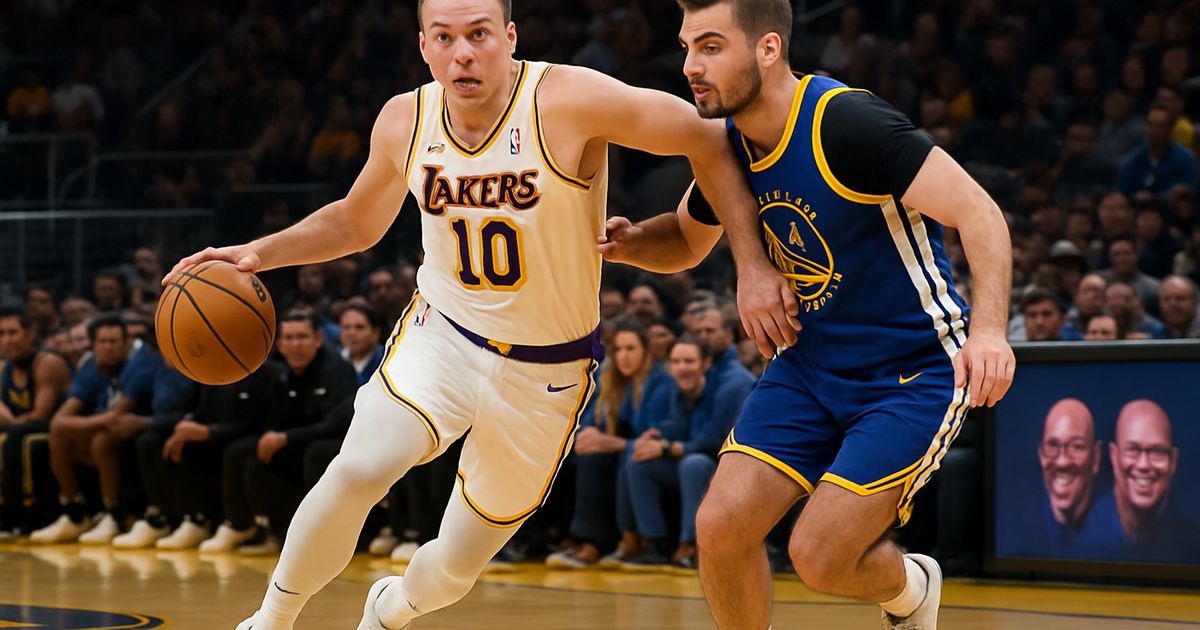
In the aftermath of a quiet 2026 NBA trade deadline, the Los Angeles Lakers' sole acquisition, veteran guard Luke Kennard, has become a focal point of fascination and frustration. Head coach JJ Redick, himself a former elite shooter, has publicly lauded Kennard for his ability to "start the blender" for the Lakers' offense—creating chaotic closeouts and making intelligent reads that benefit the entire team. This praise followed a blowout win against the Golden State Warriors where Kennard's connective play was highlighted. Yet, simultaneously, a painful realization is dawning in Los Angeles, one that Detroit Pistons fans know all too well: for a player renowned as one of the league's most efficient three-point specialists, Luke Kennard simply does not shoot the ball enough.
This paradox defines Kennard's early tenure with the Lakers. On one hand, his impact is palpable in the offensive flow. On the other, his statistical output reveals a startling hesitancy. Since his debut, where he shot 2-of-4 from deep for 10 points, his volume has plummeted. In a narrow 110-109 loss to the Orlando Magic, Kennard played 15 minutes, scored nine points, and did not attempt a single three-pointer. For the season, he is shooting a blistering 49.1% from three-point range, a figure that leads the league, but he is averaging a mere 2.3 attempts per game with the Lakers. The disconnect between his elite skill and his reluctance to deploy it has become the central narrative of his fit in Hollywood.

From Detroit to LA: A Career-Defining Tendency
To understand the Lakers' current dilemma, one must look back to Kennard's origins with the Detroit Pistons, who selected him 12th overall in the 2017 NBA Draft. In Detroit, Kennard developed a reputation as a smooth, high-IQ player with a picture-perfect jumper. However, even in his best statistical season with the Pistons—his final year, where he shot 39.9% on 6.5 attempts per game—the sample size was limited to just 28 games. The desire for him to be more assertive was a constant refrain from the Detroit fanbase and media.
Kennard's career has been a journey of elite efficiency paired with perplexing passivity. His two other seasons averaging at least six three-point attempts per game came in 2021-22 (6.0 attempts in 70 games) and 2023-24 (6.1 attempts in 39 games), demonstrating he is capable of higher volume in the right system and with the right mindset. Upon arriving in Los Angeles, Kennard himself acknowledged the need for aggression, telling reporters, "I feel like I know the game of basketball very well, and I will shoot it. I will be aggressive. I know that’s what they want me to do." The early returns, however, suggest old habits are hard to break, and the Lakers are now confronting the same challenge that once plagued his tenure in Detroit.
Redick's Vision vs. On-Court Reality
First-year Lakers coach JJ Redick's perspective on Kennard is nuanced and reveals a coach seeing beyond the box score. Redick, whose playing career was built on movement shooting and high basketball IQ, values Kennard for more than just catch-and-shoot prowess. In his post-game comments, Redick emphasized Kennard's "we score" mentality and his cerebral approach to the game. He illustrated this with a specific play: after calling an ATO (After Timeout play) for Kennard, who scored, they ran it again. Kennard recognized the defense adjusting, screened his own man, and created a layup for a teammate.
"That’s just connective offense right there and that’s what Luke does," Redick stated. This analysis points to Kennard being a premium offensive connector—a player who makes the system work better through intelligent decisions, spacing, and unselfishness. For a Lakers bench unit that ranks 29th in the league in production, this skillset is undeniably valuable. The core question, however, is whether "connective offense" is enough for a team that acquired him specifically to space the floor for stars like Luka Dončić, LeBron James, and Austin Reaves. Can a player be too unselfish? The Lakers' need for him to be a scoring threat, not just a playmaking conduit, creates a tension between Redick's appreciation for his style and the team's glaring need for perimeter shooting volume.
The Luka Dončić Factor
A critical subplot in this saga is the relationship between Kennard and superstar Luka Dončić. On paper, Kennard is a dream fit alongside Dončić—a knockdown shooter who can capitalize on the defensive attention drawn by the Slovenian maestro. The source material notes that Dončić, despite having played only a handful of games with Kennard, already has "high confidence" in him. This chemistry is crucial. Dončić's wizardry with the ball demands teammates who are ready to fire without a second thought. Kennard's historical efficiency suggests he should thrive in this role, but his instinct to make the "right" extra pass could sometimes run counter to the "best" shot, which might be his own open look.
A Historical Comparison: The Specialist's Dilemma
Luke Kennard's situation is not entirely unique in NBA history. He belongs to a category of players whose supreme skill is so refined that it sometimes becomes a cage. Players like Steve Kerr or Detlef Schrempf were historically efficient shooters who often deferred to teammates, though their roles were more clearly defined. A more direct comparison might be to a player like Wally Szczerbiak—an All-Star caliber shooter who could dominate a game with his scoring but was often criticized for not seeking his shot enough within team structures.
In the modern analytics-driven NBA, where three-point volume is prized almost as highly as efficiency, Kennard's profile is an outlier. Teams actively seek players who will launch 8-10 threes per game at a 37-38% clip. Kennard provides elite efficiency but at a fraction of the expected volume. This makes him a challenging player to value and scheme for. Is a player who makes 1.1 of 2.3 attempts (48%) more valuable than one who makes 2.8 of 8.0 attempts (35%)? The answer depends heavily on context, roster construction, and offensive philosophy. For the Lakers, who lack volume shooters, they need Kennard to morph into the latter, even if it means his pristine percentage dips.
The Front Office Calculus: Short-Term Fix or Long-Term Piece?
Lakers General Manager Rob Pelinka's decision to acquire Kennard was framed by discipline. As reported, Pelinka was "aggressive in his pursuit of win-now deals" but opted to "stay disciplined to keep future flexibility." Kennard, on an expiring contract, was a low-risk, potentially high-reward move that didn't mortgage the future. The early returns have justified the trade's boldness in flashes, showcasing his fit, but they have also complicated the long-term decision.
If Kennard continues to be a high-IQ connector who shoots sparingly, does he merit a new contract in a crowded Lakers financial picture? His skill set is rare, but his application of his best skill is inconsistent. The evaluation period is not just about how many points he scores, but about whether he can overcome a deep-seated psychological barrier to become the volume spacer the Lakers' star-centric offense desperately requires. The front office must decide if this is a correctable flaw or an intrinsic part of his basketball DNA.
Why It Matters
The Luke Kennard experience in Los Angeles transcends a simple player evaluation. It serves as a compelling case study in the conflict between process and results, between basketball purity and pragmatic necessity. Most coverage focuses on the binary: he needs to shoot more. The wider implication is what this reveals about player development and role acceptance in the NBA. Kennard is, by all accounts, a brilliant basketball mind who sees the game a step ahead. His desire to make the "right play" is a virtue, but in an ecosystem built around stars, the right play for a role player is often to capitalize on the advantages those stars create by being a direct scoring threat.
This connects to a broader pattern of highly skilled specialists who struggle with assertiveness. It challenges coaching staffs to reprogram instincts honed over a lifetime. For readers and fans, the Kennard saga should prompt a shift in how we evaluate role players. It's not enough to look at a percentage in a vacuum; intent and volume are inseparable from efficiency. A player's value is dictated not just by what they can do, but by their willingness to do it repeatedly within the flow of the game. The lesser-known angle here is that Kennard's passivity might actually be a byproduct of his greatest strength—his court vision. He sees the open man so clearly that he sometimes overlooks the open shot, which, for a shooter of his caliber, is the most open man of all.
What to Watch For Next
The remainder of the Lakers' season will be a live laboratory for the Luke Kennard paradox. The primary indicator will be his three-point attempt rate. Watch for games where he takes five or more threes; that will signal a shift in mentality, likely spurred by direct instruction from Redick. As a former shooter, Redick is uniquely positioned to get inside Kennard's head and give him the green light—not just permission, but a mandate—to let it fly.
Secondly, monitor his chemistry with Luka Dončić in clutch moments. Will Dončić, in need of a bail-out option, look for Kennard in the corner with confidence? Will Kennard catch-and-shoot in one motion, or will he hesitate, pump-fake, and drive? These micro-moments will define his playoff utility. Finally, watch the contract rumors. Kennard's market value will be a direct reflection of how the league interprets his Lakers tenure. Will teams see a flawed specialist or a premium offensive connector whose shooting is a bonus? The answer will determine not only his future in Los Angeles but the ultimate legacy of a player whose talent has never been in question, only his willingness to fully wield it.