The Stalled Quarterback Carousel: Mac Jones' Uncertain Future
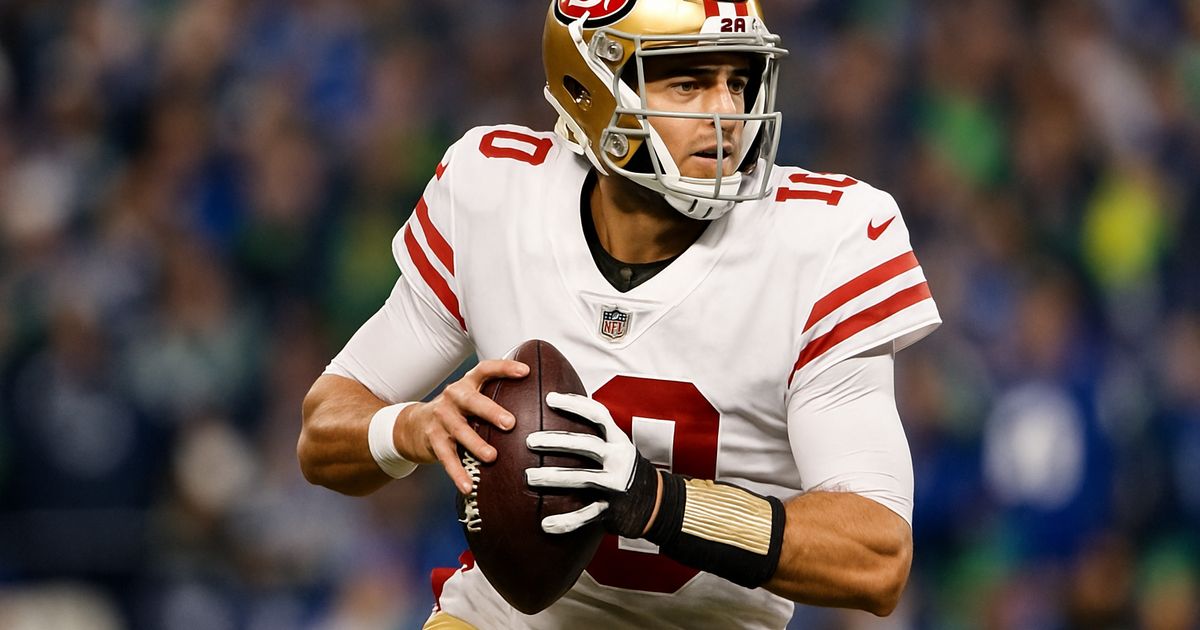
As the NFL's annual quarterback shuffle begins in earnest, one notable name remains conspicuously absent from the trade and free agency chatter: Mac Jones. According to a report from The Athletic, cited by NBC Sports, no market has yet emerged for the San Francisco 49ers' backup quarterback. This development comes despite widespread speculation that the 49ers, who signed Jones to a two-year deal last offseason, might be willing to trade him for the right price. The team maintains they don't want to trade him, but league observers widely interpret this as posturing. With Jones due a modest $3.25 million in 2026 and the 49ers holding full control over his rights, the situation presents a complex puzzle for both the player and potential suitors.
The core of the issue, as outlined in the source material, is timing and economics. The current NFL landscape is flooded with available quarterback options through free agency and impending roster cuts. Teams with quarterback needs are logically prioritizing players who can be acquired without surrendering draft capital. Trading for Jones would require giving up at least a draft pick to the 49ers, whereas signing a free agent costs only money. Furthermore, any team acquiring Jones with the intention of making him a starter or a competitor for the job would likely need to renegotiate his current backup-level salary, adding another financial and logistical layer to a potential deal. This confluence of factors has created a standstill, leaving the 2021 first-round pick in professional limbo as the league's quarterback carousel begins to spin.

From Pro Bowl Promise to Backup Role: The Mac Jones Trajectory
To understand the significance of Jones' current market stagnation, one must examine his rapid rise and equally swift decline. Selected 15th overall by the New England Patriots in the 2021 NFL Draft, Jones immediately became the heir apparent to Tom Brady's legacy in Foxborough. His rookie season was a revelation: he started 17 games, completed 67.6% of his passes for 3,801 yards, 22 touchdowns, and 13 interceptions, leading the Patriots to a 10-7 record and a playoff berth. His efficient, poised play earned him a Pro Bowl selection and widespread acclaim as the most promising quarterback from his draft class, which included Trevor Lawrence, Zach Wilson, Trey Lance, and Justin Fields.
However, the trajectory flattened and then nosedived. In 2022, with offensive coordinator Josh McDaniels departing for Las Vegas, Jones regressed noticeably. The Patriots' offense, under the disjointed leadership of Matt Patricia and Joe Judge, became one of the league's least functional units. Jones' statistics dipped, his frustration became visible, and whispers about his attitude and physical limitations grew louder. By 2023, after a disastrous start to the season, he was benched in favor of Bailey Zappe. The Patriots' new regime, led by head coach Jerod Mayo and de facto general manager Eliot Wolf, had no allegiance to the previous administration's pick. In March 2024, they traded Jones to the 49ers for a conditional late-round pick, a stunningly low return for a former first-round quarterback just three years into his career. In San Francisco, he was firmly planted behind Brock Purdy on the depth chart, a role he occupied throughout the 2024 season.
Analyzing the Market Forces: Why Teams Are Hesitant
The report of a quiet market for Mac Jones is not an anomaly but a symptom of several converging NFL realities. First is the sheer volume of available quarterback talent. The 2025 offseason features a robust free-agent class headlined by established veterans and intriguing younger options who require no trade compensation. Teams can shop in this aisle without depleting their draft stock, which is increasingly valued as a cost-controlled mechanism for building rosters. Second, Jones' recent performance history is a major deterrent. His tape from 2022 and 2023, marked by poor decision-making, declining accuracy under pressure, and a perceived lack of elite athleticism, has significantly depressed his value. NFL front offices operate on "what have you done lately," and lately, Jones has been a backup.
Third, and perhaps most critically, is the contract situation. While his $3.25 million salary for 2026 is team-friendly for a backup, it becomes a complicating factor for any team viewing him as a potential starter. As the source material notes, such a team would almost certainly need to extend or renegotiate his deal, committing more money and years to a player with significant questions. This creates a paradox: teams looking for a cheap backup won't trade for him because they can find one in free agency, and teams looking for a starter are wary of both his recent play and the immediate financial re-commitment required. This leaves Jones in a no-man's land, a purgatory for former high-draft-pick quarterbacks whose perceived potential has collided with harsh on-field results.
The 49ers' Calculated Position and Potential Timeline
The San Francisco 49ers find themselves in a position of moderate leverage. As reported in related headlines, if they plan to trade Mac Jones, logic suggests a deal would most likely occur during key league windows like the draft or the week following major free-agent signings. The team's front office, led by General Manager John Lynch, is savvy. They acquired Jones for virtually nothing, providing a high-profile insurance policy behind Brock Purdy. Their public stance of wanting to keep him serves dual purposes: it maintains Jones' value by not appearing desperate to sell, and it ensures they have a competent backup if no suitable offer arrives.
However, the "right price" remains elusive. The 49ers would likely accept a late-round draft pick (a sixth or seventh-rounder) to clear the roster spot and perhaps gain a small asset. But they are under no pressure to do so. Jones' salary is negligible against the cap, and he knows Kyle Shanahan's system. This patience is a luxury. The real pressure point may come later in the offseason, as suggested in the source material. Once the initial wave of free agency subsides and teams that missed on their primary targets reassess their quarterback rooms, a club may become more willing to part with a late-round pick to secure a player like Jones, who is still only 26 and has a Pro Bowl season on his resume.
Historical Context: The Fickle Nature of NFL Quarterback Valuation
The arc of Mac Jones' career thus far fits a familiar, if brutal, pattern in the National Football League. He is far from the first highly-drafted quarterback to see his value evaporate within his rookie contract. Recent history is littered with examples: Sam Darnold (traded for second, fourth, and sixth-round picks after three years), Carson Wentz (traded for a first and a third after five years, then subsequently traded again for less), and Mitchell Trubisky (whose fifth-year option was declined before he left in free agency). Each case involved a combination of organizational instability, coaching changes, and personal performance regression that the league collectively decided was irredeemable.
Jones' case is particularly striking because of the height of his initial success relative to the depth of his fall. The comparison to his 2021 draft classmates is instructive. Trevor Lawrence secured a massive extension in Jacksonville. Justin Fields, despite his own ups and downs, was traded to the Pittsburgh Steelers for a conditional sixth-round pick that could become a fourth—a market that did exist, however modest. Trey Lance, drafted third overall, was traded to the Dallas Cowboys for a fourth-round pick. Zach Wilson was released and signed with the Denver Broncos. Jones, the one who initially appeared the most pro-ready and successful, now has the least discernible trade market of them all. This underscores a harsh truth: for quarterbacks, perceived ceiling often trumps early production. Teams may be more willing to bet on the physical tools of a Fields or a Wilson than the perceived limited upside of a player like Jones, whose athletic profile is seen as ordinary.
Why It Matters
The Mac Jones saga matters far beyond the fate of one player or the backup quarterback depth chart of the San Francisco 49ers. It serves as a critical case study in the NFL's flawed and often unforgiving quarterback development ecosystem. Jones was lauded as a perfect product of a pro-style system at Alabama, dropped into a complex Patriots offense, and succeeded immediately under a veteran coordinator. When that support structure was removed, his performance collapsed. The league's response has not been to question the system that failed him but to label him as damaged goods. This highlights a systemic issue: teams are often quicker to discard a quarterback than to invest in rebuilding the infrastructure around him. The implication for fans and analysts is to be deeply skeptical of "quarterproof" evaluations. A quarterback's success is inextricably linked to coaching, scheme, and supporting cast; when judging young passers, the failure may belong to the institution as much as the individual.
Furthermore, this situation exposes the shifting economic strategies of NFL front offices. The quiet market for Jones is a direct result of the league's increased valuation of draft capital and financial flexibility over reclamation projects. Trading a draft pick for a question mark is now seen as a greater risk than it was five years ago. Teams would rather use that pick on a cheaper, younger unknown or spend cap space on a known veteran commodity. This recalculation changes how quarterback careers are managed. For readers and fans, it means the traditional "trade a mid-round pick for a change-of-scenery QB" move is becoming rarer. The path for a struggling former first-rounder is now more likely to be release and a minimum free-agent deal, not a trade. This reality should temper expectations whenever a high-profile name becomes available; the market may be colder than assumed.
Finally, Jones' story is a stark reminder of the NFL's "what have you done for me lately" ethos, which is more intense at quarterback than any other position. His Pro Bowl rookie season is now a distant memory, completely overwritten by two poor years. This resetting of the narrative clock is brutal but standard. For anyone evaluating NFL talent—whether a fan, a fantasy player, or an aspiring analyst—the lesson is to heavily weight the most recent 16-24 games of a player's career, especially a quarterback's. Past glory, particularly when achieved under markedly different circumstances, holds almost no transactional value. The Mac Jones of 2021 is irrelevant to the 2025 trade market; only the Mac Jones of 2023-2024 matters.
What to Watch For Next
The immediate future for Mac Jones hinges on the dominoes of the NFL offseason. The first key period is the initial wave of free agency, where quarterback-needy teams like the Denver Broncos, Las Vegas Raiders, Seattle Seahawks, and New England Patriots will address the position. If these teams sign or trade for other quarterbacks, Jones' potential landing spots shrink. The next critical window is the 2025 NFL Draft. Should a team like the Raiders or Seahawks fail to draft a quarterback early or miss on their preferred target, they may revisit the trade market afterward, potentially viewing Jones as a low-cost bridge option. The 49ers' activity during the draft will also be telling; if they select a quarterback on day three, it could signal their readiness to move on from Jones.
Beyond the immediate transaction cycle, the long-term outlook for Jones is a test of resilience and adaptation. If he remains with the 49ers for the 2025 season, his performance in preseason and practice, working within Kyle Shanahan's quarterback-friendly system, could rehabilitate his value. A strong preseason showing might ignite interest ahead of the 2026 trade deadline or the following offseason when he is scheduled for free agency. The most likely path forward, however, is one of patience. Jones may need to embrace a full season as a backup in a stable system, demonstrate professionalism and growth, and hit the open market in 2026 as a still-young quarterback with recent exposure to one of the league's best offensive minds. His career is not over, but its trajectory has been fundamentally altered. His journey from here will be a compelling study in how a player rebuilds value after the NFL has seemingly passed its judgment.