A Historic Address and a Strategic Pivot
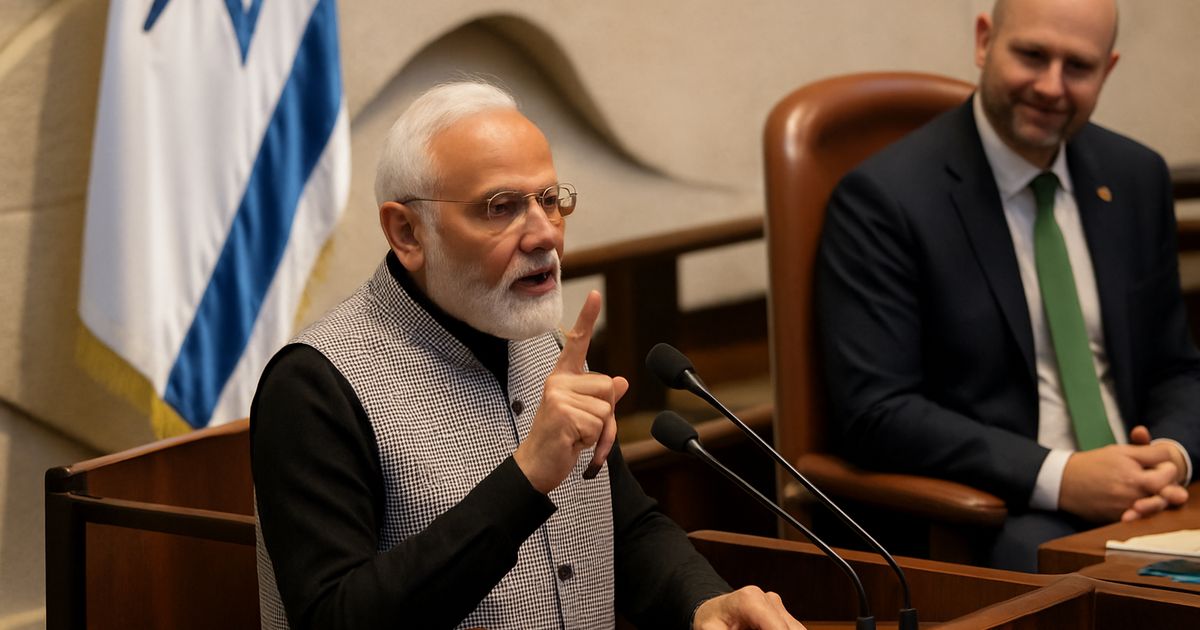
In February 2026, Indian Prime Minister Narendra Modi stood before the Israeli Knesset in Jerusalem, receiving a standing ovation and chants of his name from parliamentarians. This address, a centerpiece of his two-day visit, was more than a diplomatic courtesy; it was a powerful affirmation of a relationship that has undergone a profound transformation. Modi's speech delved into shared history but firmly focused on a future of deepened strategic and economic integration, explicitly urging closer cooperation on two key frameworks: the India-Middle East-Europe Economic Corridor (IMEC) and the I2U2 grouping. This moment crystallized the emergence of a robust India-Israel axis, a partnership moving beyond bilateral trade into the realm of reshaping regional connectivity and geopolitical alignments.
The significance of the setting cannot be overstated. Modi became the first Indian prime minister to visit Israel in 2017, and nearly a decade later, his return to address the Israeli parliament underscored the relationship's elevated status. In his speech, Modi offered unequivocal support for Israel in the wake of the October 7, 2023, Hamas-led attacks, stating, "We feel your pain. We share your grief," and affirming that India stands with Israel "with full conviction." He framed the partnership as one of "trusted partners" whose cooperation "contributes to global stability and prosperity." The visit was punctuated by personal warmth, as highlighted in related coverage noting Israeli Prime Minister Benjamin Netanyahu's fond recollections of his "first date" with his wife at an Indian restaurant, a anecdote symbolizing the personal and cultural threads weaving the two nations together.

Unpacking the Strategic Frameworks: IMEC and I2U2
Modi’s specific call to advance the IMEC and I2U2 initiatives provides the substantive blueprint for this strengthened axis. These are not mere acronyms but ambitious geopolitical and economic projects designed to create new corridors of influence and integration.
The India-Middle East-Europe Economic Corridor (IMEC)
Announced on September 9, 2023, during the G20 summit in New Delhi, the IMEC is a visionary infrastructure project. It proposes an integrated rail and shipping corridor connecting India to Europe via the Middle East. The envisioned route would pass through India, the United Arab Emirates, Saudi Arabia, Jordan, Israel, and into Europe. The project aims to create a network of railways, ports, and highways to dramatically improve logistics and facilitate the free flow of trade, positioning itself as an alternative to traditional maritime routes.
According to its official outlines, the IMEC has dual objectives: fostering deep economic cooperation and promoting green development through sustainable infrastructure. By physically linking the Indian subcontinent with Europe through the Arabian Peninsula and the Eastern Mediterranean, it seeks to unlock new economic potential and strengthen ties between participating nations. For India and Israel, it offers a direct, overland and maritime link that bypasses the volatile choke points of the Strait of Hormuz and the Suez Canal, enhancing strategic autonomy and economic resilience.
The I2U2 Grouping: The "West Asian Quad"
Established at a virtual summit on July 14, 2022, the I2U2 brings together India, Israel, the United Arab Emirates, and the United States. Analysts often dub it the "West Asian Quad" or "Middle Eastern Quad," drawing a parallel to the Indo-Pacific Quadrilateral Security Dialogue (Quad) involving the US, Japan, Australia, and India. The I2U2, however, is explicitly focused on non-military, collaborative initiatives addressing global challenges.
The U.S. Department of State notes the group's mandate spans water, energy, transportation, space, health, food security, and technology. Its stated goals are to modernize infrastructure, advance low-carbon development pathways, and improve public health. Concrete projects already underway include a food security initiative in India, a hybrid renewable energy project in India's Gujarat state, and a collaborative effort to tackle environmental and climate change challenges using space-based observation data—a domain where both India and Israel possess advanced capabilities.
The Evolution of India-Israel Relations: From Non-Alignment to Strategic Alignment
To understand the weight of Modi's 2026 Knesset address, one must appreciate the long and complex journey of India-Israel relations. For decades after independence, India's foreign policy was staunchly pro-Palestinian, rooted in its own anti-colonial struggle and its leadership role in the Non-Aligned Movement. India initially opposed Israel's creation and UN membership, only granting recognition in 1950. Full diplomatic relations were not established until 1992, a delay reflecting India's cautious geopolitical calculations during the Cold War.
The post-1992 era saw a gradual, quiet expansion of ties, primarily in defense and agriculture. However, the relationship remained largely under the radar, constrained by domestic politics and India's ties with Arab nations. The decisive shift, as noted in the source material, began in 2014 with Narendra Modi's ascent to power. His 2017 visit broke the prime ministerial taboo, signaling a new openness and strategic intent. Since then, the relationship has "improved exponentially." Trade figures tell a compelling story: bilateral trade skyrocketed from a modest $200 million in 1992 to $6.5 billion in 2024, making India Israel's second-largest trading partner in Asia, trailing only China.
This transformation is part of a broader recalibration of Indian foreign policy, which now prioritizes pragmatic national interest and strategic autonomy over ideological posturing. Israel, with its cutting-edge technology in defense, cybersecurity, agriculture, and water management, presents a natural complement to India's economic and security needs. The signing of an investment treaty mentioned by Modi in his speech is designed to provide further "confidence and predictability" for businesses, locking in this upward trajectory.
Analysis: Geopolitical Implications and Regional Reconfigurations
The active promotion of the IMEC and I2U2 by the Indian and Israeli leaders carries significant implications that extend far beyond their bilateral partnership. It represents a conscious effort to create new geopolitical and economic architectures that can withstand regional turbulence.
First, the IMEC is a direct challenge to other transnational connectivity initiatives, most notably China's Belt and Road Initiative (BRI). By offering a U.S.-backed, democratic-alternative corridor that emphasizes transparency and sustainability, IMEC participants aim to provide nations with strategic options. For Israel, it is a pathway to deeper normalization and economic integration with key Arab states like the UAE and Saudi Arabia, even amidst the ongoing conflict in Gaza. For India, it is a crucial land bridge to Europe that reduces dependency on longer sea routes and strengthens its role as a Indo-Pacific power with reach into the Mediterranean.
Second, the I2U2 institutionalizes a unique quadrilateral format that bypasses traditional regional divisions. It seamlessly combines two key U.S. allies (Israel and the UAE) with a strategic U.S. partner (India) to work on tangible, apolitical projects. This model of "minilateralism" allows for cooperation on specific issues without the baggage of broader political disagreements. The success of projects in renewable energy and food security in India could serve as a template for wider regional cooperation, demonstrating that collaboration can yield concrete benefits despite political complexities.
However, this axis does not exist in a vacuum. Modi's strong pro-Israel statements, as reported, and the deepening partnership inevitably draw scrutiny regarding India's historical stance on Palestine. The related headline "Who is really safe in India and Israel?" hints at the domestic and international critiques that accompany this shift, questioning the security and moral dimensions of the alliance amidst ongoing conflict. India's diplomacy now walks a tightrope, seeking to maintain its historically strong ties with the Arab world while pursuing a overtly close partnership with Israel—a balancing act where initiatives like IMEC, which includes Arab states, become essential.
The Road Ahead: Challenges and Opportunities
The vision articulated by Modi in Jerusalem is ambitious, but its realization faces a landscape fraught with challenges. The primary obstacle is the persistent and devastating conflict in Gaza and the wider Israeli-Palestinian issue. The war that began in October 2023, referenced in Modi's speech, creates immense political and logistical headwinds for any project requiring cooperation between Israel and Arab nations. The viability of the IMEC corridor, which depends on seamless transit through Jordan and Saudi Arabia, is particularly sensitive to the regional political climate.
Furthermore, internal political stability in the involved nations is a factor. The durability of the partnership is tied to the continuity of current leadership in both India and Israel. While the relationship has strong institutional and economic foundations, personal diplomacy has been a notable accelerant.
Despite these challenges, the drivers for cooperation remain powerful. Watch for progress in the following areas:
- Defense and Technology: The core of the relationship, expect further joint ventures in drone technology, missile defense systems, and cybersecurity.
- IMEC Working Groups: Observers should monitor the activation of the various IMEC working groups (on rail, shipping, clean energy, etc.) for tangible planning milestones, especially regarding financing and route finalization.
- I2U2 Project Expansion: The launch of new I2U2 projects in water technology, space, and healthcare will be a key indicator of the group's momentum and practical utility.
- Arab State Engagement: The stance of Saudi Arabia—a critical IMEC node—will be decisive. Its willingness to engage publicly with the corridor will signal the project's true potential.
A New Chapter in an Ancient Friendship
Prime Minister Narendra Modi's 2026 address to the Knesset was a landmark event, formally elevating a once-clandestine relationship to a public, strategic axis aimed at shaping the future of regional connectivity. By championing the IMEC and I2U2, India and Israel are not merely deepening bilateral ties but are attempting to architect new multilateral frameworks that link South Asia, the Middle East, and the West. This partnership, built on a confluence of technological complementarity, shared security concerns, and economic ambition, has moved from the margins to the center of both nations' foreign policies.
The journey from India's early support for the Palestinian cause to Modi's declaration of standing with Israel "with full conviction" encapsulates a dramatic foreign policy evolution. While this pivot offers significant opportunities in trade, security, and infrastructure, it also demands deft diplomatic navigation of the region's enduring conflicts and complexities. The success of the India-Israel axis, and the ambitious corridors it seeks to build, will ultimately be tested not in parliamentary speeches, but on the ground—in the deserts crossed by railways, in the security of shipping lanes, and in the tangible benefits delivered to the people of the participating nations. The foundations have been laid; the next few years will reveal the strength and shape of the structure they are meant to support.