Deadly Clashes Erupt Across Pakistan Following Khamenei Assassination
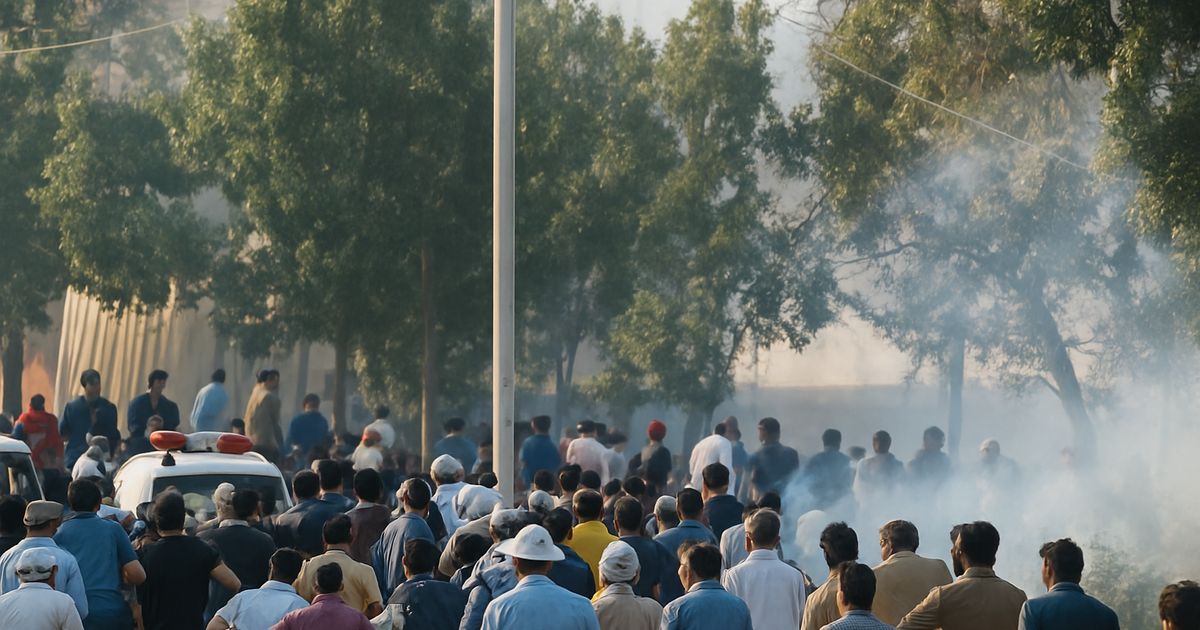
On Sunday, March 1, 2026, a wave of violent protests swept across Pakistan, leaving at least 22 people dead and more than 120 injured. The catalyst was the killing of Iran's Supreme Leader, Ayatollah Ali Khamenei, in a military strike attributed to the United States and Israel. The most severe violence occurred in Karachi, Pakistan's largest city, where hundreds of pro-Iran demonstrators attempted to storm the U.S. Consulate. According to police and hospital officials, security forces opened fire on the crowd, resulting in at least 10 fatalities at that location alone. A video posted on social media from the scene captured a protester yelling, "The death of the leader has been avenged," as others breached the consulate's reception hall and lit a small fire.
The unrest was not confined to Karachi. In the northern Gilgit-Baltistan region, thousands of protesters, angered by the strikes on Iran, attacked the offices of the United Nations Military Observer Group and the U.N. Development Programme (UNDP). Clashes with police there left 12 people dead and over 80 wounded. Local police official Asghar Ali confirmed the attacks, while government spokesman Shabir Mir stated all U.N. staff were safe. Additional fatalities were reported in the capital, Islamabad, bringing the nationwide death toll to 22. The U.S. Embassy in Pakistan issued security alerts, advising citizens to avoid large crowds and monitor local news as protests were also reported in Lahore and calls for demonstrations emerged for the embassy in Islamabad and the consulate in Peshawar.

The Trigger: A Decapitation Strike on Iran's "Axis of Resistance"
The immediate and explosive reaction in Pakistan and beyond was triggered by the extraordinary event of a sitting head of state being assassinated by foreign powers. Ayatollah Ali Khamenei, the 86-year-old Shia Islam cleric, had been Iran's supreme leader for 36 years. His death represents a seismic shock to the Middle Eastern geopolitical order he helped architect. Under his leadership, Iran pursued a security policy focused on building a network of proxy militias across the region—a network Tehran proudly labeled the "axis of resistance." This axis included powerful groups like Lebanon's Hezbollah, Yemen's Houthis, Iraqi militias, and Palestinian Hamas, all of which were trained, equipped, and funded by Iran to act as an anti-U.S. and anti-Israeli bulwark.
Khamenei's killing is described in source reports as "a major blow to an axis of resistance already severely weakened by Israel over the last two-and-a-half-years." It follows another symbolic wound to Shia Muslims: the death of Hezbollah's longtime leader, Hassan Nasrallah, in an Israeli airstrike in 2024. Both figures were revered by their supporters as major figures of resistance to Western oppression. The secretary general of Hezbollah, Naim Qassem, eulogized Khamenei as a "mujahid" (religious warrior) and martyr who was "leading the march of jihad and resistance against the tyrannical and oppressive American and Israeli forces." The depth of this loss explains the scale of the emotional and violent response from Shia communities and Iran-aligned groups worldwide.
Regional Reverberations: From Baghdad to Beirut
The protests in Pakistan were part of a wider regional eruption of anger. In Iraq, hundreds of pro-Iran protesters waving flags and throwing stones tried to storm Baghdad's heavily fortified Green Zone, which houses the U.S. embassy. Security forces responded with teargas to disperse the crowds. This came amid a backdrop of recent U.S.-Israeli strikes targeting Iran-backed armed groups within Iraq itself. The attempted breach of the Green Zone—a recurring flashpoint in U.S.-Iraqi relations—underscored the immediate threat to American diplomatic personnel across the region.
Mourning and mobilization were also visible in Lebanon and Yemen. In the southern suburbs of Beirut, a Hezbollah stronghold, tens of thousands of supporters and Shia Muslims gathered, waving Hezbollah and Iranian flags and carrying pictures of Khamenei. In Sanaa, Yemen, pro-Houthi media claimed a "million-person march" in support of Iran and commemoration of the slain leader. These displays of solidarity highlight the deep ideological and sectarian bonds that Khamenei's Iran cultivated, transforming local conflicts into part of a broader regional struggle. However, the reaction was not universally mournful. In Syria, where Iran had been the primary patron of Bashar al-Assad's regime until its overthrow in 2024, people reportedly celebrated in the streets, honking car horns and singing revolutionary slogans.
Pakistan's Precarious Position: Between Public Sentiment and State Diplomacy
The violent protests place the Pakistani government in an acutely difficult position. Pakistan is a majority-Sunni nation with a significant Shia minority, and it shares a long, porous border with Iran. The government must balance domestic religious sentiments, its need to maintain internal security, and its complex diplomatic relationships with Iran, the United States, and Saudi Arabia. President Asif Ali Zardari's official statement expressed "profound sorrow over the martyrdom" of Khamenei and conveyed condolences to Iran, asserting that "Pakistan stands with the Iranian nation in this moment of grief." This diplomatic language carefully aligns with Pakistani public sentiment among Shia and certain political factions without explicitly condemning the U.S. and Israel, key security and economic partners.
However, the state's use of lethal force against its own citizens to protect a U.S. diplomatic facility reveals the other side of this balancing act. The police action in Karachi, which resulted in numerous civilian deaths, risks inflaming sectarian tensions within Pakistan and could be exploited by extremist elements. The attacks on U.N. offices in Gilgit-Baltistan further complicate Pakistan's international standing, portraying an image of instability that deters foreign investment and challenges the state's monopoly on violence. The government's deployment of troops to quell the unrest indicates it views the protests as a significant threat to public order and its own authority.
The Historical Context: A Pattern of Escalation and Retaliation
The events of March 2026 did not occur in a vacuum. They are the culmination of a multi-year escalation between Iran's axis of resistance and the U.S.-Israel alliance. The source material references Israel severely weakening this axis over the preceding two-and-a-half years, a period likely marked by targeted assassinations (like that of Nasrallah), cyberattacks, and military campaigns against Iranian assets in Syria and elsewhere. The direct killing of a supreme leader represents a dramatic escalation from shadow warfare and proxy conflict to a decapitation strike at the highest level.
Historically, attacks on U.S. embassies and consulates have served as potent symbols of anti-American rage, most infamously in Iran in 1979 and in Benghazi, Libya, in 2012. The attempt to storm the U.S. Consulate in Karachi fits this pattern, using the diplomatic compound as a physical representation of the perceived aggressor. Similarly, the targeting of U.N. offices in Pakistan, while unusual, reflects a broader anger at international institutions perceived as being influenced by Western powers. This moment echoes the aftermath of the 2020 U.S. drone strike that killed Iranian General Qasem Soleimani, which triggered massive protests and rocket attacks on U.S. bases but stopped short of all-out war. The killing of Khamenei is a far more profound provocation, targeting the regime's ideological core.
Why It Matters
While most coverage focuses on the immediate death toll and diplomatic fallout, the deeper implication lies in the potential unraveling of a managed conflict system. For decades, the U.S.-Iran rivalry was characterized by "gray zone" conflict—fought through proxies, cyber tools, and economic pressure, with both sides avoiding direct, regime-threatening strikes. The assassination of Khamenei shatters that paradigm. It signals that the red lines preventing the direct targeting of a nation's supreme leadership have been erased. This creates a dangerous new precedent where the rules of engagement are fundamentally rewritten, increasing the likelihood of unpredictable and existential retaliation in future conflicts between state and non-state actors.
Furthermore, this event exposes the fragile nature of state control in pivotal countries like Pakistan. The protests reveal how transnational ideological and sectarian loyalties can instantly override national citizenship, mobilizing citizens to attack the embassies of their own government's allies. For readers, this underscores that in an interconnected world, a geopolitical shock in one region can instantly manifest as street violence and instability in another, with local police forces becoming the front line of a global conflict. It challenges the notion of domestic politics as a separate sphere from foreign policy.
Finally, the muted reaction from regional governments, as noted in the sources—with most foreign ministries failing to comment—is telling. It reflects a strategic caution and possibly a quiet realignment. With Iran's central pillar removed, Saudi Arabia and other Gulf states may see an opportunity to reshape the regional order, while former Iranian allies may begin to distance themselves. The real story may not be the protests themselves, but the silent calculations happening in capital across the Middle East as powers assess a future without Khamenei's Iran at the helm of the resistance axis.
What to Watch For Next
The immediate priority is containing further violence. The security of U.S. and other Western diplomatic installations across the Muslim world will be under extreme threat in the coming weeks. Intelligence agencies will be on high alert for planned attacks by Iranian proxies seeking vengeance. The response from Iran's remaining leadership—likely the Islamic Revolutionary Guard Corps (IRGC) and the Assembly of Experts tasked with selecting a new Supreme Leader—will be critical. Will they pursue a massive, direct retaliation against U.S. or Israeli assets, risking full-scale war, or will they continue to operate through proxies, seeking to orchestrate a campaign of asymmetric attacks?
Within Pakistan, the government's handling of the aftermath will be crucial. Will there be official inquiries into the police shootings? How will it manage the simmering sectarian tensions? The attacks on U.N. offices could also prompt a reassessment of international aid and presence in certain regions of the country. Long-term, the event may strain the U.S.-Pakistan security relationship, with Washington demanding greater protection for its assets and Islamabad resenting the domestic instability caused by American actions. The world should watch for signs of whether this event becomes a fleeting crisis or a catalyst for a more profound realignment of alliances and a new, more volatile phase of open confrontation in the Middle East and South Asia.