A Blunt Message from a Mediator: Qatar's Anger and Iran's 'Betrayal'
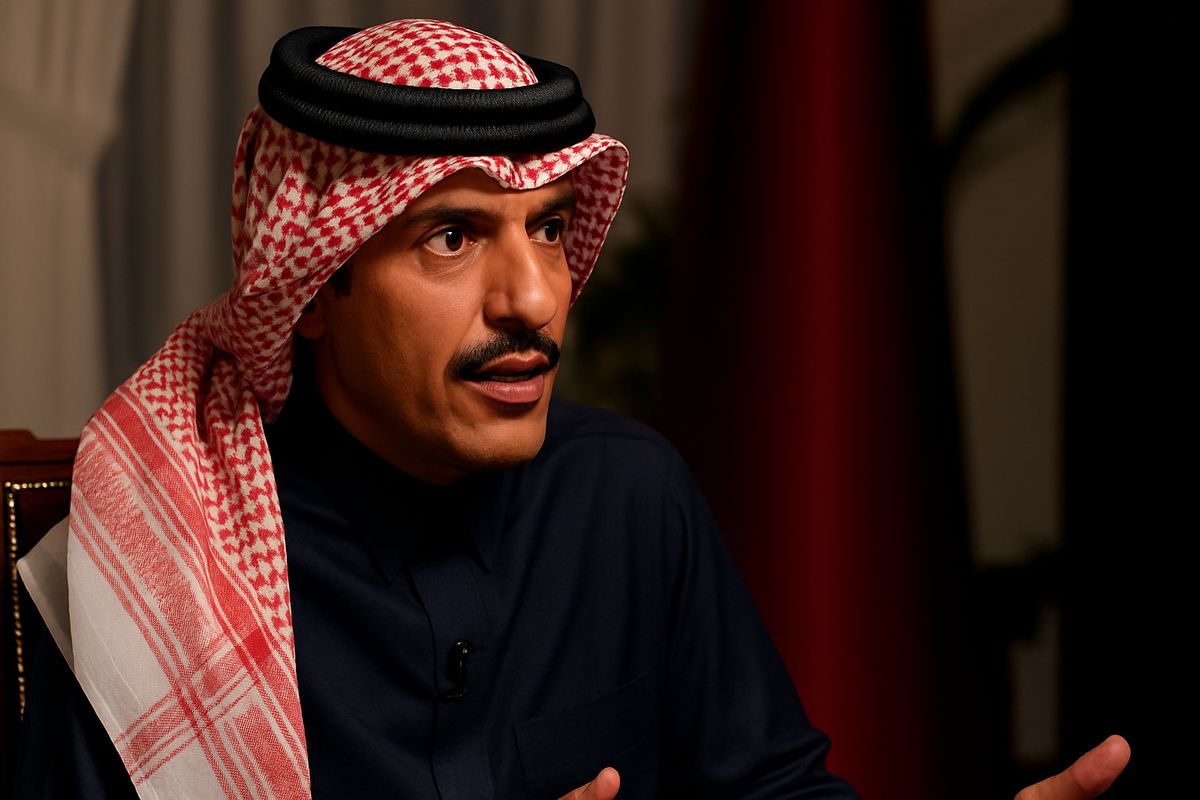
In a striking departure from its traditional role as a neutral mediator, Qatar has delivered a searing public condemnation of Iran, accusing its neighbor of a "dangerous miscalculation" that has "destroyed everything." The message came directly from Qatar's Prime Minister, Sheikh Mohammed bin Abdulrahman al Thani, in an exclusive interview with Sky News on Monday, March 9, 2026. Speaking for the first time since Qatar came under repeated missile and drone attacks, the Prime Minister articulated a "big sense of betrayal" felt across the Gulf Cooperation Council (GCC) states, revealing a profound rupture in regional diplomacy. His words mark a critical inflection point in a widening Middle Eastern conflict, as nations that sought to avoid direct involvement find themselves on the front lines.
The Prime Minister's interview provided chilling details of the assaults. He revealed that attacks began "just an hour after the start of the war," targeting not only Qatar but other Gulf countries. He forcefully rejected Iran's justifications for the strikes, stating that a staggering 25% of the attacks were aimed at civilian facilities, including international airports, water utilities, and critical gas infrastructure. This targeting of civilian and economic assets, he argued, exposes the indiscriminate nature of the escalation. For Qatar, a nation that has painstakingly maintained open channels with Tehran even during periods of intense regional volatility, the public expression of such anger and sense of betrayal is unprecedented and signals a dramatic shift in the geopolitical landscape of the Persian Gulf.

The Strategic Pivot: Qatar's Mediation Role Under Fire
To understand the weight of Sheikh Mohammed's statements, one must appreciate Qatar's unique foreign policy identity. For decades, Doha has cultivated a reputation as a global diplomatic hub and an agile mediator, capable of speaking to all sides in complex conflicts. It hosts a major U.S. military base at Al Udeid while also maintaining robust economic and political ties with Iran, with which it shares the vast South Pars/North Dome gas field. This balancing act allowed Qatar to broker talks between the U.S. and the Taliban, facilitate channels between Western powers and Hamas, and serve as a crucial intermediary during periods of U.S.-Iran tension. The Prime Minister himself has been a central figure in these efforts, earning international recognition for his diplomatic acumen.
This carefully constructed position is now in jeopardy. The Prime Minister's blunt language—"We have always tried to preserve a good relationship with Iran, but the justifications and pretexts they are using are completely rejected"—indicates that the foundational principle of Qatar's Iran policy, engagement despite differences, has been severely damaged. The attacks have forced Doha into a corner, compelling it to publicly choose sides in a manner it has assiduously avoided. The strain on this relationship is not just rhetorical; it has real-world consequences for regional security dialogues, energy cooperation, and any future negotiations involving Iran, as one of its few consistent interlocutors in the Gulf now feels directly threatened.
Escalation on Multiple Fronts: The Gulf Dragged Into War
The conflict, as described by the Qatari leader, has fundamentally expanded beyond its original participants. What may have begun as a confrontation between the United States, Israel, and Iran has now ensnared the Gulf Arab states, transforming a bilateral or trilateral conflict into a regional conflagration. The Prime Minister made clear that Qatar and its GCC neighbors had explicitly declared their neutrality, stating, "We made clear that we were not going to take part in any wars against our neighbours." Iran's decision to strike across the Gulf, therefore, is viewed not as a tactical military action but as a strategic choice to regionalize the war, punishing states it perceives as aligned with its adversaries regardless of their declared stance.
This expansion creates a terrifying new dynamic. The Gulf states, for all their military modernisation and U.S. security partnerships, are now active targets. The Sky News interview references specific incidents, including missile interceptions over Doha's sky on March 5 and a free-falling missile hitting the Qatari capital on February 28. These are not distant threats but direct hits on sovereign territory. The Prime Minister's warning that military escalation "would only deepen the crisis" is a plea born of this new, vulnerable reality. The front line is no longer just on Iran's borders with Iraq or near the Strait of Hormuz; it is in the skies above the gleaming cities of the Arabian Peninsula, putting millions of civilians and the world's most critical energy infrastructure at immediate risk.
The Global Stakes: Energy, Economy, and the Specter of Wider War
Sheikh Mohammed repeatedly emphasized the international ramifications of the crisis, underscoring that "what happens in the Gulf won't stay in the Gulf." This is not hyperbole. Qatar is a linchpin of the global energy market, supplying roughly 20% of the world's liquefied natural gas (LNG). It is also one of the planet's largest fertiliser producers. Sustained attacks on its export facilities, ports, and production infrastructure would trigger immediate shockwaves through energy markets, spike prices for electricity and heating in Europe and Asia, and disrupt global agricultural supply chains, exacerbating food insecurity. The targeting of civilian airports further threatens international travel and commerce in a key global transit hub.
The Prime Minister's message was also directed at Washington, as he called on the U.S. to reduce tensions. This highlights the delicate and dangerous position of the Gulf states: they are under attack from Iran while simultaneously urging their American security guarantor to show restraint. It is a diplomatic tightrope walk of immense difficulty. The region is caught in a classic security dilemma, where actions taken by one side for its own defense (e.g., U.S. force posture enhancements, Israeli operations) provoke attacks from Iran that then threaten to drag the Gulf states into a full-scale war they desperately want to avoid. The global economy hangs in the balance of this precarious standoff.
Why It Matters: The Unraveling of Regional Deterrence and Diplomatic Capital
The significance of Qatar's condemnation extends far beyond the immediate crisis. It represents a fundamental failure of regional deterrence and risk-assessment frameworks. For years, the Gulf states and their international partners operated on an assumption that Iran, despite its aggressive rhetoric and proxy warfare, would hesitate to launch direct kinetic attacks on GCC sovereign territory due to fears of overwhelming retaliation and the collapse of its remaining economic relationships. Iran's "dangerous miscalculation," as labeled by Doha, shatters that assumption. It reveals that Tehran's calculus in a direct confrontation may be more reckless than previously believed, willing to burn diplomatic bridges with pragmatic neighbors like Qatar for perceived strategic gains. This forces a wholesale reevaluation of Gulf security doctrines, likely accelerating military integration among GCC states and deepening their dependency on—and demands from—extra-regional powers.
Furthermore, the crisis critically wounds the very concept of mediation that has been a cornerstone of conflict management in the Middle East. Qatar was not just a mediator; it was the mediator of last resort for the West with several Iranian-aligned actors. By attacking Qatar, Iran has effectively disabled a key node in the international community's circuit board for dialogue. This creates a more binary and dangerous landscape, with fewer channels for de-escalation, misunderstanding, or crisis communication. The Prime Minister's insistence that "the answer now must be renewed negotiations" feels, in this context, like an attempt to salvage a diplomatic tool that Iran itself has blunted. The world is left with a more volatile region where the voices for calm have been physically threatened and the pathways to peace have been deliberately targeted, making uncontrolled escalation a terrifyingly plausible scenario.
A Path Forward from a 'Very Difficult Period'
Sheikh Mohammed bin Abdulrahman al Thani concluded his interview with a somber acknowledgment that Qatar has entered "a very difficult period," while praising the professionalism of its defense forces. His stance remains paradoxically dualistic: unwavering in its condemnation of Iran's actions yet adamant that de-escalation and diplomacy are the only viable paths forward. "They are our neighbours—it's our destiny," he stated, a phrase that encapsulates the inescapable geographic reality of the Persian Gulf. The Gulf states cannot move away from Iran; they must find a way to coexist, however fraught that coexistence may now be.
The coming weeks will test whether this call for de-escalation can gain traction. The Prime Minister's interview, covered by Sky News under headlines like "Attacking Gulf states 'dangerous miscalculation'" and "Qatari PM says he will seek de-escalation," serves as both a powerful indictment and a desperate plea. It documents the moment a mediator becomes a victim, and a neutral space becomes a battlefield. The "miscalculation" he describes may indeed have destroyed the previous status quo of guarded engagement. Whether it destroys the prospect for any future stability in the Gulf depends on the choices made in capitals from Tehran and Washington to Riyadh and Doha in the days ahead. The world, reliant on the region's energy and terrified of a wider war, watches and waits.