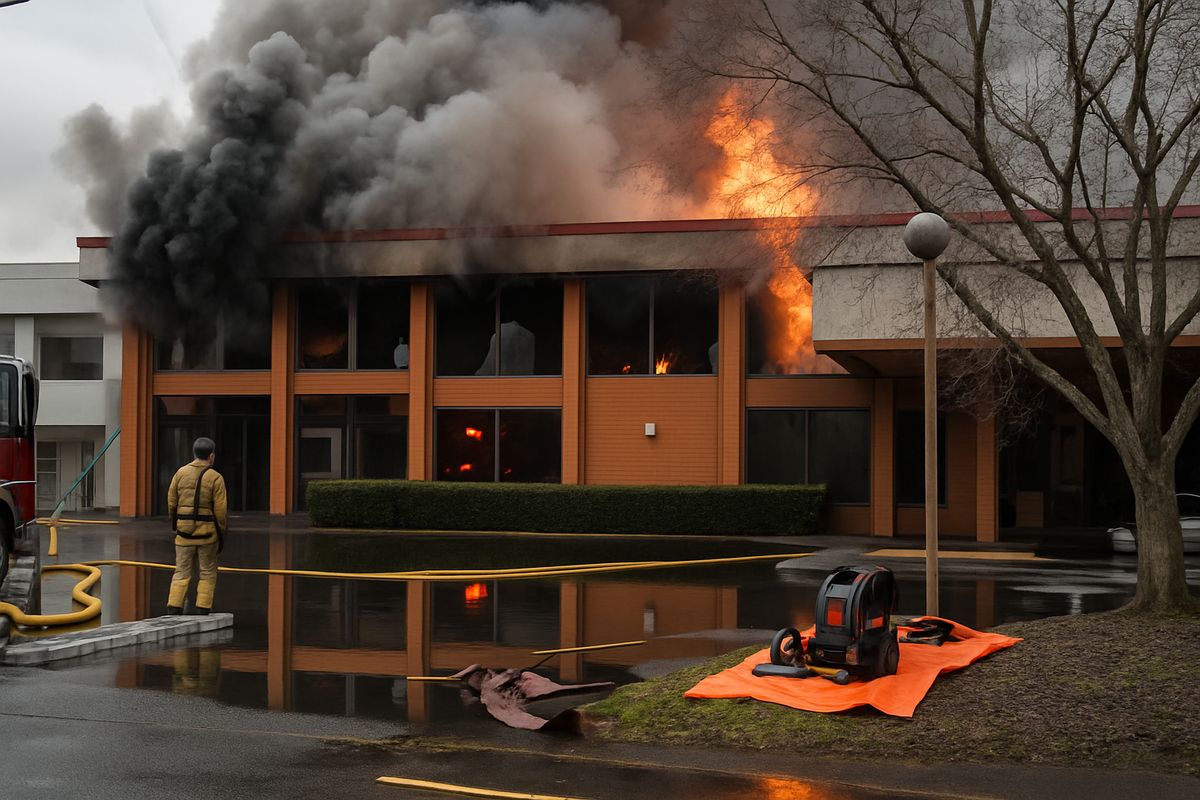
Major Fire Erupts at Kelso's Red Lion Hotel, Prompting Mass Evacuation
A significant commercial fire broke out at the Red Lion Hotel in Kelso, Washington, on Saturday afternoon, March 8, 2026, drawing a massive emergency response and leading to the safe evacuation of all guests and employees. Firefighters from Cowlitz 2 Fire & Rescue were dispatched to the hotel at 510 Kelso Drive at 1:39 p.m. after a fire alarm activation. Upon arrival, crews reported smoke emanating from the front side of the building, which quickly escalated into a two-alarm fire with heavy smoke billowing from the structure. The incident, which saw part of the hotel roof collapse by 4:30 p.m., represents a major emergency event for the Kelso-Longview community and raises immediate questions about fire safety in older hospitality structures.
The response was substantial and coordinated. Resources on scene included six fire engines, three ladder trucks, one water tender, and five chief officers managing the incident. Multiple agencies converged on the location, including Cowlitz 2 Fire & Rescue, Longview Fire Department, Clark Cowlitz Fire & Rescue, Columbia River Fire & Rescue, Cowlitz County Fire District 6 in Castle Rock, Cowlitz County Fire District 5 in Kalama, and Lewis County Fire. Support also came from the Kelso Police Department, Cowlitz County Public Works, and Cowlitz County Public Utilities. Despite the intensity of the blaze and the structural damage incurred, authorities confirmed a critically positive outcome: no injuries were reported among guests, employees, or first responders. The cause of the fire remains under investigation and is not known at this time.

Anatomy of a Major Emergency Response
The scale and speed of the response to the Red Lion Hotel fire underscore the protocols in place for commercial structure fires in Cowlitz County. The activation of a two-alarm fire signifies that the initial responding units determined the incident exceeded their capacity, automatically triggering requests for additional personnel and equipment from surrounding jurisdictions. This mutual aid system is a cornerstone of firefighting in the Pacific Northwest, where resources are shared across district lines to combat large-scale emergencies effectively. The presence of five chief officers on scene highlights the complex command structure required to manage such an operation, coordinating attack lines, evacuation logistics, and support services simultaneously.
The specific equipment deployed tells a story of the fire's challenges. Ladder trucks are essential for gaining aerial access to fight fires from above and for ventilation operations—cutting holes in the roof to release heat and smoke. The deployment of a water tender indicates a potential concern about water supply in the area, as these tanker trucks shuttle large volumes of water to the scene to supplement hydrant systems. The collapse of a section of the roof, reported by firefighters on scene, is a dangerous and common occurrence in prolonged structural fires, as the integrity of wooden supports and trusses is compromised by intense heat. That this happened while crews were actively fighting the fire underscores the perilous conditions they faced.
The Red Lion Brand and Its Place in Kelso
The affected property, the Red Lion Hotel at 510 Kelso Drive, is part of a once-dominant regional hospitality chain with deep roots in the Pacific Northwest. Founded in 1959 in Spokane, Washington, Red Lion Hotels was for decades a familiar name along the West Coast's major highways, known for its signature red lion statues. While the brand has undergone significant changes in ownership and strategy in the 21st century—with many properties being sold or rebranded—it remains an iconic name in the region. The Kelso location, situated near the junction of Interstate 5 and the Cowlitz River, has long served as a key lodging option for travelers, business visitors, and attendees of local events at nearby venues like the Rister Stadium.
Hotels like the Red Lion in Kelso function as critical infrastructure for small to mid-sized cities. They accommodate visiting professionals for local industries, families during reunions or graduations, and tourists exploring the Columbia River Gorge or Mount St. Helens. The loss of a significant number of rooms, even temporarily, has a ripple effect on local commerce, affecting nearby restaurants, gas stations, and event planning. Furthermore, such properties often employ dozens of local residents in roles from housekeeping to management. The immediate evacuation, while successful, also displaces guests who may have been long-term residents or in town for specific, time-sensitive reasons, creating a secondary humanitarian and logistical challenge for the community.
Historical Context of Hotel Fires and Safety Evolution
Major hotel fires have been a tragic catalyst for improvements in building codes and fire safety regulations throughout modern history. Landmark disasters like the 1946 Winecoff Hotel fire in Atlanta (which killed 119 people) and the 1980 MGM Grand fire in Las Vegas (85 fatalities) led to sweeping changes, including mandatory sprinkler systems in high-rise buildings, improved fire-resistant materials, and stricter requirements for multiple, clearly marked exits. The fact that no lives were lost in the Kelso fire, despite the roof collapse and intense flames, is a testament to the efficacy of modern alarm systems, rapid emergency response, and likely, the building's adherence to contemporary fire codes for guest evacuation.
In the context of Washington state and the Pacific Northwest, the region has seen its share of significant commercial fires. The climate, with wet winters and dry summers, coupled with older building stock in many downtown cores, presents unique challenges. Fire investigations in the coming days and weeks will scrutinize several potential factors common to such blazes: electrical systems in older buildings, heating and ventilation equipment, kitchen facilities, or careless disposal of smoking materials. The age and construction type of the specific Red Lion building in Kelso will be a key focus. Many hotels of that era were built with large, open attic spaces or void areas that can allow fire to spread rapidly and unseen until it breaks through, which may explain the sudden appearance of heavy smoke and the subsequent roof collapse.
The Critical Role of Inter-Agency Cooperation
The list of responding agencies to the Red Lion fire reads like a roster of southwestern Washington's emergency services. This level of cooperation is not automatic; it is the result of years of planning, joint training exercises, and established mutual aid agreements. For a fire department in a community like Kelso or Longview, a large, sustained structure fire can quickly deplete local resources. Automatic aid agreements ensure that when a call goes out as a "two-alarm" fire, predetermined units from neighboring districts are mobilized immediately, without delay for administrative approval. This system was visibly in effect, bringing in crews from as far as Kalama, Castle Rock, and Lewis County.
This incident serves as a live-stress test for these protocols. The coordination required between different agencies—each with its own command structures and radio channels—is immense. A unified command system, where chiefs from multiple agencies collaborate to run the incident, is essential to prevent confusion and ensure firefighter safety. The successful evacuation and lack of injuries suggest this system functioned as designed. The aftermath will likely include a formal after-action review where responding agencies analyze what worked and what could be improved, ensuring lessons from the Red Lion fire strengthen the regional response network for future emergencies.
What's Next: Investigation, Recovery, and Community Impact
The immediate aftermath of the fire transitions into a complex phase of investigation, structural assessment, and community reckoning. The first priority for fire investigators will be to secure the scene and begin the meticulous process of determining the fire's origin and cause. This involves interviewing witnesses, including evacuated guests and staff, examining the fire's burn patterns, and potentially bringing in electrical or mechanical experts. The cause may remain "undetermined" for days or weeks as evidence is sifted through. Simultaneously, structural engineers will need to assess the integrity of what remains of the building. The roof collapse indicates significant damage, and the entire structure may be at risk of further failure or require demolition.
For the Red Lion Hotel's ownership and the broader community, the path forward involves several challenging questions. If the building is a total loss, the owners must decide whether to rebuild, a decision weighed against insurance payouts, the economic viability of a hotel in that location, and the costs of modern construction. For the city of Kelso, the loss of a major hotel affects tax revenue, employment, and tourism infrastructure. Displaced employees face immediate financial uncertainty, and the city may work with social services to provide support. In the longer term, this event will likely prompt local fire marshals to conduct renewed inspections of similar hospitality properties in the area, reviewing alarm systems, sprinkler coverage, and evacuation plans to prevent a repeat tragedy.
This fire also casts a spotlight on the resilience of older commercial buildings. As structures age, their systems can degrade, and original construction methods may not meet today's more stringent life-safety standards. Whether through voluntary upgrades or spurred by insurance requirements, many older hotels have undergone retrofits. The investigation will reveal if such upgrades were present at the Kelso Red Lion and how they performed. The outcome could influence policy discussions at the state level regarding mandatory retrofits for older high-occupancy buildings, balancing public safety with the economic burdens on small business and property owners. The story of the Red Lion Hotel fire is thus not just about one afternoon's emergency, but about the ongoing challenge of maintaining safety in an aging built environment.