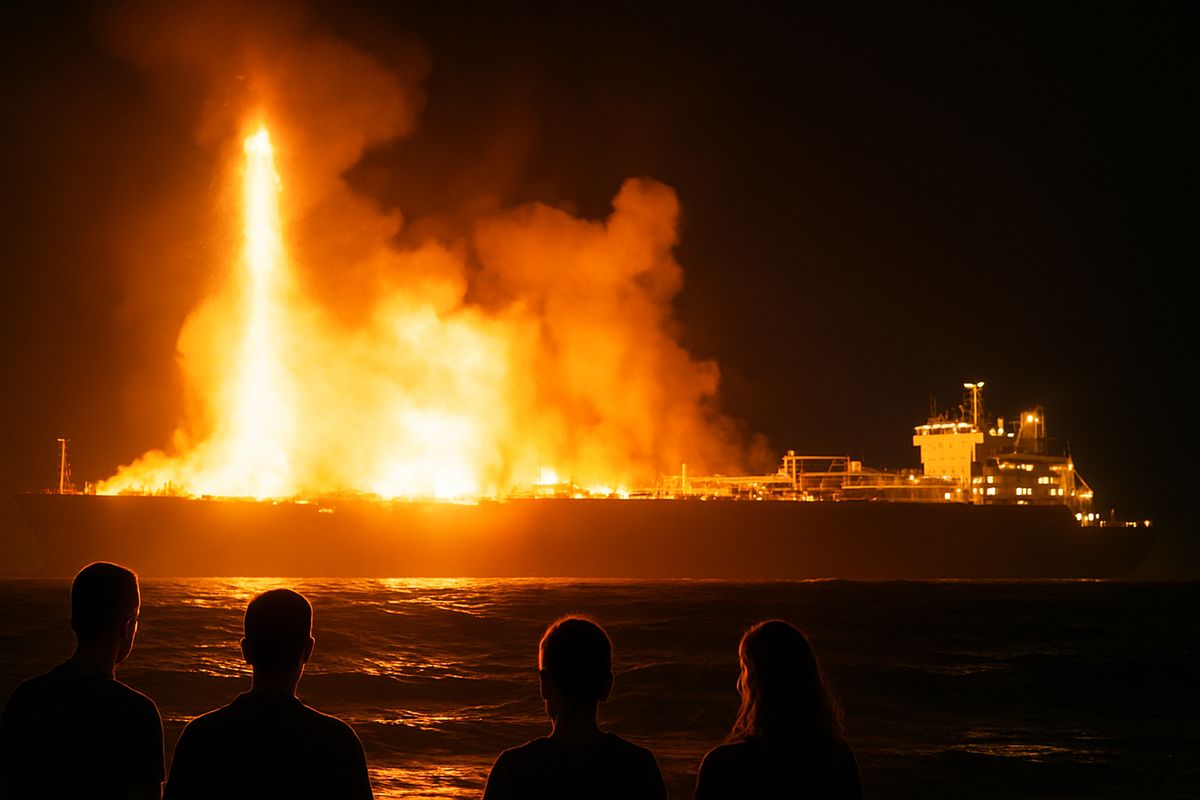
A Tanker in Flames: The Sinking of the Arctic Metagaz
On the night of March 3, 2026, a sudden series of explosions tore through the hull of the Russian liquefied natural gas (LNG) tanker Arctic Metagaz as it sailed in the central Mediterranean Sea. Located approximately 130 nautical miles north of the Libyan port of Sirte, the vessel was engulfed in a massive fire that Libyan port officials said ultimately led to its complete sinking. The incident, occurring in international waters between Libya and Malta, has escalated maritime tensions in the ongoing Russia-Ukraine conflict, drawing accusations of a long-range drone attack and raising urgent questions about the security of global shipping lanes.
Russia's transport ministry was quick to assign blame, accusing Ukraine of targeting the tanker with "uncrewed sea drones" launched from the Libyan coast. Russian President Vladimir Putin labeled the event "a terrorist attack," stating, "This isn't the first time we've encountered something like this." The ministry further condemned the act as "international terrorism and maritime piracy." In a fortunate turn, all 30 Russian crew members aboard were rescued safely by Malta's armed forces, found "safe and sound in a lifeboat," according to Maltese Home Affairs Minister Byron Camilleri. The tanker was carrying an estimated 62,000 tonnes of LNG from Russia's northern port of Murmansk, reportedly destined for Port Said in Egypt.
Ukraine has maintained official silence, with its SBU state security service declining to comment on the allegations. However, a Ukrainian government-linked social media account, United24, posted a teasing message suggesting the drones were "Definitely. Maybe" not part of the Ukrainian fleet. Unverified imagery shared by Serhii Sternenko, an adviser to Ukraine's defence minister, purported to show the vessel with a "serious hole in the engine room compartment and is beyond repair." The Libyan port authority noted the cause of the fire was unclear, and Egypt's Petroleum Ministry denied any contractual connection to the cargo, further obscuring the tanker's final mission.

The Shadow Fleet: Russia's Sanctions-Dodging Armada
To understand the significance of the Arctic Metagaz attack, one must examine the vessel's identity. It was not a standard commercial carrier but a key component of Russia's so-called "shadow fleet." Following the full-scale invasion of Ukraine in 2022 and the imposition of severe Western sanctions, Russia deployed a surging number of aged tankers with obscure ownership and insurance to transport its oil and gas. This parallel fleet operates outside Western financial and insurance systems, allowing Moscow to continue exporting energy and generating critical revenue to fund its war effort.
The Arctic Metagaz itself had been widely sanctioned by the United States and the European Union. Marine tracking data indicated that prior to the fire, the tanker had likely deactivated its automatic identification system (AIS), a common tactic for shadow fleet vessels seeking to obscure their routes and destinations. This practice, while evading sanctions, also creates significant safety and environmental risks, as these older vessels often lack proper oversight and maintenance. The sinking of an LNG carrier—a ship carrying fuel cooled to -162°C (-260°F)—poses a substantial, though in this case reportedly contained, pollution threat, prompting Libya's maritime agency to warn other vessels to avoid the area.
Russia's reliance on this shadow fleet has turned its energy transport infrastructure into a legitimate military target in Kyiv's view. Ukraine has consistently argued that striking the economic lifelines of Russia's war machine is a necessary component of its self-defence. The Arctic Metagaz thus represents more than a single ship; it is a floating symbol of the sanctions regime and the ongoing economic battle underpinning the physical conflict.
The Evolution of Ukrainian Naval Drone Warfare
While Ukraine has no traditional navy to rival Russia's Black Sea Fleet, it has pioneered an innovative and devastating form of asymmetric maritime warfare using uncrewed surface vessels (USVs), commonly called naval drones. Prior to this incident, nearly all of Ukraine's successful drone strikes on Russian vessels had occurred in the confined waters of the Black Sea, where they have been instrumental in degrading Russian naval dominance, forcing the fleet to relocate, and securing a grain export corridor.
These drones, often described as kamikaze vessels, are packed with explosives and guided over long distances using advanced cameras and satellite communications. They are low-cost, difficult to detect, and can inflict severe damage on much larger, more expensive warships and tankers. The alleged attack on the Arctic Metagaz, however, marks a dramatic geographical and strategic expansion. Striking a target approximately 1,000 miles from Ukraine's nearest coastline in the central Mediterranean represents a quantum leap in operational range and capability.
If confirmed, the attack demonstrates Ukraine's ability to project power far beyond its immediate theatre of war, potentially threatening Russian maritime logistics across the Mediterranean. This aligns with a pattern of escalating strikes on Russian energy infrastructure, including refineries deep inside Russia and a previous drone strike on a Russian tanker in the Mediterranean in December 2025. The implication is clear: no Russian vessel involved in transporting sanctioned cargo may be considered safe, regardless of its location.
Geopolitical Fault Lines: Libya's Role and International Law
Russia's specific accusation—that the drones were launched from the Libyan coast—adds a complex layer of geopolitical intrigue to the incident. Libya has been fractured by civil war for over a decade, with rival governments in the east and west and various foreign powers, including Russia, backing different factions. The presence of the Russian-backed Wagner Group in Libya is well-documented. The suggestion that Ukraine could launch an operation from this chaotic territory points to the conflict's ability to spill over and exploit existing global fault lines.
From a legal perspective, the incident plunges into a grey area of international maritime law. Russia's invocation of "maritime piracy" is legally tenuous, as piracy is typically defined as acts for private ends, not state-directed military action. Conversely, if the tanker was part of Russia's war-sustaining logistics chain, Ukraine could argue it was a legitimate military target under the laws of armed conflict, even in neutral waters. However, attacking a civilian-crewed vessel, even one carrying sanctioned cargo, raises serious legal and ethical questions and sets a precedent that could endanger global merchant shipping.
The international response has been muted, reflecting the diplomatic tightrope many nations walk. The European Union, accused by Russia of complicity, has made no immediate statement on the attack itself, likely focusing on the broader sanctions enforcement. The incident underscores the challenges of managing a hybrid conflict where traditional battlefields blur into global economic and maritime domains.
Why It Matters
Most coverage will focus on the immediate tit-for-tat of the attack and the dramatic imagery of a sinking tanker. However, the deeper significance lies in its function as a stress test for the global system of sanctions and the laws of war at sea. This event is not an anomaly but a logical escalation in a conflict where economic warfare is as decisive as territorial gains. It demonstrates that sanctions, unless perfectly watertight and globally enforced, create shadow markets, and shadow markets become battlefields. The world is witnessing the weaponization of maritime sanctions evasion.
Furthermore, this attack signals the democratization of long-range, precision naval strike capability. Ukraine, a nation with a largely defunct conventional navy, is now able to threaten shipping across a major international sea using relatively inexpensive, scalable technology. This blueprint will be studied by state and non-state actors worldwide, potentially lowering the threshold for maritime conflicts and complicating freedom of navigation. For global commodity traders and insurers, the calculus of risk has just expanded geographically; the premium for moving contested cargoes anywhere in the world is likely to rise.
For the average reader, this matters because it illustrates how a regional war recalibrates global trade and security. The energy you use, the goods you buy, and the stability of their prices are indirectly linked to such incidents. It also poses a uncomfortable strategic question: if cutting off an aggressor's war funding is a goal, at what point do attacks on civilian-crewed vessels, even those operating in legal grey zones, undermine the very norms the international community seeks to uphold? The sinking of the Arctic Metagaz is a milestone in the normalization of economic targets in warfare, with blurred lines that may haunt global commerce long after the Ukraine war ends.
What to Watch For Next
The immediate aftermath will focus on environmental monitoring and official investigations. The full environmental impact of an LNG carrier sinking needs assessment, though the cargo likely dissipated rather than creating a traditional oil slick. More critically, the world should watch for Russia's response. Will it launch retaliatory strikes on Ukrainian or allied commercial shipping? Will it attempt to blockade Ukrainian ports again, or escalate attacks on civilian infrastructure in Ukraine? The risk of a cycle of escalation in the maritime domain is now significantly higher.
Second, observe the reaction of the international shipping and insurance industries. If insurers (those still covering Russian shadow fleet vessels) declare a wider area of the Mediterranean a high-risk zone, it could disrupt flows of all commodities, not just Russian energy. This would achieve a broader de-facto sanction but at a cost to global trade. Finally, monitor diplomatic channels. This event will fuel debates at the UN Security Council and the International Maritime Organization about the protection of commercial shipping in times of hybrid conflict. It may spur calls for new international protocols governing naval drones and the status of "shadow fleet" vessels, though reaching consensus in the current climate will be exceedingly difficult.
The sinking of the Arctic Metagaz is more than a tactical event in a long war. It is a signal that the battleground has irrevocably expanded. The rules of engagement at sea are being rewritten in real-time, not by great power consensus, but by the necessities of a brutal conflict, with consequences that will ripple far beyond the Mediterranean horizon.