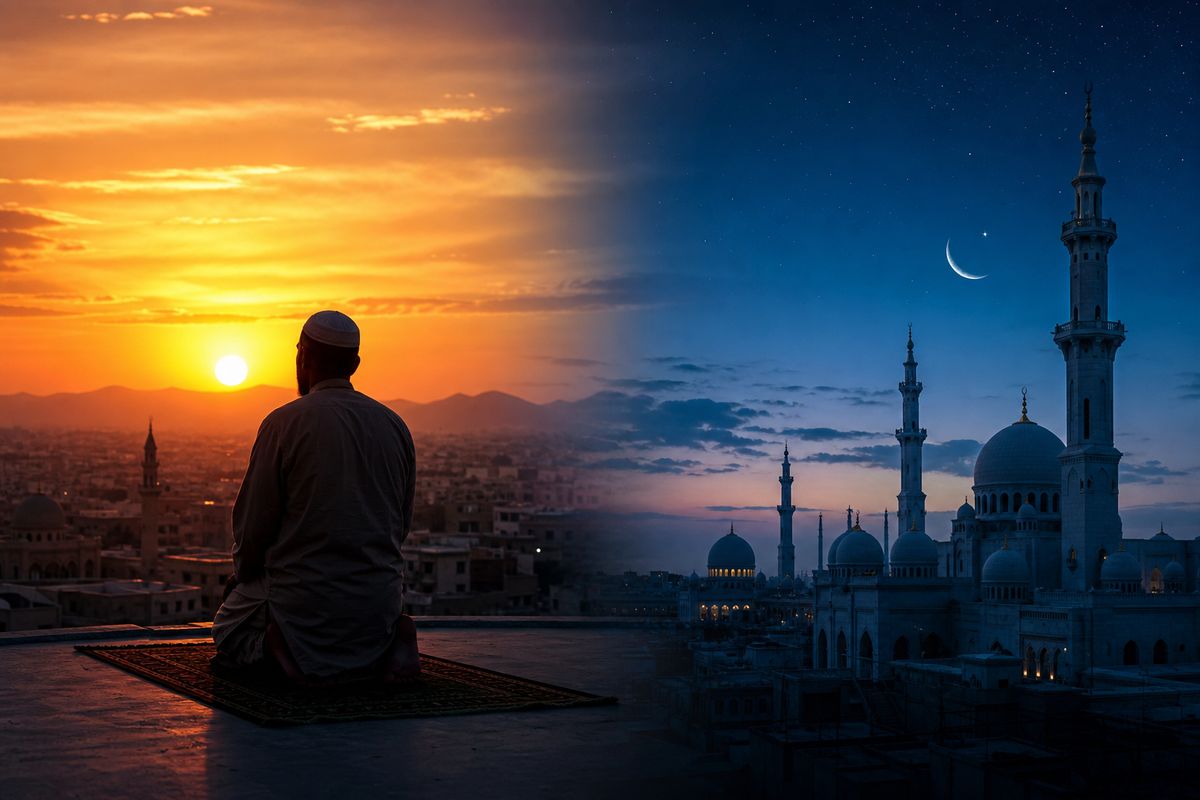
The Great Summer Prayer Time Debate
For Muslims living in the UK, summer brings more than long evenings and barbeques. It brings a headache. When the sun barely dips below the horizon, how do you determine the start of Ishā and Fajr? It is a question that has split communities, filled mosque committee meetings with shouting, and forced scholars to revisit classical rulings.
This year, the debate has flared up again. Islam21c, a well-known UK-based Islamic publication, recently published a video titled “The BIG Discussion: 18° Prayer Timetable” alongside an article on “Summer ‘Ishā & Fajr Prayer Times.” The fact that both pieces triggered a security block (likely due to high traffic) shows just how hot this topic is. While we cannot quote the exact arguments from those pages, the headlines alone confirm that the 18° angle methodology is once again under scrutiny.
The core problem is simple. At higher latitudes, during the summer months, the sun never dips 18 degrees below the horizon. That means the astronomical twilight required for Ishā (full darkness) never occurs, leaving Muslims with a dilemma: pick a different angle, use a calculation based on Mecca, or follow the nearest night at a lower latitude. None of these options is perfect.

What Are the Standard Methods for Determining Prayer Times?
Islamic prayer times are tied to the position of the sun. Fajr begins at dawn, when the first light appears on the horizon. Ishā starts after the red twilight has vanished. To automate these times, scholars use degrees of solar depression: the angle the sun is below the horizon at those moments.
The most common angle globally is 18 degrees. Many organisations, including the IslamicFinder and the Muslim World League, default to this. But it is not the only one. Some schools of thought use 15 degrees, especially for Ishā in the Hanafi school. Others use 12 degrees for Fajr. And in extreme latitudes, bodies like the European Council for Fatwa and Research have issued rulings that allow using the last third of the night or times from the nearest location with a normal night.
In the UK, many mosques stick with 18 degrees year-round. That works fine in winter. But come June, things get messy. In London, from mid-May to late July, the sun never reaches 18° below the horizon. So those timetables either produce no Ishā time at all, or they assign a time that is technically invalid because darkness never arrives. This is the crux of the summer prayer time issue.
The Science of Twilight
To understand the conflict, it helps to know the three types of twilight. Civil twilight (6° below horizon) is when there is enough light to read. Nautical twilight (12°) shows a clear horizon. Astronomical twilight (18°) is when the sky is fully dark. For Fajr, most classical scholars define it at the beginning of astronomical twilight. But some modern astronomers argue that the first light of dawn appears closer to 15° or even 14°. And for Ishā, the disappearance of the red glow can happen before 18° in some regions. So there is both a fiqh dimension and a scientific one.
The 18° Timetable Under the Microscope
The Big Discussion video from Islam21c is part of a broader trend. Over the past decade, more scholars have openly questioned whether 18° is appropriate for UK summers. One argument goes like this: if you insist on 18°, you effectively lose the Ishā prayer for weeks. And since prayer is an obligation that cannot be abandoned, the method must be wrong. Others defend 18° as the most authentic, citing hadith that describe the darkness of Ishā as when the red twilight fades, which in many regions does occur at 18°.
The debate is not new. It has been raging since at least the 1990s, when UK mosques started using computer-generated timetables. But the internet has amplified it. Every year, social media fills with screenshots of timetables and heated arguments. Some mosques switched to 15° or even the Shafi’i standard of 18.5°. Others adopted the “Unified Timetable” that uses a combination of methods to avoid missing prayers entirely.
One key point is that the Islam21c video suggests the discussion is still very much alive. With summer solstice just passed (June 21, 2026), the issue is at its most acute right now. The fact that a major platform is hosting a debate signals that the need for a clear consensus remains urgent.
Historical Context: How Scholars Handled Extreme Latitudes
This problem is not new to the 21st century. Medieval Islamic scholars living in places like Baghdad or Cairo never faced summer nights that simply didn’t get dark. But they did discuss the issue of “the land where the sun does not set” – such as the far north. The classical answer was often to use the nearest location where night and day are distinguishable, or to follow the times of Mecca or Medina.
Today, the European Council for Fatwa and Research (ECFR) has issued detailed guidelines. They recommend using the nearest latitude that experiences a normal day-night cycle, combined with precautionary measures. Another approach, known as the “Nearest Valid Night” method, takes the timing from the closest parallel of latitude where the sun dips below 18°. Some UK mosques have adopted this, but it creates a mismatch with the local astronomical observation.
The challenge for scholars is to balance the literal text of the Quran and Sunnah with practical necessity. The Prophet (peace be upon him) was asked about a land where the sun does not set for six months. He reportedly said to estimate the times. That hadith is often cited as the basis for using calculation in extreme cases. But estimating is exactly what modern software does, albeit with precision. The disagreement is over which estimation is closest to the spirit of the law.
What This Means for Muslims in the UK and Beyond
For the average Muslim in Manchester or Glasgow, the summer prayer time debate is not an abstract academic exercise. It affects when they break their fast in Ramadan, when they can pray Ishā at the mosque, and how they organise their evening. If a mosque sticks with 18°, the Ishā prayer in mid-June might be scheduled at, say, 11:15 PM. That is hard for families with children. And some people simply give up on praying Ishā in congregation because it is too late.
On the other hand, switching to 15° means Ishā can be as early as 10:30 PM. That difference of 45 minutes has a huge impact on community life. But critics argue that 15° does not represent true darkness. They say you can still see red in the sky at that time. This is where the scientific debate comes in. Studies of twilight in the UK show that the red glow can persist until around 16° depression, not exactly 18°. So even the 18° standard might be too strict for some places.
Several UK-based organisations, such as the Moonsighting Committee UK, have tried to produce a unified timetable. But mosque autonomy means that each local committee decides for itself. The result is a patchwork of different timings. In Birmingham alone, different mosques within a mile of each other can use different angles. This undermines the sense of community unity that Friday prayers and Ramadan are supposed to foster.
The Search for a Consistent Method: Science and Faith
Underneath all this is a deeper question: how do you reconcile an ancient faith with modern astronomy? The sun does not care about our debates; it follows the same physics. But Islamic jurisprudence is built on human observation and interpretation. When the Prophet (peace be upon him) said “the time for Ishā ends at midnight,” he was referring to a known celestial event. But for a Londoner in June, midnight is not dark. So which midnight do we use – solar midnight (1:00 AM) or the midpoint between sunset and sunrise? Different scholars have different answers.
There is also the issue of Isha and Fajr in the context of the tahajjud (night prayer) and suhoor (pre-dawn meal). Accuracy matters. If you pray Fajr too early, before the actual dawn, your prayer is invalid. If you eat suhoor too late, you break your fast. So people need reliable timings. This is why the debate is so emotionally charged. It is not just about convenience; it is about the validity of worship.
Many Muslim astronomers, like The Islamic Crescents’ Observation Project, have published data showing that the optimal angle for the UK may be 16.5° for Fajr and 15° for Isha. These are based on actual observations of twilight, not on a one-size-fits-all figure. The trouble is that changing an established community practice requires trust in both the science and the religious authority. And that trust is often lacking.
Looking Ahead: Will There Be a Unified Timetable?
The odds of a single UK-wide timetable are slim. Localism is too strong. But there is growing pressure for a standardised approach, at least within the major Islamic organisations. The British Board of Scholars and Imams has discussed the issue, and some regional councils have adopted a default of 15° for summer months. Others have stuck with 18° but added a warning that after a certain date, prayer times are an estimation and should be treated with caution.
Technology might provide a solution. Smartphone apps now allow users to select their own preferred angle and method. That individualises the choice, but it also fragments the community further. Some scholars argue that Muslims should follow their local mosque’s timetable, even if they disagree, for the sake of unity. Others say that if a timetable is astronomically wrong, following it is not acceptable.
In the meantime, the summer of 2026 will play out much like the previous ones. Mosques will print their timetables, debates will erupt on WhatsApp groups, and some people will just follow the nearest Saudi time. The Islam21c video and article are a sign that the conversation is not dying down. If anything, it is becoming more structured and more public. That is a good thing. The worst possible outcome is silence – where communities follow a method they know is flawed but change nothing. At least the Big Discussion is happening.
For now, the advice remains: consult your local scholar, check your local horizon, and don’t expect a single answer. Summer in the UK forces Muslims to confront the limits of classical fiqh. And that tension, uncomfortable as it is, might ultimately lead to a more robust understanding of how to practice Islam in a high-latitude world.