The Trafalgar Square Prayer Row: Free Speech, Faith, and Public Space
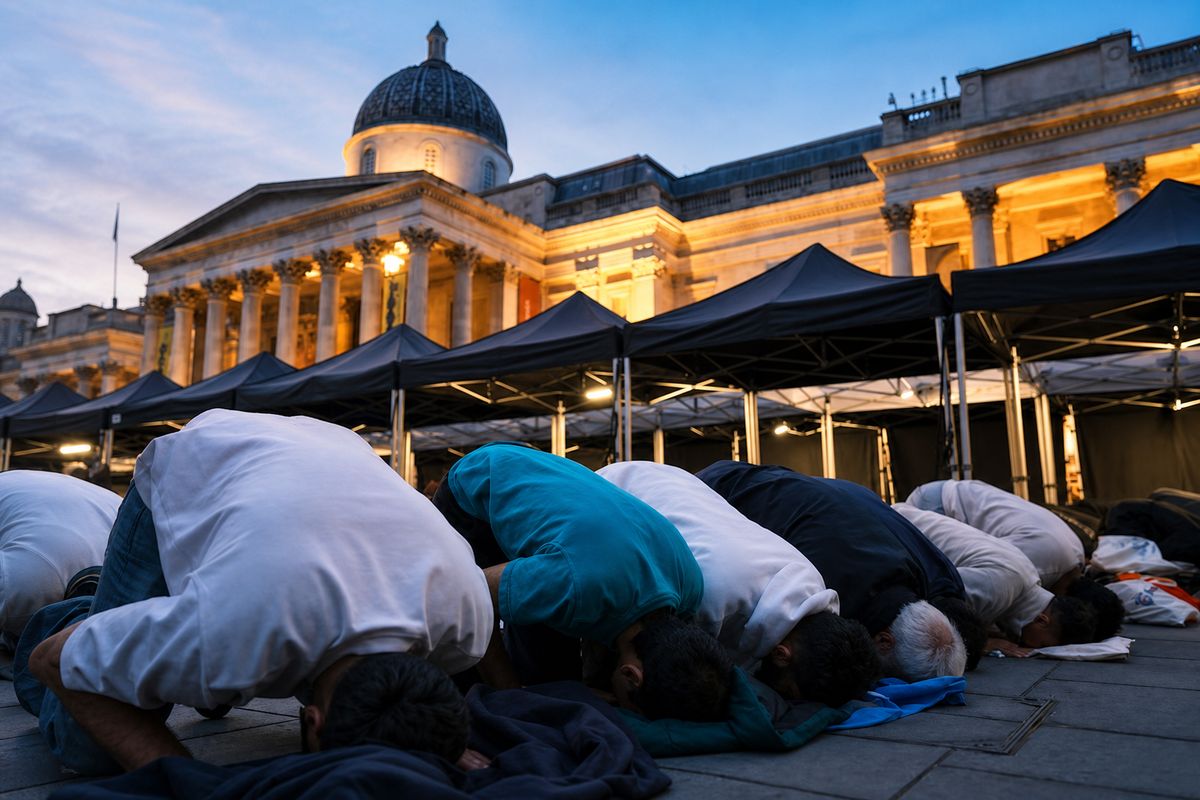
In late June 2026, a video of mass Muslim prayer in London's Trafalgar Square went viral. The footage showed hundreds of worshippers prostrating on the pavement during an open iftar event, with the sounds of the adhan echoing past Admiral Nelson's column. Within hours, Conservative MP Nick Timothy had posted a critical comment on X (formerly Twitter). And within days, Britain was locked in a furious national argument about where the line between religious expression and public domination falls.
Timothy, the shadow justice secretary, wrote that the gathering was "an act of domination and therefore division." He called the adhan "a declaration of domination" and said such "domination of public places is straight from the Islamist playbook." The response was immediate and polarised. Many thanked him for speaking out. Others, including senior Labour figures, denounced him as Islamophobic. Prime Minister Keir Starmer called Timothy's comments "appalling" and urged Conservative leader Kemi Badenoch to sack him. The row has become a defining test of Britain's attitudes to free speech, religious diversity, and the uses of its most iconic public spaces.
At stake is a fundamental question: in a secular society with a Christian heritage, should large-scale public Islamic prayer be celebrated as multicultural inclusion or criticised as a display of dominance? The answers, as this article will explore, reveal deep and uncomfortable divisions.

What Happened: The Event and the Furore
The open iftar in Trafalgar Square was organised as part of Ramadan celebrations, with the participation of London's mayor, Sadiq Khan. It featured a mass Islamic prayer service, including the call to prayer and congregational prostration. Videos circulated widely on social media, prompting Timothy's intervention.
The Conservative MP did not mince words. "Mass ritual prayer in public places is an act of domination," he posted. "The adhan – which declares there is no god but allah and Muhammad is his messenger – is, when called in a public place, a declaration of domination." He argued that performing such rituals in "our public places" rather than in mosques was deliberately provocative.
The backlash was swift. Labour's deputy leader, Lucy Powell, branded the tweet an "extreme reaction" and accused Timothy of whipping up "desperate hatred." Labour MP Uma Kumaran denounced his "blatant Islamophobia." Lib Dem MP Josh Babarinde called him a "racist prick." Even Starmer waded in, demanding that Badenoch denounce and sack him. Timothy, far from backing down, doubled down, arguing that he was merely stating what many Britons felt but were afraid to say.
The Digital Mobbing and Its Chilling Effect
Brendan O'Neill, writing in The Spectator, described the response as "profoundly chilling." He compared it to a witch hunt, with critics seeking to have Timothy "cast out" of public life. "Would you rather live in a society where a man is free to criticise religious practices or one where such a man might be dragged to the public square to be damned and shamed as a blasphemer?" he asked. O'Neill argued that Timothy's tormentors were the real threat to free speech, not the MP himself.
The row has exposed a deep fault line in British politics. On one side are those who see any criticism of Islamic practices as inherently racist. On the other are those who insist that questioning public displays of religious piety is a legitimate part of democratic debate. The battle lines are drawn not just between parties but within them, and across the broader culture.
Context and Comparisons: Why Public Prayer Feels Different
One of the most contentious aspects of the debate is the claim that Muslims are being "exceptionalised." Labour MP Naseem Shah, who has a history of controversial statements about Israel and Jews, argued that other faith groups regularly hold celebrations in Trafalgar Square. She pointed to Christmas carol services, Jewish Chanukah menorah lightings, and Hindu Diwali events.
But Jonathan Sacerdoti, a British journalist and commentator, pushed back hard. In The Spectator, he wrote that equating a Chanukah celebration with mass Islamic prayer is "intellectually dishonest" and "socially tone-deaf." He noted that the words "Allahu akbar" are the same ones shouted by terrorists in attacks across the West. "Instinctive reactions matter because they expose deeper dispositions," he wrote. "It is unsettling" to hear those same words echoing through Britain's most famous square.
Sacerdoti also highlighted the symbolism of the venue. Trafalgar Square commemorates a naval victory. The very room in Westminster Hall where Queen Elizabeth II and Winston Churchill lay in state had recently been used for Islamic prayer. "Both venues carry the weight of being iconic, historical settings which represent different branches of power in our nation," he observed. "They represent power through royalty, parliament, and military victory."
Theological and Political Dimensions
Behind the surface debate lies a deeper unease about Islam as a proselytising religion. Unlike Judaism, which actively discourages conversion, Islam has a concept of Dawah (invitation to the faith). The Spectator articles explicitly link this to the Islamist playbook of using public space to assert dominance. Critics of Timothy dismiss this as Islamophobic scaremongering. But the fear is real for many Britons, and it is not confined to the far right.
Even quiet, necessary prayer is usually uncontroversial. Sacerdoti noted that he has seen Muslim men praying at Ben Gurion Airport without anyone batting an eyelid, just as Jewish men wrap tefillin in airports worldwide. "These episodes tend be uncontroversial because they are clearly quiet, personal moments of religious reflection," he wrote. "Mass street worship is different." The distinction, he argued, is between private devotion and public spectacle with political overtones.
From Trafalgar Square to the Theatre: A Tale of Two Approaches to Inclusion
While the Trafalgar Square row dominated headlines, a quieter movement has been underway in Britain's arts sector. The hyphenonline.com article from February 2025 profiled pioneers making UK theatres more Muslim-friendly. Shahid Iqbal Khan's play "10 Nights" at Riverside Studios in Hammersmith was praised for centring Muslim experience with diverse casting and subtitles. But the venue lacked a dedicated prayer room, a common oversight.
Director Samir Bhamra said he always checks prayer times when planning a show. But Rhys Williamson, head of programming at Riverside Studios, acknowledged the gap: "If we had more Muslim representation in our office staff, that's something we could have proactively and instinctively thought to ask." Research from Arts Council England found that in London, where 46% of the population comes from minority ethnic backgrounds, people of colour accounted for only 5% of theatre employees.
Khayaal Theatre Company, based in Luton, has been a trailblazer. Since 1998, they have ensured that performances do not clash with salah (prayer), provided prayer spaces inside venues, and even held congregational prayers on stage during intermissions. They also do not serve alcohol, removing a major barrier for observant Muslims. As artistic director Luqman Ali put it: "Our mission is to make theatre spaces welcoming to Muslims."
This approach offers a stark contrast to the Trafalgar Square controversy. Here, accommodation is voluntary, sensitive, and collaborative. It is about making space within existing institutions, not demanding public squares for mass displays. The theatre example shows that Muslim inclusion need not be confrontational. But it also underscores how far the mainstream arts industry has to go.
The Bigger Picture
The Trafalgar Square row is not really about prayer. It is about power, symbolism, and the contested meaning of public space in a rapidly diversifying society. Britain is a secular country with a deep Christian heritage. Its national holidays, architecture, and legal framework are steeped in that tradition. The introduction of large-scale Islamic rituals into that landscape feels to many like a replacement, not an addition.
This is where the concept of "Islamophobia" becomes slippery. Critics of Timothy accuse him of racism. But the objection is not to Muslims as a racial group; it is to a particular form of religious practice that some perceive as assertive, even aggressive. As Brendan O'Neill noted, "It is not 'phobic' to raise concerns about public displays of religious fervour." In a free society, citizens must be able to question whether such spectacles align with secularist traditions and Christian history.
What most coverage misses is the asymmetry in how different faiths are received. Christmas carols in Trafalgar Square feel benign because they are part of the cultural mainstream. A Chanukah menorah lighting is a minority celebration that does not dominate the square. But an Islamic call to prayer, with its explicit declaration of Allah's supremacy and Muhammad as his messenger, carries a weight that is theological and political. It is not just a prayer; it is a statement. And in a country still grappling with the legacy of terrorism committed in Islam's name, that statement will inevitably provoke unease.
The theatre example offers a way forward: accommodation without conquest, inclusion without domination. But it requires goodwill on all sides. As long as critics of Islamic public prayer are branded as racists and heretics, that goodwill will remain scarce. And as long as mass street worship is presented as a right rather than a negotiation, the tensions will only deepen.
Conclusion: Free Speech or Blasphemy? The Choice Before Britain
The furore over Nick Timothy's tweet has laid bare a fundamental choice: do we want a society where people are free to criticise religious practices, or one where such critics are hounded from public life? Timothy's defenders say he is in tune with England's great traditions of liberty. His detractors say he is a bigot who needs to be silenced.
The truth is more complicated. Timothy's language was blunt and provocative. But the response to it was disproportionate and, in many ways, more dangerous to democratic debate. The calls for his dismissal from politics are a form of censorship that would have horrified the Enlightenment thinkers who shaped modern Britain.
Ultimately, the row over Muslim prayer in Trafalgar Square is not just about one event or one tweet. It is about how a diverse society negotiates its shared spaces and symbols. The easy answer is to call for dialogue and mutual understanding. The hard answer is to acknowledge that some differences may be irreconcilable, and that the right to express discomfort with religious practices is itself a fundamental liberty. That liberty is precious. It should not be sacrificed on the altar of a false, forced harmony.