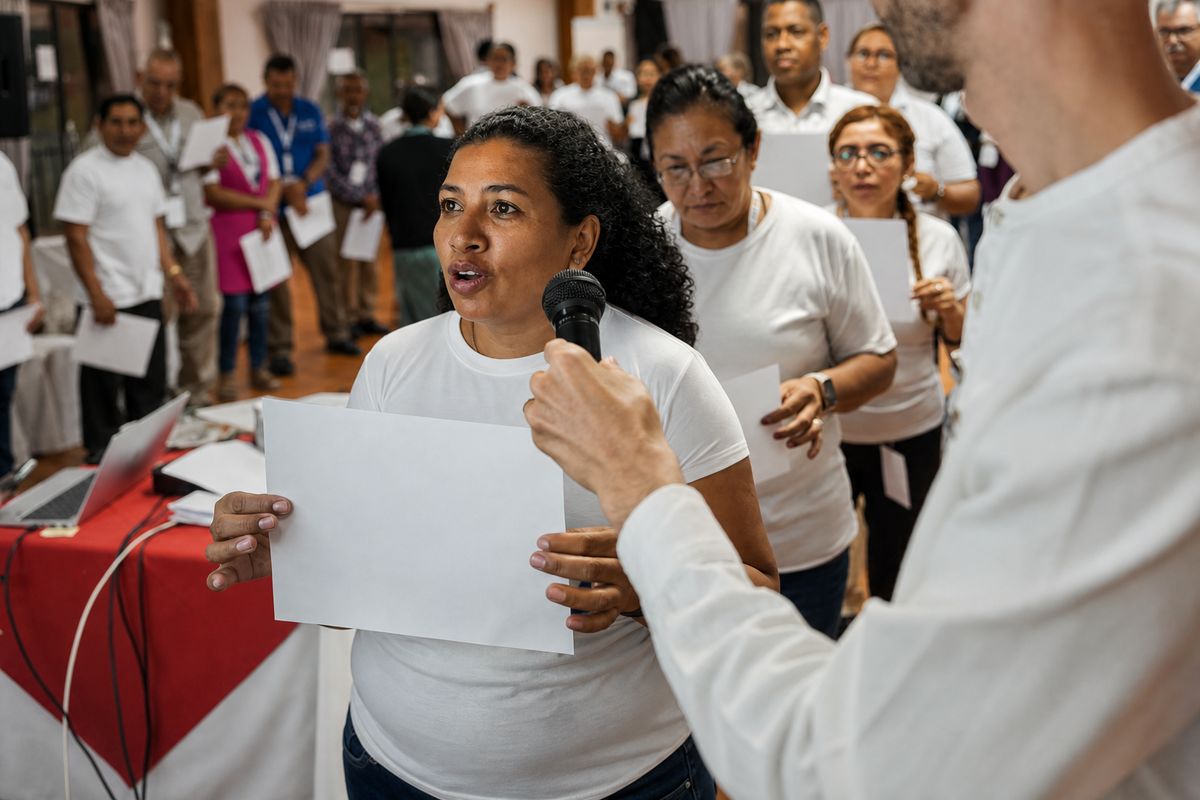
Families of missing persons conference, a rare global stage for a quiet crisis
The Families of missing persons conference is not a typical humanitarian summit. It is built around the people who usually get pushed to the margins, mothers, fathers, siblings, partners and children living with a question that never stops nagging. Where are they? And what happened?
In November 2025, that question sits at the centre of the fourth International Conference for Families of Missing Persons, hosted by the International Committee of the Red Cross (ICRC) alongside Red Cross and Red Crescent National Societies. The ICRC describes it as the only global forum of its kind, and the scale is striking: more than 900 participants from over 50 countries, joining in person and online. The event runs 11 to 13 November 2025 in a hybrid format, with Geneva as the anchor point.
And yes, it is a big deal. Disappearances are often treated as a side effect of war, migration routes, organised violence, or state repression. But for families, the disappearance is the main event, the thing that reshapes every decision, every relationship, every plan. The conference exists because families asked for it, first launched in Sarajevo in 2019, and now held every two years. That origin story matters, because it explains why the tone is different: less policy theatre, more lived reality.

Inside the fourth Families of missing persons conference, dates, format, and what makes it different
The ICRC’s 4 November 2025 news release sets out the structure clearly. The conference takes place 11 to 13 November 2025, hosted by the ICRC and National Societies, and it is designed as a confidential space dedicated to families. That confidentiality is not a footnote. In many contexts, searching for a missing relative can expose people to surveillance, intimidation, stigma, or scams. A protected environment is part of the humanitarian response, not a nice extra.
At the same time, the organisers make a deliberate shift in 2025: for the first time, the Opening and Closing Ceremonies are livestreamed and open to the public. The Opening Ceremony is scheduled for 11 November, 14:00 to 16:00 CET, featuring remarks by Pierre Krahenbuhl, the ICRC’s Director General, and testimonies from families. The Closing Ceremony is set for 13 November, 16:00 to 18:00 CET, with remarks by Cristian Rivier, head of the ICRC’s Central Tracing Agency (CTA), and the read out of a joint statement by families. The ICRC provides livestream links via its Missing Persons Platform pages, including its conference announcement.
The British Red Cross account adds texture from the ground. It describes 50 hubs around the world where families gather to participate, and highlights a UK hub hosted in Leeds, where a small group of people from Syria take part. Emily Knox, head of restoring family links at the British Red Cross, attends and reflects on sessions focused on memorials, visibility, advocacy, coping with loss, and practical safety while searching. Her piece, Families of missing persons conference, makes the point in plain language: families are not only grieving, they are also organising, learning, and protecting one another.
The scale of disappearances, what the numbers say, and what they do not
One of the few hard global figures available in the source material is sobering. The ICRC says that by the end of 2024, more than 284,000 people were registered as missing with the Family Links Network. It immediately adds a crucial caveat: this is only a fraction of the true global scale. That is not hedging, it is an honest description of the data problem. Many disappearances are never reported to the Red Cross and Red Crescent, some families cannot safely report, and in some places there is no trusted channel to do so.
The Family Links Network is the backbone of this work. It is the ICRC working with National Societies worldwide to search for missing people and reconnect families separated by conflict, disasters, or migration. The ICRC’s definition is also important for readers trying to understand the statistic: a person is considered missing from the moment a family registers them until the case is resolved, either by Red Cross and Red Crescent teams, or because the family reports they have found their loved one.
But the number alone does not capture the real weight of the issue. The ICRC points to the layered harms families face: stigma, financial hardship, legal obstacles, and the psychological toll of uncertainty. The British Red Cross uses a term that clinicians and researchers increasingly rely on in this context: ambiguous loss. It is grief without an ending, mourning without a body, hope that keeps flickering even when it hurts. And that ambiguity can echo across generations, as Knox notes, shaping children who grow up around absence and unanswered questions.
Who is involved, and why families are being positioned as experts
The conference is hosted by the ICRC and National Societies, but the messaging is explicit: families are not passive recipients of help. They are central actors. Cristian Rivier, as head of the ICRC’s Central Tracing Agency, frames it as a rights issue as much as a humanitarian one: families have the right to know what happened to their loved ones. He also links the response to longer term needs that are often ignored in emergency coverage, including legal, administrative, economic, and psychosocial support.
Caroline Douilliez, head of the CTA Advisory Centre, goes further, arguing that those addressing missing persons must position families and their experience and expertise at the centre of any effort, while ensuring safety and well being. That line matters because it pushes back against a common institutional reflex: treating families as sources of testimony rather than partners in design. In practice, families often know the patterns, the routes, the detention sites, the local power structures, and the risks. Ignoring that knowledge is not only disrespectful, it is ineffective.
The British Red Cross story gives a human example through Rima, a family member supported by the organisation who speaks during the final ceremony. Her quote is not a policy demand, it is a description of impact: hearing stories of families reunited and the efforts of tracing teams inspires her to get involved. She also uses a metaphor of five fingers becoming a powerful hand when united, a simple image, but one that captures the conference’s purpose: solidarity as a form of strength when institutions move slowly.
What the joint call for action is really asking for, and why it lands now
At the end of the conference, families issue a joint public statement, shared with media under embargo until 13 November 2025, 16:30 CET, and read aloud at the Closing Ceremony. The ICRC includes a short excerpt that is worth sitting with: “Experiencing disappearance dismantles the foundation of family and community. We appeal to the world to hear us and amplify our voice. Together we can make a difference.” It is not technical language. It is a direct appeal for attention and action, and it frames disappearance as social damage, not only personal tragedy.
The British Red Cross summary of the statement adds more detail about what families want from the outside world. They ask the media to make their voices louder, they ask for support from civil society, and they call for legal frameworks and tools that allow families to take part in the search process. They also ask for the creation of places to remember missing loved ones, which might sound symbolic, but is actually practical. Memorials, rituals, and objects can be coping mechanisms, and they can also be public records of absence, a way of resisting erasure.
There is also a darker, very current thread running through the British Red Cross account: safety. Knox notes that people desperate for news can be targeted with fraud and exploitation. That is a reminder that disappearances create an information vacuum, and vacuums get filled, sometimes by criminals. So when families ask for tools and frameworks, they are also asking for safer pathways to information, verification, and accountability.
Industry and policy implications, why missing persons work is becoming central to peace and reconciliation
The ICRC makes a claim that is both moral and strategic: disappearances are preventable, and states and parties to conflicts have the primary responsibility under international law to prevent people from going missing, clarify the fate of the missing, and support families. That is a direct challenge to the idea that missing persons are an unavoidable by product of chaos. It reframes the issue as something shaped by choices: detention practices, record keeping, battlefield conduct, migration enforcement, and whether authorities cooperate with tracing efforts.
It also ties missing persons work to outcomes that governments say they want. The ICRC points to experience from Colombia, the Balkans, and other contexts, arguing that resolving missing persons cases is essential for peace processes, reconciliation, and community recovery. The source material does not provide case statistics from those regions, so it is not possible to quantify the effect here. But the logic is straightforward: when families are left in limbo, mistrust hardens. When answers arrive, even painful ones, societies have a better chance of moving from rumour and grievance to record and accountability.
For the humanitarian sector, the conference signals a shift in how success is measured. Reuniting families is the most visible outcome, but the ICRC and British Red Cross both emphasise longer term support, legal and administrative help, psychosocial care, and safe participation. That pushes organisations to invest in sustained services rather than short project cycles. And it nudges donors and policymakers to accept that “closure” is not a quick deliverable. Sometimes the most honest outcome is a verified fate, not a reunion.
Historical context, from Sarajevo 2019 to a hybrid global forum
The conference begins in Sarajevo in 2019, launched at the request of families. That detail is more than a timeline marker. Sarajevo is a city shaped by war, siege, and the long afterlife of missing persons cases. Starting there signals that this is not abstract humanitarianism. It is rooted in places where disappearances have been systematic, politicised, and painfully slow to resolve.
By 2025, the event is biennial and global, and the hybrid model matters. It allows participation from families who cannot travel for financial, legal, or safety reasons. It also creates a network effect: hubs in different countries, connected sessions, shared practices. The ICRC mentions live multilingual interpretation from its Humanitarium studio in Geneva, which is not glamorous, but it is essential. If families cannot speak in their own language, they cannot fully participate, and the whole “families at the centre” promise falls apart.
The British Red Cross snapshot of memorial practices shows how knowledge travels in this setting. Families share rituals, songs, objects, and methods of remembrance, including pillows printed with faces to hug, boxes of mementos, and even a cookbook designed to bring people back to happier memories of eating together. None of that replaces investigations or legal processes, obviously. But it does show how families build parallel systems of meaning when formal systems fail them. And those systems can become the seeds of public memory later on.
What's Next
The most immediate next step is visibility. The decision to livestream the Opening and Closing Ceremonies in 2025 sets a precedent. If it continues in future editions, it could change how missing persons issues are covered, moving them from occasional human interest features to a more regular part of conflict, migration, and justice reporting. Families explicitly ask the media to amplify their voice, and livestreaming makes it harder for editors to claim there is no access point.
Policy wise, the pressure is likely to build around participation and protection. Families are asking for legal frameworks and tools that let them take part in the search process. That implies more formal channels for submitting information, receiving updates, and challenging inaction, while also safeguarding families from retaliation and scams. Expect more attention to practical guidance on safe searching, because fraud and exploitation thrive where official information is scarce. Humanitarian organisations may increasingly need to act as trusted intermediaries, not only searchers.
And there is a longer arc here that should not be ignored. The ICRC frames missing persons work as key to peace and reconciliation, not an optional add on. If that argument gains traction, future peace processes and post conflict recovery plans may be judged partly on whether they include credible mechanisms to clarify the fate of the missing and support families over years, not weeks. That is a higher bar. But fair enough, the alternative is leaving hundreds of thousands of families, at least those registered, and likely far more, stuck in permanent uncertainty.
Closing thoughts, why this conference matters beyond Geneva
The fourth International Conference for Families of Missing Persons is, in one sense, a gathering. In another, it is a corrective. It insists that disappearances are not background noise, and that families are not footnotes. The ICRC’s language is clear: behind every missing person is a family living in uncertainty and pain, and meeting their long term needs is a humanitarian imperative.
It also shows how the Red Cross and Red Crescent ecosystem operates when it is at its best: global reach, local hubs, confidential spaces, and a willingness to let families lead. The British Red Cross hub in Leeds, with Syrians participating, is a reminder that this is not only “over there”. Migration, conflict, and separation land in UK communities too, and the pain does not respect borders.
Ultimately, the conference’s power comes from something simple. Families are asking to be heard, and to be involved, and to be protected while they search. They are also asking the world to treat disappearance as preventable, and therefore as a responsibility. That is an uncomfortable message for states and armed actors. But discomfort is sometimes the point. If the conference achieves anything lasting, it will be that missing persons are no longer treated as an inevitable tragedy, but as a problem that can, and must, be solved.