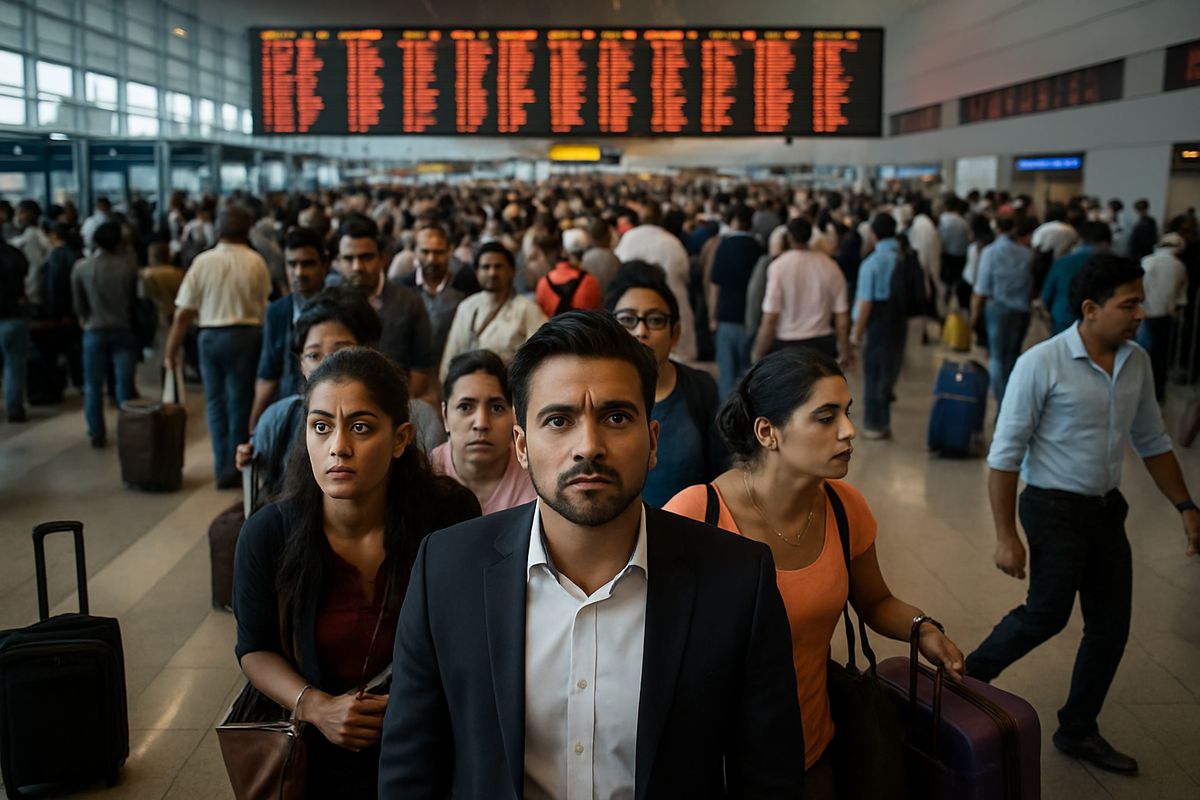
Widespread Cancellations Paralyze Key Saudi Aviation Hub
On March 8, 2026, King Khalid International Airport (RUH) in Riyadh became the epicenter of a significant international travel disruption. A total of 21 flight cancellations and one major delay stranded hundreds, if not thousands, of passengers and rippled across some of the world's busiest air corridors. The cancellations were not isolated to a single airline but represented a multi-carrier crisis, impacting major global operators including Qatar Airways, IndiGo, KLM, Air France, Air India, Saudia, and Etihad Airways. The affected routes connected the Saudi capital to critical international hubs in Doha, Delhi, Mumbai, Amsterdam, Paris, Bengaluru, and Hyderabad, demonstrating the airport's role as a pivotal node in global aviation networks linking the Middle East, South Asia, and Europe.
The scale of the disruption was substantial. Qatar Airways bore the brunt with nine cancellations, primarily on its high-frequency shuttle to Hamad International Airport in Doha. IndiGo, India's largest carrier, faced seven cancellations, severing connections on one of the world's busiest labor and family travel corridors between Saudi Arabia and major Indian cities. European carriers KLM and Air France saw multiple cancellations to Amsterdam and Paris, respectively. The single delay reported for Etihad Airways, while less severe, added to the overall climate of uncertainty for travelers. This event forced airlines to scramble for rebooking solutions and left passengers facing extended, unplanned stays in Riyadh, with the financial and logistical burdens that entails.

Dissecting the Disruption: Airlines and Routes Most Affected
A closer examination of the flight data reveals a clear pattern of disruption centered on key geopolitical and economic routes. The most severely impacted connection was between Riyadh and Doha. The nine cancelled Qatar Airways flights underscore the volume of traffic on this route, which serves as a critical link for business, diplomatic, and connecting travel through Qatar's mega-hub. This corridor has historically been sensitive, having been completely shut down during the Saudi-led blockade of Qatar from 2017 to 2021. Its prominence in this disruption event is therefore particularly notable.
The second major axis of disruption was the Saudi-India corridor. IndiGo's seven cancellations, supplemented by one from Air India, hit flights to Delhi's Indira Gandhi International Airport, Mumbai's Chhatrapati Shivaji Maharaj International Airport, Bengaluru's Kempegowda International Airport, and Hyderabad's Rajiv Gandhi International Airport. This route is among the most trafficked in the world, fueled by a vast Indian expatriate workforce in the Gulf, robust business ties, and tourism. The simultaneous cancellation of multiple flights on March 8 would have created a significant backlog of passengers, given the typically high load factors on these sectors.
European Connections and the Ripple Effect
While the Middle East and South Asia links saw the highest number of grounded flights, the cancellation of KLM and Air France services to Amsterdam and Paris extended the disruption's reach into the heart of Europe. These routes cater to business travelers, European expatriates, and tourists connecting through major European hubs. The impact, therefore, was not confined to passengers destined for Saudi Arabia or originating there; it also affected travelers using Riyadh as a transit point or those in Europe whose travel plans depended on connections from Schiphol or Charles de Gaulle. This wide geographic spread turned a local airport issue into an international travel headache.
Contextualizing the Crisis: A Region on Edge
The source material explicitly links this operational crisis to "wider Middle East aviation instability linked to the ongoing U.S.–Israel conflict with Iran." This is a crucial piece of context. Aviation is exceptionally sensitive to geopolitical tension, especially in a region where airspace is complex and contested. While the source article does not specify the exact cause of the cancellations—be it airspace closures, heightened security alerts, crew scheduling issues due to rerouting, or a combination—the timing and location are telling. King Khalid International Airport, as a major gateway to a nation deeply involved in regional security dynamics, is on the front line of any aviation instability.
This event did not occur in a vacuum. It was preceded by proactive measures from regional carriers hinting at anticipated turbulence. For instance, the related headline noting that "Saudia extends suspension of flights to six regional destinations until March 8" indicates that the Saudi national carrier had already been curtailing its network to certain locations, likely due to security or operational concerns stemming from the same regional tensions. Furthermore, the advisory that "Saudi passengers urged to verify flight updates from airlines before heading to airport" points to an environment of expected unpredictability, where last-minute changes had become the norm rather than the exception. The March 8 cancellations represent the materialization of those widespread fears into a large-scale, multi-airline operational breakdown.
Operational and Reputational Fallout for Airlines and Airports
For the airlines involved, an event of this magnitude triggers a cascade of costly challenges. Immediate costs include passenger re-accommodation on other flights, which may involve booking on rival carriers, providing hotel vouchers and meal allowances for stranded passengers, and managing customer service crises. Longer-term, there is significant reputational damage. Airlines like Qatar Airways and IndiGo pride themselves on operational reliability, especially on their core routes. A mass cancellation event undermines traveler confidence and can influence future booking decisions, particularly for business travelers and those visiting family for critical occasions.
For King Khalid International Airport itself, this is a stark test of its crisis management and passenger welfare protocols. As Saudi Arabia aggressively pursues its Vision 2030 goals, which include transforming the Kingdom into a global tourism and logistics hub, the performance of its flagship airports is under a microscope. Mass strandings contradict the narrative of a smooth, welcoming, and efficient travel experience. The airport authority, along with the Saudi General Authority of Civil Aviation (GACA), would have been under pressure to coordinate with airlines, manage crowd control in terminals, and provide clear communication—a difficult task when the root causes may be linked to fast-moving geopolitical events beyond their direct control.
The Bigger Picture: Aviation as a Geopolitical Barometer
This disruption at King Khalid International Airport is not merely an operational hiccup; it is a potent demonstration of how commercial aviation serves as a real-time barometer of geopolitical stability. The concentration of cancellations on routes to Doha and to India is highly symbolic. The Doha route is a bellwether for intra-Gulf relations, which have been in a state of careful recalibration since the Al-Ula reconciliation in 2021. Its vulnerability indicates that beneath the surface diplomacy, operational realities remain fragile when broader regional tensions flare. The heavy impact on India flights highlights the economic and human vulnerability of the Gulf's reliance on South Asian labor and connectivity. When aviation between these regions stutters, it doesn't just delay tourists—it impacts remittance flows, project timelines, and family reunifications.
Historically, similar patterns have emerged during periods of tension. The aftermath of 9/11, the 2010 Eyjafjallajökull ash cloud, the Gulf diplomatic crisis of 2017-2021, and the initial COVID-19 groundings all showed how aviation networks are the first to fracture and the last to heal during global crises. The March 8 event fits into this pattern but with a 21st-century twist: the instability is driven not by a bilateral dispute or a natural disaster, but by a multi-faceted, protracted geopolitical standoff involving state and non-state actors across the region. This makes the risk less predictable and more persistent. Airlines are now forced to bake in a constant "geopolitical disruption premium" into their operations in the Middle East, affecting scheduling, insurance costs, and route planning in ways that will ultimately be passed on to the passenger.
Furthermore, this incident exposes the strategic dilemma for global aviation. Hubs like Doha, Dubai, and Istanbul have thrived by positioning themselves as stable connectors between East and West, even during regional turmoil. Riyadh, with its massive investments in a new airline and airport, aims to join this club. However, events like March 8's cancellations reveal that when the core region itself is unstable, the entire network's resilience is tested. It pushes airlines to consider longer, more expensive routings to avoid hotspots, challenging the economic model of Middle East mega-hubs. The future of efficient global connectivity may increasingly depend not just on airport infrastructure and airline service, but on diplomatic de-escalation and regional security frameworks that keep critical airspace open and safe.
Navigating an Era of Unpredictable Travel
The mass cancellations at King Khalid International Airport on March 8, 2026, serve as a stark reminder that in the interconnected world of aviation, a disruption in one key node can have global consequences. For passengers, the lesson is clear: in the current climate of Middle Eastern aviation, flexibility and robust travel insurance are not luxuries but necessities. The related advisory urging passengers to verify flight updates directly from airlines before heading to the airport is prudent, standard advice that has taken on new urgency.
For the industry, the event underscores the need for more resilient network planning and transparent communication protocols during crises that are geopolitical in origin. As long as the underlying tensions referenced in the source material persist, the risk of repeat incidents remains high. The recovery from this specific event will be measured in days as airlines reposition aircraft and crews. However, the restoration of long-term confidence in the stability of Middle Eastern aviation corridors will be a much longer journey, one inextricably linked to the diplomatic and security landscape far beyond the airport tarmac. The skies over Riyadh, and indeed the entire region, will remain a space to watch not just for travelers, but for analysts gauging the health of international relations.