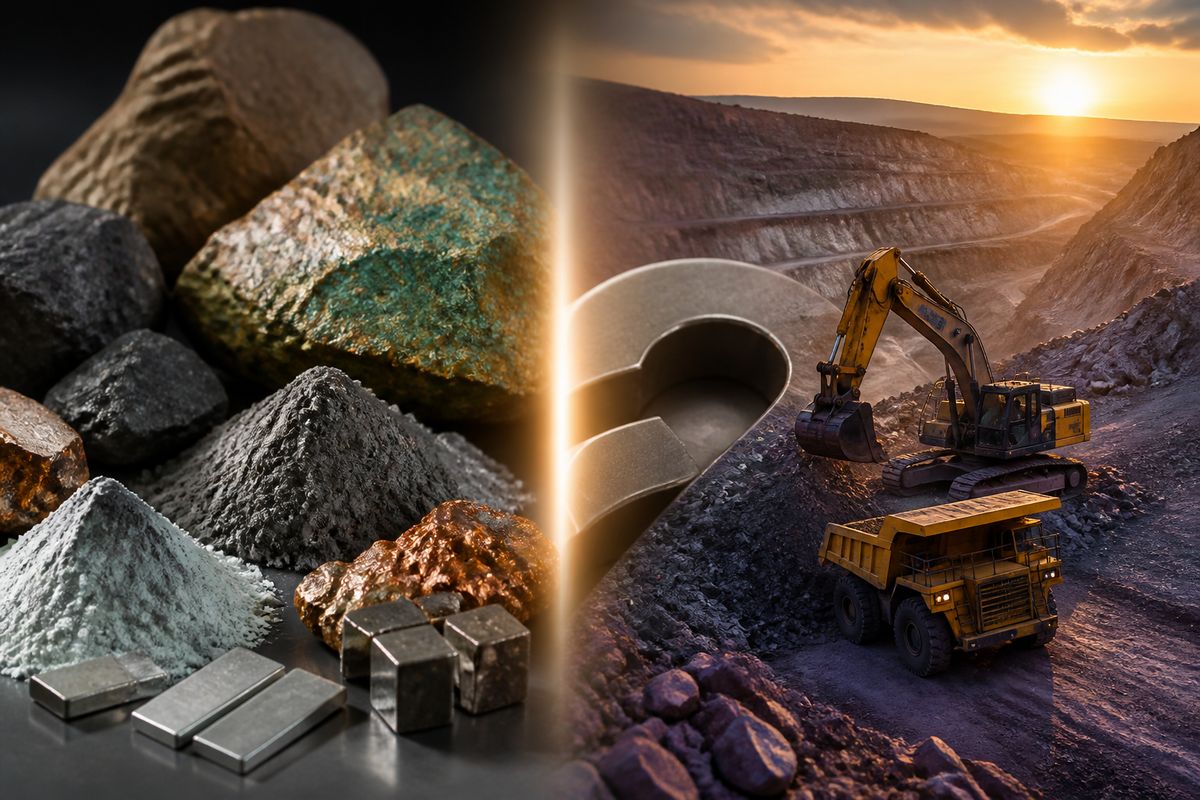
Critical minerals investing in 2026, governance certainty vs magnet-metal upside
Critical minerals are no longer a niche corner of the market, they are a live question for investors, manufacturers, and governments trying to keep electrification plans on track. And right now, two very different kinds of “news” land on the desk at the same time. On one side, Technology Minerals Plc, a UK listed battery metals resilience play, announces a change of external auditor in London. On the other, a US distributed market commentary hypes a new wave of rare earth magnet projects, with Greenland Mines Ltd closing an acquisition in Greenland that it frames as strategically significant for neodymium and praseodymium supply outside China.
They sound like different worlds, because they are. But for anyone trying to decide where the smarter exposure sits in 2026, the comparison is useful. One story is about corporate plumbing, audit oversight, and the kind of governance signals that can matter a lot for smaller listed companies. The other is about strategic materials, supply chain geopolitics, and the sheer difficulty of building new rare earth capacity fast enough to meet demand from EVs, wind turbines, robotics, advanced electronics, and defence.
This guide sets the two narratives side by side: Technology Minerals’ auditor switch versus rare earth magnet miners’ growth pitch. It is not a price target exercise, and it does not pretend these are directly comparable businesses. But it does answer the practical question many readers face: in the critical minerals theme, is the bigger near term signal coming from governance and reporting stability, or from the magnet metals land grab?

Critical minerals news event, what actually happened this week
Technology Minerals Plc (LSE: TM1) announces on 3 September 2026 that it appoints RPG Crouch Chapman LLP as its external auditor with immediate effect. The appointment follows the resignation of PKF Littlejohn LLP. PKF Littlejohn confirms to the company that there are no circumstances connected with its resignation that it considers should be brought to the attention of members or creditors. In plain English, the outgoing auditor is not flagging a dispute or a red flag in the formal way auditors sometimes do.
For a UK listed company, an auditor change is not automatically dramatic. But it is never nothing either. Audit firms resign for mundane reasons, capacity constraints, fee discussions, risk appetite, or strategic focus. Investors tend to ask the same questions every time: why now, what changes in the audit approach, and does it affect reporting timelines or confidence in the numbers? Technology Minerals’ statement, as provided in the source material, does not go beyond the appointment and the “no circumstances” confirmation.
In the rare earth corner, the headline development is more operational and more promotional. A market commentary dated 2 September 2026 argues rare earths could be the mining sector’s next billion dollar opportunity, driven by demand for neodymium, praseodymium, dysprosium and terbium, the key ingredients for high performance permanent magnets. It cites the International Energy Agency expectation that demand climbs another one third by 2030, and states demand for magnet rare earths has already doubled since 2015. It also frames supply chain diversification away from China as a national security priority.
Within that same commentary, Greenland Mines Ltd (NASDAQ: GRML) says it closes the acquisition of the Sarfartoq Nd Pr Rare Earths Project in southwest Greenland on Tuesday, 1 September 2026, following Greenland government approval. The company’s president, Dr Bo Møller Stensgaard, describes Sarfartoq as a top tier upstream magnet project and claims that at 2025 consumption levels, planned annual NdPr oxide production from the ST1 deposit alone would represent roughly 34 percent of all NdPr oxide refined outside China for each of the project’s nine scheduled operating years. The commentary also references an independent initial assessment with a high case pre tax NPV of about $2.05 billion and a pre tax IRR of 118.6 percent, based entirely on ST1.
Critical minerals basics, battery metals vs magnet rare earths
Before comparing the two, it helps to be clear about what “critical” means in policy terms, because it is not just marketing. Under the US Energy Act of 2020, a critical mineral is any mineral, element, substance, or material designated as critical by the Secretary of the Interior acting through the US Geological Survey. A critical material is defined as a non fuel mineral, element, substance, or material that the Secretary of Energy determines has a high risk of supply chain disruption and serves an essential function in one or more energy technologies, or it can be a critical mineral as designated by Interior.

The US Department of Energy’s methodology, published in a comprehensive assessment in 2023, looks at two big axes: supply risk and importance to energy technologies. Supply risk includes availability, competing demand, political and regulatory factors, codependence on other markets, and producer diversity. Importance considers energy demand and substitutability. That framework is useful because it explains why some materials become strategic headaches even when the raw geology is not rare. Processing, permitting, and concentration of supply can do the damage.
In energy applications, the DOE lists a wide set of materials used in batteries and storage, including lithium, nickel, cobalt, graphite, manganese, copper, aluminium and more. For magnets and motors, the list includes neodymium, praseodymium, dysprosium, terbium among others. These are different bottlenecks. Battery metals are about scaling huge volumes and managing price cycles. Magnet rare earths are about a tighter set of specialised materials, where processing and separation capability can be as decisive as the mine itself.
That is why the two news items, auditor change at a UK battery metals resilience company and acquisition closure at a magnet rare earth project developer, can be read as two sides of the same critical minerals coin. One is about the credibility and continuity of disclosure. The other is about the race to secure non Chinese supply of a very specific set of inputs that sit inside motors, turbines, and defence systems.
Technology Minerals vs rare earth magnet miners, what each story signals
Technology Minerals positions itself as a UK listed company focused on building national resource and manufacturing resilience in the battery metals sector. The auditor appointment of RPG Crouch Chapman LLP, following PKF Littlejohn’s resignation, is a governance event. It is about the machinery that underpins annual reports, interim statements, and the credibility of financial controls. For smaller listed companies, that matters because access to capital can hinge on whether investors believe reporting is robust and timely.
The key line in the announcement is the outgoing auditor’s confirmation that there are no circumstances connected with its resignation that should be brought to members or creditors. That does not prove everything is perfect, and it is not a guarantee against future issues. But it does reduce the immediate fear that the resignation is a protest over accounting treatment or an unresolved dispute. In the UK market, that distinction can be the difference between a shrug and a full blown confidence wobble.
Rare earth magnet miners, as framed by the market commentary, are selling a different signal: scarcity, strategic leverage, and potential valuation re rating if projects move from exploration and assessment into construction and offtake agreements. Greenland Mines’ Sarfartoq acquisition is presented as a step change, moving from a deal narrative to “boots on the ground” development. The company says its technical team returns to Sarfartoq in September 2026 and that it moves immediately from acquisition to resource growth development.
But it is worth being a bit hard headed here. The commentary provides eye catching economics for Sarfartoq’s initial assessment, including a high case pre tax NPV of $2.05 billion and pre tax IRR of 118.6 percent. Those are not trivial numbers. Yet they are still, by definition, assessment stage outputs, and the source material does not provide the assumptions, capex, opex, or price deck behind them. Investors comparing this to a governance update should recognise they are comparing different types of uncertainty: reporting and oversight risk versus project execution and commodity risk.
Side by side comparison, governance catalyst vs supply chain catalyst
To make the decision clearer, it helps to lay out what each development tends to mean in practice. An auditor change can be a short term distraction, or it can be a reset that improves audit fit and reduces future friction. A project acquisition closure in rare earths can be a genuine strategic milestone, or it can be the start of a long, expensive, and politically sensitive build out where the hardest part is not mining, but processing and separation.

The table below compares the two “options” as they appear in the source material. It is not a ranking of companies. It is a comparison of the type of signal each headline sends into the market in 2026.
| Dimension | Technology Minerals, auditor change | Rare earth magnet miners, Sarfartoq style acquisition |
|---|---|---|
| What happened | RPG Crouch Chapman LLP appointed auditor, PKF Littlejohn LLP resigns | Greenland Mines closes Sarfartoq Nd Pr project acquisition on 1 September 2026 |
| Primary market signal | Governance and reporting continuity, reduced immediate concern via “no circumstances” statement | Strategic supply chain positioning, non Chinese magnet metals narrative |
| Key materials focus | Battery metals resilience theme, specific materials not listed in the announcement | NdPr, plus broader magnet rare earths like dysprosium and terbium |
| Time horizon implied | Immediate effect on audit process and upcoming reporting cycles | Multi year development pathway, resource growth and eventual production |
| Quantitative details provided | None beyond firm names and the “no circumstances” confirmation | Claimed 34% of NdPr refined outside China at 2025 consumption levels, high case NPV $2.05bn, IRR 118.6% |
| Main risk category | Perception risk if investors suspect deeper reasons for auditor exit, plus execution of audit transition | Project execution, permitting, processing complexity, commodity price sensitivity, geopolitical scrutiny |
There is also a subtle point about information quality. The Technology Minerals item is a straightforward corporate announcement, reviewed and presented as a press release style update. The rare earth piece is a market commentary that includes forecasts and promotional language. Some of its numbers may be accurate, but the reader should treat it as a higher hype format and look for corroboration in formal filings and technical reports, which are not included in the source material here.
Still, the magnet metals thesis is not exactly outlandish. The DOE’s own framing of critical materials is built around supply disruption risk and importance to energy technologies. Permanent magnets sit inside the hardware of electrification. If demand rises and supply remains concentrated, the strategic premium is real, even if individual projects take years to deliver.
Pros and cons, stability play vs high beta strategic metals
Investors often pretend they are choosing between “good” and “bad” news. In reality, they are choosing between different mixes of risk. The lists below summarise the trade offs implied by the two headlines, sticking to what can be supported by the source material.
Option A: Technology Minerals, auditor appointment
Pros
- Clear governance action, a named auditor (RPG Crouch Chapman LLP) is in place with immediate effect.
- Reduced immediate alarm, PKF Littlejohn confirms no circumstances connected with its resignation should be raised to members or creditors.
- Fits the 2026 policy mood, the company’s stated focus on battery metals resilience aligns with critical materials priorities in energy storage.
Cons
- Limited detail, the announcement does not explain why the resignation occurs or what changes in audit scope or timing.
- Transition risk, any auditor change can create friction in the next reporting cycle, even when everything is above board.
- No operational catalyst in the headline, it is governance news, not a project milestone.
Option B: Rare earth magnet miners, Sarfartoq acquisition narrative
Pros
- Direct exposure to magnet rare earths, neodymium and praseodymium are central to high performance permanent magnets.
- Strategic supply chain angle, the commentary explicitly frames diversification away from China as a priority.
- Specific project claims, Sarfartoq is presented with quantified potential significance, including the 34% outside China NdPr refining comparison at 2025 consumption levels.
Cons
- Promotional framing, the source is a market commentary format, not a neutral technical summary, and assumptions behind NPV and IRR are not provided here.
- Execution complexity, rare earth projects often hinge on processing and separation, not just mining, and the source material does not detail the processing route.
- Long lead times, acquisition closure is a milestone, but it is early compared with construction, commissioning, and stable production.
Put bluntly, Technology Minerals’ update is the kind of thing that can calm nerves or raise eyebrows depending on what comes next. The rare earth story is the kind of thing that can light up a thematic portfolio, but it can also burn investors who underestimate how long it takes to turn a “world class” deposit into a reliable supply chain.
And there is a wider industry implication here. Critical minerals policy is increasingly about bankability. Governments and manufacturers want supply, yes, but they also want counterparties with credible reporting, governance, and delivery. In that sense, audit and assurance are not boring footnotes. They are part of the infrastructure of trust that lets projects get financed.
Historical context, why these two signals keep repeating
The tug of war between governance signals and resource nationalism is not new, it just has a new cast. In previous commodity cycles, investors chased the biggest deposits and the loudest stories, then got reminded that financing, permitting, and operational discipline decide who survives. Critical minerals add another layer: the buyer is often not a spot market trader but an industrial customer with long qualification cycles and reputational risk. That tends to reward companies that can demonstrate control, documentation, and consistency.
From the policy side, the DOE’s critical materials framework shows why the conversation has shifted from “is it rare?” to “is it vulnerable?”. Supply risk is not just geology. It is producer diversity, political and regulatory factors, and codependence on other markets. Rare earths are the textbook case, because the supply chain has historically been concentrated, and processing capability is unevenly distributed. That is why the market commentary leans so heavily on the “outside China” framing.

At the same time, the battery metals story has its own history of boom and bust, with waves of enthusiasm followed by price resets and project delays. A company that talks about national resource and manufacturing resilience is implicitly responding to that volatility, and to a policy environment that wants domestic or allied supply chains. In that environment, a clean auditor transition, with an explicit “no circumstances” statement from the outgoing firm, is a small but meaningful piece of reputational scaffolding.
So yes, these signals repeat because the underlying tensions repeat. The world wants more electrification hardware. The inputs are constrained. Capital is cautious. And credibility, whether in financial reporting or technical delivery, becomes a competitive advantage rather than a box ticking exercise.
The Verdict, which critical minerals angle looks stronger in 2026?
The right choice depends on what the reader is actually trying to achieve. If the goal is lower drama exposure to the critical minerals theme, the Technology Minerals style headline is the more grounded signal. An auditor appointment is not exciting, fair enough, but it speaks to the basics: can the company keep its reporting house in order, and can it avoid the kind of governance fog that scares off long term capital? The outgoing auditor’s statement that there are no circumstances to raise is particularly important in that context, because it narrows the range of worst case interpretations.
If the goal is high beta upside tied to magnet metals scarcity, the rare earth magnet miner narrative is the one with the bigger potential catalyst. The commentary’s core argument, that demand for magnet rare earths has doubled since 2015 and is expected to rise another one third by 2030, fits the broader electrification and defence modernisation story. Greenland Mines’ Sarfartoq acquisition closure on 1 September 2026 is a tangible milestone, and the project is framed with unusually bold claims about NdPr supply outside China, plus high case economics in its initial assessment.
But the recommendation, based strictly on what is in the source material, is to treat them as different tools. For risk aware investors, governance certainty comes first, and an auditor transition with a clean “no circumstances” note is a positive, if modest, datapoint. For thematic investors who can tolerate long timelines and execution risk, magnet rare earth projects may offer the sharper strategic edge, but only if the hype is matched by credible technical delivery and financing, details that are not provided in the material here. In 2026, the smartest stance is not picking one story and ignoring the other. It is recognising that critical minerals winners need both, a compelling asset and the boring, essential credibility that lets the market fund it.
Closing thoughts, what to watch next
For Technology Minerals, the next questions are procedural but important. Does the auditor change affect the timing of upcoming accounts? Does the company provide more colour on the transition, scope, and audit plan? And does the market treat the appointment of RPG Crouch Chapman LLP as a neutral swap, or as a signal about the company’s scale and risk profile? Those are not glamorous questions, but they are the ones that decide whether institutions stay engaged.
For the rare earth magnet miners, the watch list is more operational. Greenland Mines says its technical team returns to Sarfartoq in September 2026 and that it moves immediately into resource growth development. Investors should look for evidence of that progress, and for clarity on how the project plans to navigate the real choke points in rare earths, processing, separation, and qualification. The strategic narrative is powerful, but the industry has learned, sometimes the hard way, that strategic does not automatically mean investable.
And zooming out, the DOE’s critical materials framing is the reminder that this is not a passing fad. Supply risk and importance to energy technologies are now baked into policy and procurement. That keeps the pressure on both ends of the market: companies must build assets that matter, and they must run themselves in a way that makes partners and financiers comfortable. In critical minerals, the future belongs to the firms that can do both, even when the headlines look wildly different.