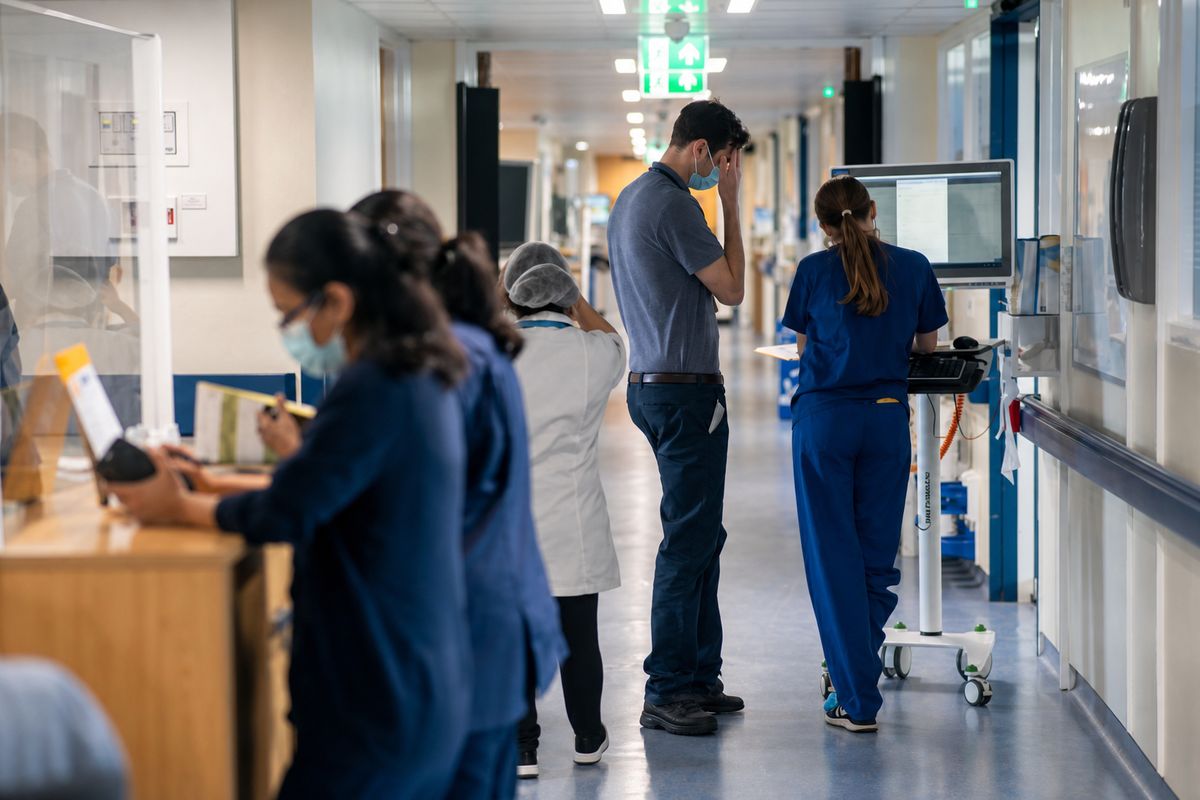
Critical Incident Stood Down, But Winter Pressures Leave A&E on the Brink
NHS trusts in the West of England have stood down critical incidents declared last week amid surging flu, norovirus, and demand. But health leaders are warning that so-called 'significantly long' A&E wait times are far from over. Meanwhile, a separate but deeply connected crisis is unfolding in Sussex, where end-of-life patients are increasingly being treated in corridors and ambulances, forcing clinicians to make impossible choices about who gets a bed. These two stories, separated by geography, are symptoms of the same systemic illness: a health and social care system that is buckling under chronic underfunding, a workforce in burnout, and a winter that never seems to end.
On 14 January 2025, NHS Gloucestershire and NHS Somerset declared critical incidents after high levels of seasonal illness and a surge in demand overwhelmed emergency departments. Dozens of ambulances were queuing outside Gloucestershire Royal Hospital. The critical incidents were stood down by 21 January, but the integrated care board made clear that services were only on a 'more stable footing', not out of the woods. The public was still urged to only call 999 or attend A&E for life-threatening conditions. This is not exactly a vote of confidence.
The picture in Somerset was similar. Musgrove Park Hospital in Taunton and Yeovil District Hospital remained 'extremely busy', with waiting areas so cramped that the trust asked patients to attend alone if possible. The irony is palpable: a system designed to care for people is now asking them not to bring a loved one because there's no space.

The West of England: A Regional Snapshot of a National Crisis
The critical incidents in Gloucestershire and Somerset were triggered by a triple whammy: flu, norovirus, and a general surge in emergency admissions. According to the NHS Gloucestershire Integrated Care Board, GP practices and community services were also facing 'huge challenges' during what was already a 'particularly difficult winter season'. Chief Medical Officer Dr Ananthakrishnan Raghuram praised staff for going 'well beyond the call of duty', but praise alone does not unblock a corridor or discharge a patient.
The trusts activated their emergency plans to create extra capacity, accelerate discharges, and relieve pressure on emergency departments. Yet the moment those plans are relaxed, the underlying pressures resurface. The critical incident stood down is not a cure; it is a temporary patch on a leaking dam. The fact that the public is still being told to stay away from A&E except in dire emergencies speaks volumes about the fragility of the system.
This is not a regional anomaly. The Royal College of Emergency Medicine has repeatedly warned that delayed discharges are a 'huge challenge' across the entire NHS. When patients who are medically fit cannot leave hospital because social care or community support is unavailable, beds fill up. And when beds fill up, the only place left for new arrivals is the corridor.
End-of-Life Care in Crisis: The Sussex Warning That Should Terrify Us All
If the West of England story is about a system under pressure, the story from Sussex is about moral injury. In an internal meeting of health leaders on 4 November 2025, a consultant in palliative care at University Hospitals Sussex NHS Trust laid out a devastating slide presentation titled 'Palliative and End of Life Care in Sussex'. A recording of that meeting, heard by the BBC, reveals the grim reality: end-of-life patients are being cared for in A&E corridors because there is nowhere else to put them.
The consultant, whose name has not been released, told the meeting: 'I am really worried that patients who have treatable conditions are not going to be able to get into hospital and be treated because there are so many end-of-life patients in hospital beds.' Think about that. The dying are blocking the treatable. It is a triage nightmare that no clinician should have to face.
She described a 'really difficult choice': either admit a dying patient from the ambulance into corridor care, or turn the ambulance around and send them home, where they 'may die on the way'. These are not abstract dilemmas. They are happening now, in a wealthy country with a publicly funded healthcare system. The consultant concluded: 'We've all known this crisis is coming it is getting worse and worse.'
Her presentation also highlighted that local hospices are struggling financially, making it harder to find placements. The NHS in Sussex acknowledged that there is 'robust partnership work' in place, but the Royal College of Emergency Medicine's president, Dr Ian Higginson, was blunt: 'Patients who would prefer to be at home may end up in our corridors, which are not the right places for anyone, let alone those who are at the end of their lives.'
Why This Matters for Every A&E Patient
When end-of-life patients occupy acute beds, the ripple effect hits everyone. Elective surgeries get cancelled. Ambulance handovers are delayed. Patients with chest pain or stroke wait longer. And the staff who have to deliver dignified death in a noisy corridor are left with lasting trauma. The anonymous NHS clinician who contacted the BBC said that 'end-of-life care delivered in emergency departments, corridors, ambulances, or via unsupported discharges home has become increasingly routine across multiple regions.' Routine. That is the word that should chill us.
The NHS Confederation acknowledged that hospitals become the 'default option' when community and social care provision is under pressure. Its acute network director, Rory Deighton, argued that the solution is not about asking hospitals alone to absorb more pressure, but to invest across the whole system. Fair enough. But investment has been promised for years, and the crisis deepens.
The Unseen Link: Hospice Funding and Social Care Collapse
Behind both the West of England critical incident and the Sussex end-of-life warning lies a common culprit: the chronic underfunding of hospice and social care. Hundreds of hospice beds are reportedly unused not because they are not needed, but because the hospices cannot afford to staff them. Toby Porter, chief executive of Hospice UK, has previously warned of a funding crisis that is forcing some hospices to close beds and reduce services. When hospice care is unavailable, patients die in hospital. When social care is unavailable, patients who could go home stay in hospital. And when both are unavailable, the emergency department becomes the waiting room for death.
The NHS has tried to push more care into the community, but community services are also stretched. The consultant in Sussex noted that it was 'sometimes not clear how much support there might be in the local community when people are sent home'. So patients are discharged into a vacuum, only to bounce back to A&E days later. It is a cycle that perpetuates itself, and each cycle leaves the system weaker.
One striking detail from the Sussex meeting: the team has stopped putting patients on the waiting list for transfer who are just straightforwardly dying. They now focus only on those with complex needs. That is a rationing of end-of-life care. It is happening quietly, in internal slide decks, while the public remains largely unaware.
The Coming Winter: Lessons from 2025 and What Needs to Change
As we sit in July 2026, looking back at the winter of 2025, the question is whether anything has been learned. The critical incidents in Gloucestershire and Somerset were stood down, but the underlying vulnerabilities remain. The warning from Sussex about end-of-life care was made nine months ago, and there is little evidence that the system has been redesigned to prevent a repeat.
The NHS winter plan for 2026/27 will need to address not just flu and norovirus, but the structural deficit in social care and hospice provision. The government has promised a new social care cap, but implementation keeps being delayed. The independent sector is not stepping in because the margins are too thin. And the workforce, already exhausted, is leaving in droves.
There is also a conversation we are not having: about what constitutes a good death and whether the NHS is the right place for it. The consultant in Sussex said there are 'lots of patients in hospital who don't need to be there'. The problem is that there is no alternative. Until we fund that alternative, we will continue to see critical incidents declared, stood down, and then declared again, while patients die in corridors.
The public can play a role too: getting vaccinated, using pharmacies and GP services appropriately, and understanding that the local A&E is not the answer for every problem. But individual behaviour change can only do so much. The system needs a transfusion of cash, personnel, and political will. Without it, the 'significantly long' wait times will become a permanent feature of British life, not just a winter crisis.
A Final Word on Resilience
The NHS is resilient. It copes because its staff go well beyond the call of duty, as Dr Raghuram said. But resilience has a limit. When the consultant in Sussex says she is 'really worried', and when the Royal College of Emergency Medicine says corridors are not the right place for the dying, we should listen. The critical incident stood down is not the end of the story. It is just the end of the first chapter. The next one is being written now, and it will determine whether the NHS can still offer dignified care to everyone, from the first breath to the last.
For now, if you need A&E in Gloucester or Somerset, go only if it is a life-threatening emergency. And if you are in Sussex, the chances are your loved one will be cared for with compassion, even if the setting is not what anyone would choose. But that is a patch, not a solution.