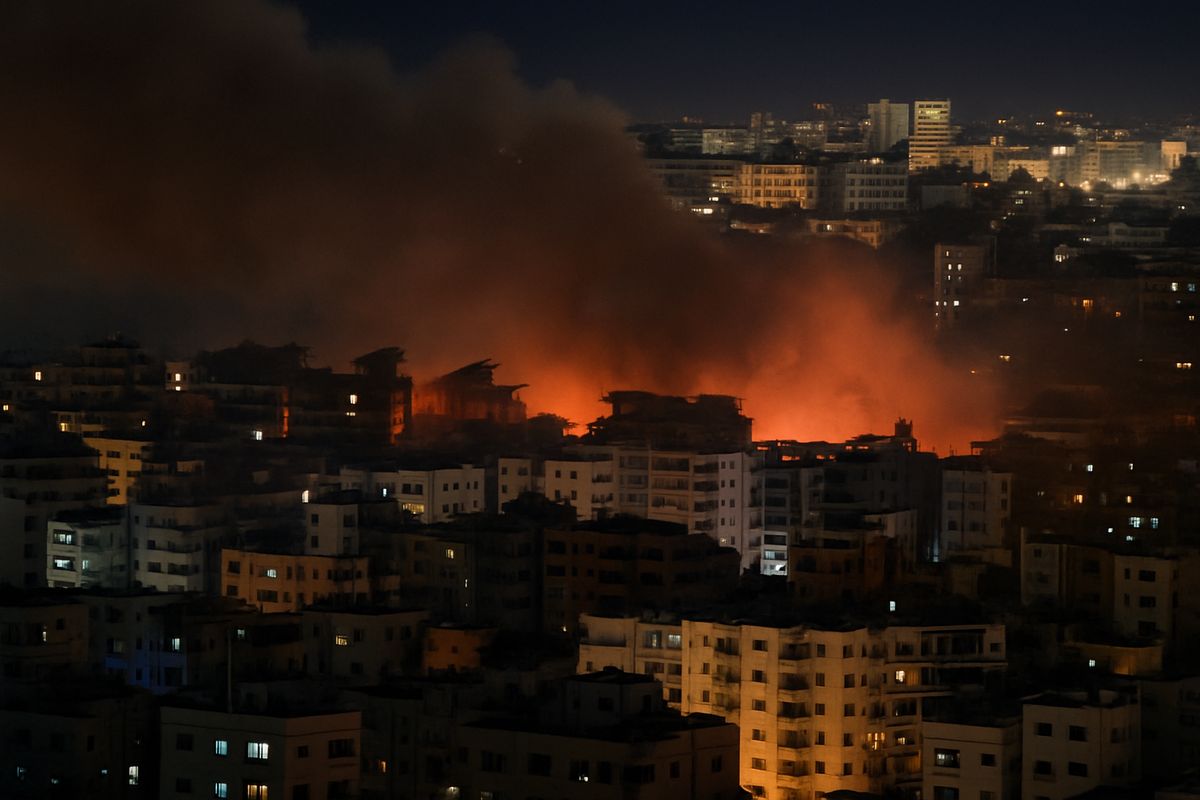
Escalation in the Gulf: A New Phase of Economic Warfare
The seventh day of heightened conflict between the US, Israel, and Iran has ushered in a dangerous new reality, marked by visible destruction in Tehran and a widening arc of attacks across the Gulf region. According to live reports from the BBC, the United Arab Emirates (UAE) has reported new missile and drone attacks, signaling a significant escalation beyond the initial flashpoints. This development moves the conflict from a regional military confrontation into the realm of global economic disruption, with immediate and tangible consequences for energy markets and inflation worldwide. The targeting of critical infrastructure in four separate Gulf countries suggests a strategic shift by Iran, potentially aiming to leverage its geographical position to inflict maximum economic pain in response to US and Israeli military actions.
This phase of the conflict is characterized by a direct assault on the world's energy heartland. While earlier days focused on military and strategic targets, the latest reports indicate a pattern of strikes on refineries and production facilities. The BBC's economics editor, Faisal Islam, notes that this represents a critical juncture: "While the disruption to date has been the by-product of the conflict, the question arises as to whether the targeting of economic infrastructure is now central to Iran’s response." Such a strategy, if sustained, fundamentally alters the risk calculus, transforming a geopolitical crisis into an immediate threat to global supply chains, commodity prices, and household budgets thousands of miles away from the conflict zone.

The Immediate Toll: Energy Prices and Market Turbulence
The economic shockwaves from the Gulf conflict are propagating with alarming speed. In the United Kingdom, the impact on fuel prices is already being felt at the pump. Average petrol prices have risen by 3 pence per litre, with diesel seeing a sharper 5 pence increase. As Faisal Islam reports, this surge has come through "unusually quickly" as markets pre-emptively price in the disruption from rising crude oil costs. The benchmark price for crude oil itself has climbed approximately 15% above its pre-conflict level, a spike that typically takes weeks to filter through to consumers but is now occurring in a matter of days due to heightened anxiety and speculative trading.
The ripple effects extend far beyond road fuel. Global gas prices have settled at a level roughly 80% higher than before the crisis began. While direct impacts on consumer energy bills in markets like the UK may be delayed until price cap adjustments in July, the wholesale cost surge is locked in. Perhaps more critically, the conflict is triggering volatility in specialized commodity markets. Jet fuel prices have more than doubled on fears of scarcity, a particularly acute problem as airlines cannot stockpile large quantities of this critical fuel. Furthermore, the price of urea, a key component in agricultural fertilizers, has "shot up." This is a direct consequence of geography: an estimated one-third of the world's urea supply transits through the vulnerable Straits of Hormuz, putting global food production costs at risk in the coming seasons.
Key Actors and the Strategic Landscape
Understanding this escalation requires examining the postures and capabilities of the main actors. Iran has signaled a readiness for a protracted confrontation. Amidst US and Israeli bombing, Tehran has publicly stated it is "ready for invasion," a declaration likely meant for domestic morale and international deterrence. Iran's primary strategic advantage lies in its asymmetric warfare capabilities—particularly its drones and missiles—and its ability to threaten the narrow maritime chokepoints of the Persian Gulf, through which about 20-30% of the world's seaborne oil passes.
On the opposing side, the US and Israel have initiated a sustained bombing campaign, the precise details of which are outlined in related coverage titled "Everything we know on the seventh day of the US and Israel’s war with Iran." The objective appears to be degrading Iran's military infrastructure and its proxy network's capabilities. However, the reported targeting of economic assets in the UAE and other Gulf states complicates this picture. It raises questions about whether Iran is retaliating directly or if its regional proxies are executing a coordinated strategy to broaden the conflict's economic front. Meanwhile, regional powers like Saudi Arabia are taking defensive measures, including diverting oil flows to overland pipelines to bypass the Gulf's vulnerable shipping lanes—a tactic highlighted by some market optimists.
The Role of Gulf Arab States
The UAE's report of new attacks underscores the precarious position of Gulf Arab states. While not primary belligerents, their critical infrastructure makes them vulnerable targets in a regional conflict. These nations have invested heavily in economic diversification away from oil, but their export revenues and global economic integration remain deeply tied to energy security. Attacks on their soil represent a direct threat to their economic stability and a test of their defense partnerships with the US and other Western powers.
Historical Context and a Dangerous New Pattern
Historically, conflicts in the Middle East have triggered oil price shocks with global recessional consequences, as seen in 1973, 1979, and 1990. The current situation shares similarities with these past crises but is distinguished by the precision and proliferation of drone and missile technology. Earlier wars involved tanker attacks or state-on-state invasions. Today, non-state actors and regional powers can deploy relatively low-cost drones to strike specific refinery units or export terminals with high economic impact, a tactic previously demonstrated in attacks on Saudi Aramco facilities in 2019.
The reported targeting of facilities in "four separate Gulf countries" suggests a coordinated campaign rather than isolated incidents. This represents a dangerous escalation from targeting military assets to targeting the core economic engines of the region and, by extension, the global economy. It is a form of economic warfare that leverages the interconnectedness of modern supply chains. The intent may be to pressure Western governments by imposing direct costs on their citizens through inflation and higher living expenses, thereby testing political resolve and public support for continued military action.
Political and Policy Responses
In response to the growing crisis, political leaders are beginning to articulate their policy responses. In the UK, Prime Minister Keir Starmer has emphasized the paramount need for "energy security," which his government defines as continuing investment in domestic renewable energy sources. This long-term strategy aims to reduce dependence on volatile global fossil fuel markets. In the short term, the Labour government's promised cut to the energy price cap is still scheduled to proceed next month, providing temporary relief before the higher wholesale gas prices potentially hit bills in July.
This juxtaposition highlights the tension between immediate crisis management and long-term strategic shifts. Western governments are caught between the need to respond forcefully to Iranian aggression and the imperative to shield their economies from inflationary spirals. The policy toolkit includes potential releases from strategic petroleum reserves, diplomatic pressure on other oil-producing nations to increase output, and accelerated sanctions. However, each option carries trade-offs and may have limited efficacy against a deliberate campaign of infrastructure targeting.
Why It Matters
Most media coverage focuses on the military tit-for-tat and the immediate price spikes, but the deeper implication lies in the potential normalization of economic infrastructure as a primary battlefield. If Iran’s strategy proves effective in moving Western political opinion, it could establish a dangerous precedent for future conflicts worldwide. Adversaries may conclude that disabling an opponent's economy through targeted strikes on supply chains is more effective than engaging their military directly. This shifts the paradigm of warfare from territorial conquest to systemic disruption, where globalized trade networks become an Achilles' heel.
Furthermore, this crisis exposes the profound vulnerability of the "just-in-time" global economy to regional conflicts. Markets for critical commodities like jet fuel and urea have minimal storage buffers; they operate on continuous flow. Disrupting that flow, even temporarily, causes immediate, disproportionate price shocks. This should compel businesses and governments to rethink resilience, not just efficiency. For the average reader, the connection is direct: the stability of their job, the cost of their food, and their ability to travel are now tangibly linked to security dynamics in the Persian Gulf. It underscores that energy security is not an abstract policy goal but a foundational element of national and personal economic security.
Readers should think differently about headlines concerning distant conflicts. They are not merely foreign news but leading indicators of domestic economic conditions. This event argues for a critical evaluation of national energy policies, emphasizing diversification and storage, not just as environmental imperatives but as strategic defenses. The contrarian angle here is that while many fear a major war, the greater immediate threat may be a sustained, low-level campaign of economic sabotage that avoids a full-scale war but successfully degrades living standards and sows political discord in Western nations, achieving strategic ends without apocalyptic risks.
What to Watch For Next
The immediate trajectory of the conflict hinges on several key indicators. First, the market will closely monitor shipping traffic through the Straits of Hormuz. Any actual interdiction or successful attack on a major tanker would signal a dramatic escalation and likely trigger another leap in oil prices. Second, the nature of future attacks will be critical. If the pattern of striking economic infrastructure across multiple countries continues or intensifies, it will confirm that this is a deliberate Iranian strategy, forcing a reevaluation of Western military and diplomatic responses.
Third, political pressure in consuming nations will mount as fuel and energy bills rise. The effectiveness of government interventions, like the UK's price cap cut, will be tested. Public tolerance for supporting a distant war may wane as personal costs increase, a dynamic Iran is likely banking on. Finally, the actions of other major oil producers, notably Saudi Arabia and the United States itself, will be decisive. Their ability and willingness to offset supply disruptions through increased production or reserve releases will be the primary buffer between regional conflict and a global energy crisis.
In conclusion, the seventh day of this conflict has revealed its true character: a hybrid war with military and economic fronts. The destruction in Tehran and the attacks across the Gulf are not isolated events but connected actions in a campaign that is already reaching into the wallets of consumers worldwide. The coming days will determine whether this economic warfare becomes the central feature of the conflict, with lasting implications for global stability, energy policy, and the very nature of how nations confront each other in the 21st century.