Unprecedented Air Travel Paralysis Grips the Middle East
The global aviation network is facing one of its most severe disruptions in decades as widespread airspace closures across the Middle East strand or divert hundreds of thousands of travellers and force the UK to plan one of the largest evacuations in its history. The catalyst for this crisis is the ongoing military conflict between the US, Israel, and Iran, which has escalated to direct strikes on regional infrastructure. As of Sunday, key transit hubs including Dubai, Abu Dhabi, and Doha have halted operations, cancelling over 3,400 flights and severing a critical artery for international travel between Europe, Africa, and Asia.
The scale of the disruption is staggering. According to aviation analytics firm Cirium, the three major airlines at the heart of the region—Emirates, Qatar Airways, and Etihad—typically move about 90,000 passengers daily through their hubs. All three have suspended flights indefinitely. Flight tracking service FlightRadar24 confirmed there were no flights over the United Arab Emirates after its government announced a "temporary and partial closure" of its airspace. The airspace of Israel, Qatar, Syria, Iran, Iraq, Kuwait, and Bahrain is also shut, creating a massive no-fly zone. The notice to airmen (NOTAM) for Iranian airspace has been extended until at least 8:30 am UK time on Tuesday, signaling that the disruption is far from over.

The Immediate Crisis: Stranded Passengers and a Logistical Nightmare
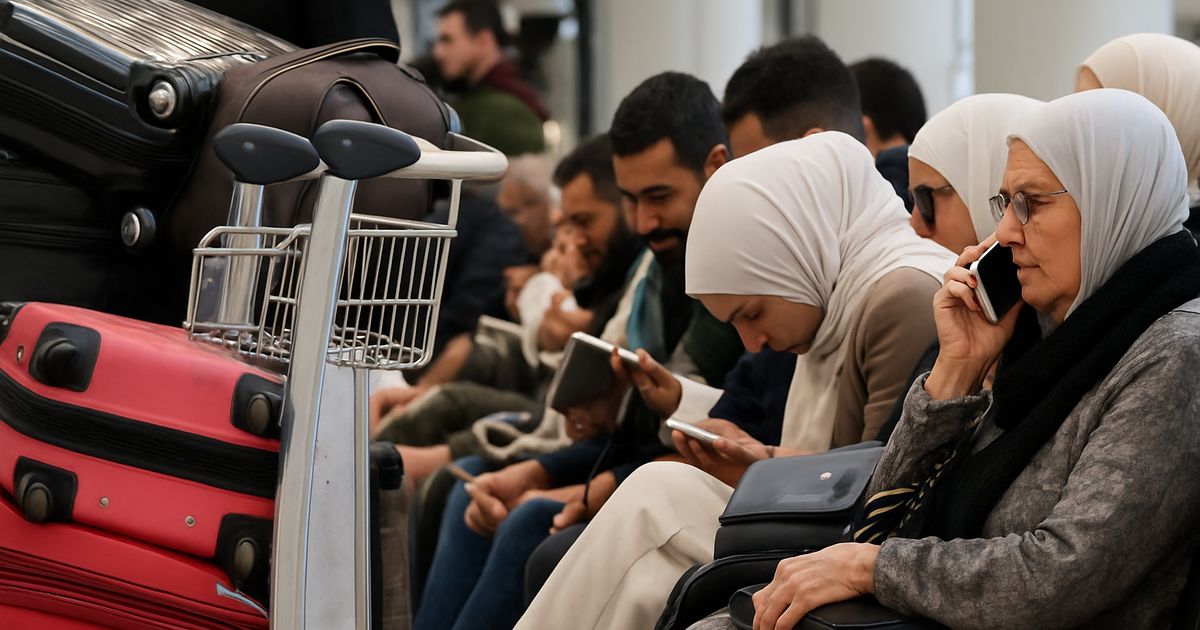
At airports from Beirut to Nepal, scenes of chaos unfolded as passengers found their travel plans shattered. The closure of Dubai International Airport—the world's busiest for international traffic—alone represents a seismic shock to global connectivity. The disruption is not merely about cancelled flights; it's about the complex web of aircraft, crew, and passengers now scattered across the globe. UK-based aviation analyst John Strickland highlighted the complexity, stating, "It is not only customers, it is the crews and aircraft all over the place." This logistical snarl will take weeks, if not months, to fully untangle even after airspace reopens.
The human toll is immense. The UK Foreign Office is now planning for the evacuation of more than 76,000 British citizens who have registered their presence in affected areas, with over two-thirds believed to be in the UAE, primarily as holidaymakers. The government's current advice is for people to shelter in place and follow local instructions, while it evaluates "all options for different eventualities." This evacuation, if executed, would be an enormous undertaking, reminiscent of historic airlifts but on a modern, civilian scale. Other nations are taking similar steps; Austrian Airlines, for instance, sent an evacuation flight to Muscat, Oman, to retrieve stranded staff and crew from Dubai.
Background: The Geopolitical Spark and the Aviation Hubs at Stake
This crisis stems directly from the US-Israeli military campaign against Iran, which has triggered retaliatory strikes. The conflict has moved beyond battlefield targets to critical civilian infrastructure. Major airports themselves have become targets: Dubai's international airport and the iconic Burj Al Arab hotel sustained damage, with four people injured. An incident at Abu Dhabi's Zayed International Airport reportedly resulted in one death and seven injuries, according to a since-deleted post by Abu Dhabi Airports on social media platform X. This escalation into targeting transit hubs marks a dangerous new phase in regional conflict, directly imperiling the civil aviation principle of neutrality.
The affected airports are not just regional facilities; they are pillars of 21st-century globalization. Dubai (DXB), Doha (DOH), and Abu Dhabi (AUH) have been engineered over the past two decades as ultra-efficient super-connectors, leveraging their geographic position to link every continent. Their business model relies on seamless, uninterrupted flow. Emirates, Qatar Airways, and Etihad are flag carriers whose growth has been synonymous with their nations' economic diversification. Their simultaneous grounding is an event without precedent in commercial aviation history, surpassing the localized disruptions caused by events like the 2010 Eyjafjallajökull volcanic ash cloud or the COVID-19 grounding, which were global health or environmental events, not targeted military actions in a core global transit zone.
The Ripple Effect on Global Travel Corridors
The closures create a cascading problem for global flight paths. The Middle Eastern airspace is a crucial corridor for flights between Europe and South/Southeast Asia, and between Africa and Asia. Airlines are now forced to reroute flights on longer, more expensive paths, likely overflying Russia or taking southern routes across Africa, increasing fuel costs, flight times, and carbon emissions. This squeeze is exacerbated by existing regional tensions; the article notes that fighting between Pakistan and Afghanistan is further narrowing available flight corridors. The result is a tangible shrinkage of efficient global air routes, increasing costs for airlines and passengers worldwide, even for flights not directly destined for the Middle East.
Historical Context and Comparison to Past Aviation Disruptions
To understand the magnitude of this event, it must be compared to historical aviation crises. The post-9/11 airspace closures in the US in 2001 were comprehensive but relatively brief for international travel, primarily affecting a single nation's airspace. The 2010 Icelandic volcanic ash cloud caused massive, week-long disruptions across Europe, but it was a passive natural event with a gradually dissipating threat. The Gulf War in 1990-91 and the Iraq War in 2003 caused significant rerouting, but the scale and centrality of the Gulf aviation hubs were far smaller then.
Today's crisis is unique because it is an active, ongoing military conflict directly impacting the world's busiest international air travel hub and its nearest competitors. It combines the suddenness of a terrorist event (like 9/11) with the geographic scope of a natural disaster (like the ash cloud) and the prolonged uncertainty of a war. The closest analogue may be the outbreak of the Second World War, which saw the sudden cessation of civilian air routes across conflict zones, but that occurred in an era when aviation was a nascent industry. The modern global economy is infinitely more dependent on the seamless air connectivity that has now been ruptured.
Industry Analysis: Immediate Fallout and Long-Term Vulnerabilities
Airline industry analyst Henry Harteveldt offered a grim prognosis for travellers: "For travellers, there’s no way to sugarcoat this. You should prepare for delays or cancellations for the next few days as these attacks evolve and hopefully end." The immediate financial impact on airlines is catastrophic. Beyond lost ticket revenue, they face enormous costs for passenger care (hotels, meals, rebooking), repositioning aircraft and crews, and operating inefficient rerouted flights. The big three Gulf carriers, whose brands are built on reliability and luxury, face a severe reputational hit that could shift long-term travel patterns.
This event exposes a critical vulnerability in the hyper-efficient, hub-and-spoke model of modern aviation. By concentrating immense passenger volume through a few mega-hubs in a geopolitically volatile region, the industry achieved incredible efficiency but created a single point of failure. The crisis will force airlines and aerospace planners to reconsider route network resilience. It may accelerate trends toward more point-to-point long-haul travel using efficient aircraft like the Boeing 787 and Airbus A350, which can bypass traditional hubs, and prompt a reevaluation of overflight risk assessments for regions previously considered stable transit zones.
Why It Matters
While most coverage focuses on stranded tourists and immediate flight cancellations, the deeper implication is the fragility of the infrastructure underpinning globalization itself. The Middle Eastern mega-hub is not a convenience; it is the central switchboard for global capital, talent, and trade. Its paralysis disrupts supply chains for high-value, time-sensitive goods (like pharmaceuticals and electronics), delays diplomatic and corporate movement, and freezes the flow of tourism revenue that entire economies depend on. This event demonstrates how a regional military conflict can instantly export severe economic dislocation worldwide, proving that in an interconnected world, there is no such thing as a "local" war.
Furthermore, this crisis challenges the long-held assumption that major international transit hubs enjoy a form of functional neutrality, insulated from regional conflicts. The targeting of Dubai and Abu Dhabi airports shatters that notion. It establishes a dangerous precedent that could incentivize state and non-state actors to view crowded international airports as leverage points. For readers, this means rethinking the perception of air travel as a purely commercial service; it is a geopolitical activity subject to sudden state decisions. The advice to "avoid all travel" to a broad swath of the Middle East, including major business hubs like the UAE and Qatar, is a stark indicator that the world's map of stable zones has abruptly contracted.
This event should also prompt a critical examination of global dependency on a single region for east-west connectivity. Just as the pandemic exposed over-reliance on specific supply chains, this airspace closure reveals an over-concentration of aviation infrastructure. The response may not be a retreat from globalization, but a push for its diversification—potentially boosting the relevance of alternative hubs in Turkey, India, Central Asia, and even southern Europe. For the everyday traveller, the lesson is to build far more contingency and flexibility into international plans, consider travel insurance that covers "war and civil unrest," and understand that the smooth flow of modern air travel is a privilege contingent on a stability that can vanish overnight.
What to Watch For Going Forward
The immediate timeline depends entirely on the cessation of hostilities and the restoration of confidence in the safety of air corridors. Travellers should monitor NOTAMs and airline communications closely, as the situation is fluid. The UK's evacuation planning will be a key indicator of perceived duration; a full-scale air or sea lift would suggest authorities expect prolonged danger. Airlines will be under immense pressure to repatriate citizens, likely leading to special, risky operations into peripheral airports as seen with the Austrian flight to Muscat.
Longer-term, observe how airlines redesign their global route maps. Will European and Asian carriers permanently reduce their dependency on Gulf airspace, establishing new corridors? How quickly can the Gulf carriers rebuild passenger trust? Also, watch for insurance and reinsurance markets to react; premiums for airlines operating in the region will skyrocket, and war risk insurance may become a standard, costly line item. Finally, this event will become a central case study in geopolitical risk assessment for global corporations, likely leading to more distributed operations and travel policies that mandate avoiding single-choke-point hubs for critical personnel movement.