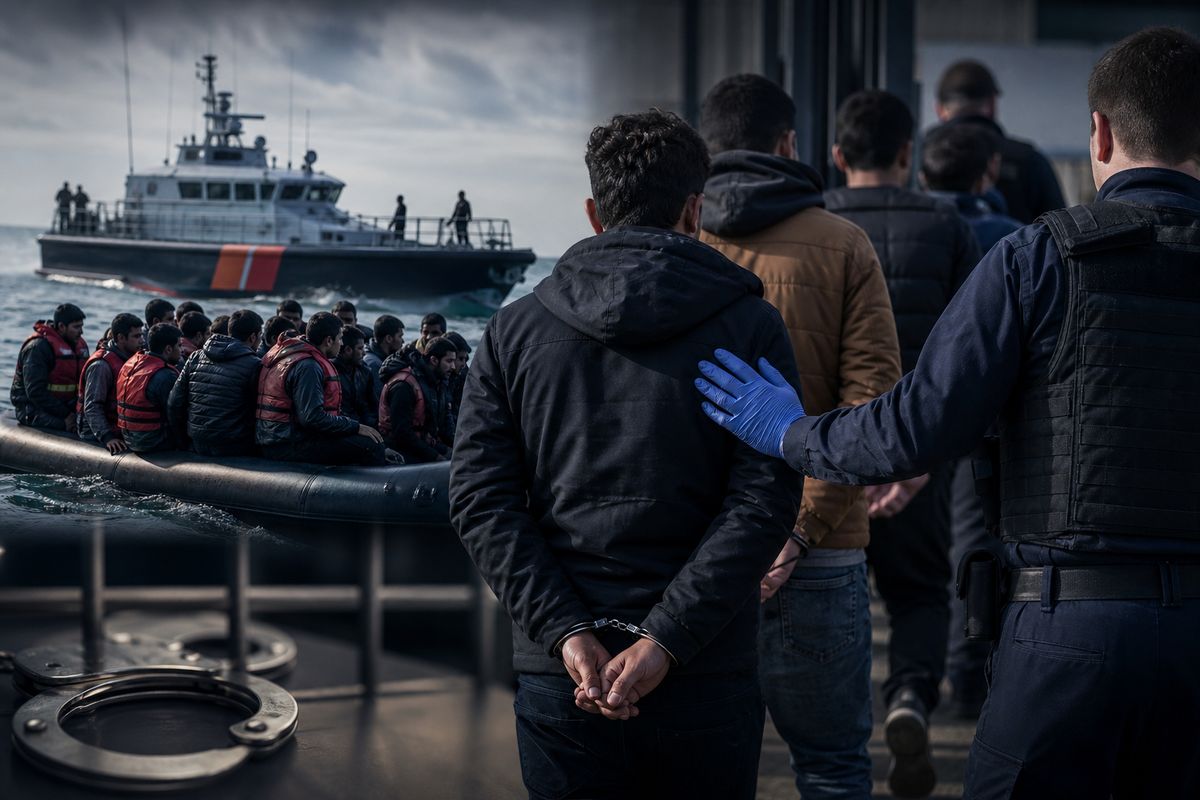
Bank Holiday Crossings Lead to Charges and Jail Time
The August bank holiday weekend saw a surge in small boat crossings across the English Channel, with over 1,100 people making the journey during a heatwave. But this time, the response from UK authorities was notably swift and severe. Six migrants have been charged and jailed following the crossings, according to multiple news outlets. The charges were brought after they were intercepted by Border Force or French authorities and brought to shore.
This marks a significant escalation in the government's enforcement strategy. Previously, many of those arriving by small boat were processed through the asylum system, sometimes released on bail or into accommodation while their claims were considered. Now, a more aggressive approach is being taken, with criminal prosecution and immediate custody becoming more common. The specific charges have not been fully detailed in the headlines, but typical offences include entering the UK without valid entry clearance or facilitating illegal immigration.
The bank holiday period has historically seen higher numbers of crossings, as smugglers take advantage of calmer seas and warmer weather. This year, the heatwave created ideal conditions, leading to a spike in arrivals. But the government's message is clear: if you cross illegally, you will be held accountable inside a courtroom, not just in an asylum processing centre.

Background: The Rising Tide of Channel Crossings
Small boat crossings of the English Channel have become a persistent feature of the UK's immigration landscape since 2018. What began as a trickle of dinghies from northern France has grown into a steady stream, with tens of thousands arriving each year. The British government has struggled to stem the flow, despite increased patrols, diplomatic pressure on France, and controversial policies like the Rwanda asylum plan.
Over 1,100 people crossing during a single bank holiday weekend is not unusual by recent standards. In fact, 2022 saw a record year with more than 45,000 arrivals. But each surge brings renewed political pressure on the Home Office to act. The decision to charge and jail six individuals this time suggests a shift in tactics. Instead of simply processing asylum claims, the authorities are now seeking to deter future crossings by making an example of those caught.
This approach aligns with the Nationality and Borders Act 2022, which strengthened the penalties for illegal entry and created new criminal offences related to asylum claims. The act made it a criminal offence to knowingly arrive in the UK without permission, carrying a maximum sentence of four years in prison. However, prosecutions under this act have been relatively rare, partly due to the logistical challenges of processing large numbers of detainees through the court system.
The Human Story: Who Are These Migrants?
While the headlines focus on the charges and jail time, the individuals involved remain largely anonymous. We know from the reports that six migrants were charged after bank holiday crossings. Who are they? Where do they come from? The source material does not provide their names or nationalities, but based on broader patterns, many of those crossing the Channel are from countries like Iran, Iraq, Syria, Afghanistan, and various African nations. Some are fleeing war and persecution; others are economic migrants seeking better opportunities.
The legal principle of non-refoulement means that even those who enter illegally cannot be returned to a country where they face a real risk of torture or persecution. This complicates the government's ability to simply deport everyone who is charged. The jail terms, while punitive, may not lead to removal if the individuals then claim asylum and succeed. And if they fail, they may be detained for months or even years before any removal can be arranged.
It is worth asking: does jailing these migrants serve as a deterrent, or is it merely a political gesture? Research from other countries suggests that harsh penalties for irregular entry do not significantly reduce migration flows, because the push factors (war, poverty, climate change) are far stronger than the pull factors of a particular country's legal regime. The smugglers who organise these crossings often tell their clients that the worst that can happen is being released with a temporary status. If news spreads that jail is now a real risk, it might change behaviour, but it could also drive migrants to seek more dangerous routes or to destroy documentation before capture.
Analysis: The Shift in Enforcement Strategy
The charging and jailing of six migrants after a single bank holiday weekend represents a tangible shift in how the UK handles Channel crossings. For years, the dominant approach has been to intercept, process, and (for most) eventually release into the community while their claims are decided. This has created a backlog of over 160,000 asylum cases and a massive accommodation crisis, with thousands housed in hotels at huge public expense.
By prosecuting and jailing arrivals, the Home Office hopes to achieve two things: first, to show the public that the government is getting tough on illegal immigration; and second, to create a deterrent effect that reduces the number of people willing to make the crossing. But there are risks. The court system is already under immense strain, and adding hundreds or thousands of new criminal cases could overwhelm it. The prison population is also at a record high, with limited space for new inmates.
Furthermore, the legal challenges are considerable. Migrants who are jailed may use their time in custody to prepare stronger asylum claims, or they may simply be released after serving their sentence and then disappear into the system. The government has a poor track record of removing those whose claims are refused; in recent years, only about half of all refused asylum seekers have been removed. So jailing may amount to a temporary inconvenience for migrants, not a long-term solution.
There is also a human rights dimension. Detaining people for the act of arriving in a country to seek asylum could be challenged under the European Convention on Human Rights, particularly Article 5 (right to liberty) and Article 3 (prohibition of inhuman or degrading treatment). The UK remains a signatory to the convention, and courts have previously ruled that punitive detention for asylum seekers must be justified and proportionate. This could lead to legal battles that further bog down the system.
The Political Calculus
From a political standpoint, the move to charge and jail migrants is popular with many voters. The Conservative government, trailing in the polls ahead of a likely 2024 general election, is under pressure to appear tough on border control. The Rwanda plan has stalled due to legal challenges, and the Illegal Migration Act 2023 (which would bar most asylum claims from small boat arrivals) has not yet been fully implemented. Prosecuting and imprisoning arrivals is a way for the Home Office to show action without waiting for legislation.
But the strategy is not without critics. Human rights groups have condemned it as cruel and ineffective. They argue that most of those crossing the Channel are genuine refugees who should be processed fairly, not criminalised. The UNHCR has repeatedly stated that people should not be penalised for entering a country irregularly if they are seeking asylum. The government's response is that the asylum system is being abused by economic migrants, and that deterrence is needed to restore order.
What's Next: Will This Deter More Crossings or Backfire?
Looking ahead, the key question is whether the charging and jailing of these six migrants will have any measurable impact on the number of people attempting the crossing. Previous crackdowns, such as the introduction of tougher sentences in France or increased naval patrols, have had at best a temporary effect. Smugglers adapt quickly, changing routes, using different vessels, or moving operations to less monitored stretches of coast.
If the government scales up prosecutions across the board, we could see thousands of migrants processed through the criminal courts. That would require a significant increase in resources: more Border Force officers to gather evidence, more Crown Prosecution Service lawyers to handle cases, more judges to hear them, and more prison places to hold those convicted. The taxpayer would foot the bill. But if it works, and crossings drop, the political payoff could be huge for the government.
However, there is a real risk of unintended consequences. Migrants who fear prosecution may destroy their identity documents, making it harder to process their cases. They may also attempt riskier journeys, such as hiding in lorries or crossing from Belgium or the Netherlands, where enforcement is different. Others may pay smugglers even more to guarantee a safe landing, further enriching criminal gangs. And if the courts start handing down sentences of several years, the Human Rights Act and the European Convention on Human Rights could be used to challenge those sentences.
Ultimately, the charging and jailing of six migrants after a bank holiday weekend is a small but telling sign of where UK border policy is heading. It is a move towards criminalisation, away from the traditional refugee processing model. Whether it becomes the new normal or a short-lived crackdown remains to be seen. What is certain is that the Channel will not quiet down overnight. The push factors that drive people to leave their homes show no sign of abating, and as long as the UK remains a relatively stable and prosperous destination, people will keep coming, whatever the legal consequences.
Conclusion: A Policy at a Crossroads
The decision to charge and jail migrants after the bank holiday crossings is a bold move by the Home Office, but it is not a magic bullet. It addresses the symptom (illegal arrival) without tackling the root causes (conflict, poverty, lack of safe legal routes). And it carries significant legal, financial and ethical costs.
For now, the six individuals sit in UK prisons, their futures uncertain. Their cases will be watched closely by the media, by human rights lawyers, and by thousands of others considering the same journey. If the deterrent effect proves real, this could be a turning point in the Channel crisis. If not, it may become just another footnote in a long and messy story. Either way, the debate over how Britain manages its borders is far from over.